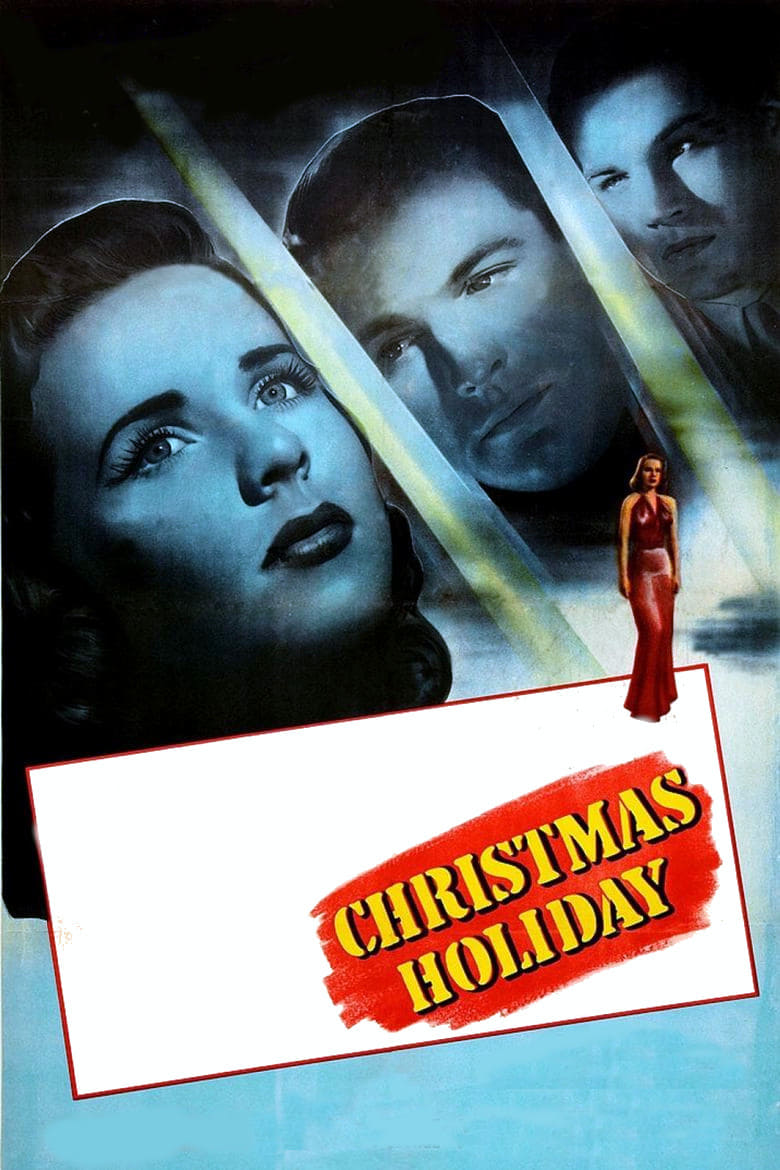
On Christmas Eve, Army lieutenant Charles Mason is diverted to New Orleans after his fiancée sends a Dear John letter. Stranded and aimless in a city he does not know, he stumbles into a low-rent cabaret and meets Jackie Lamont, a hostess of quiet, guarded demeanor who agrees to spend the holiday with him. She is not what she presents herself to be, and the city is not the festive place the season implies.
Through a series of conversations and flashbacks, Jackie's real identity surfaces: she is Abigail Martin, the wife of Robert Manette, a charming sociopath recently convicted of murder and now serving time in a Louisiana prison. The flashbacks reconstruct the courtship, the marriage, and the psychological erosion of a decent woman who loved a man incapable of moral accountability. Robert's domineering mother, Mrs. Manette, looms over the union as a second destructive force, her possessiveness indistinguishable from cruelty.
Christmas Holiday belongs to that strand of wartime noir in which the home front offers no sanctuary – where domesticity conceals pathology and love becomes a mechanism of destruction. Siodmak frames the story as a confession, giving the film an elegiac retrospective quality rather than the forward momentum of a thriller, and it is precisely that restraint that sets it apart from more conventional studio programmers of the period.
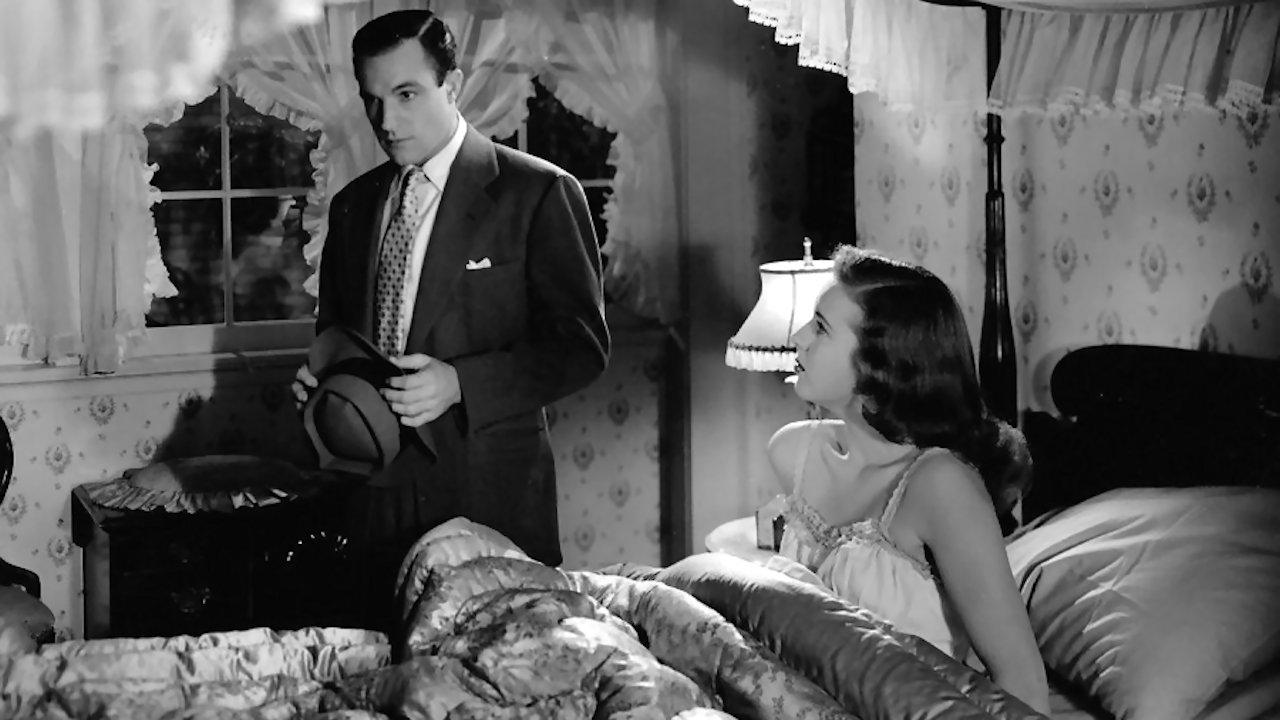
Christmas Holiday is an anomaly that rewards careful attention. Siodmak and producer Felix Jackson adapted Somerset Maugham's novel with deliberate perversity, casting Deanna Durbin – Universal's wholesome musical star – against Gene Kelly in one of his rare exercises in menace. The casting is not a gimmick; it is the film's argument. Durbin's innate decency makes Abigail's entrapment legible and, more importantly, believable. Kelly's Robert Manette is charming in the precise way that makes charm dangerous: surface warmth, hollow interior. What the film ultimately examines is the violence that operates inside respectable social structures – marriage, family loyalty, the conventions of romantic love. Siodmak, fresh from his German Expressionist training and already sharpening the techniques he would deploy in The Killers two years later, treats New Orleans not as local color but as moral atmosphere: rain-slicked streets, churches that offer no absolution, nightclubs where identity is provisional. The result is a film that uses genre conventions to conduct a genuinely unsettling inquiry into complicity.
– Classic Noir
Elwood Bredell lights Durbin from slightly above and to one side, leaving the lower half of her face in graduated shadow while the eyes remain fully exposed. The camera holds at medium close-up, refusing the flattering soft-focus conventionally assigned to female leads of the period. Behind her the club's interior dissolves into an indeterminate darkness punctuated by a single practical light source, isolating her at the table as though the rest of the world has been methodically withdrawn. When she speaks, Bredell does not cut; the scene breathes in long takes that give the confession the texture of something being dragged into the open.
The scene establishes that Jackie – Abigail – has no audience she can fully trust and no story she can tell without cost. Mason listens, but he is passing through; his sympathy is real but structurally useless to her. Siodmak uses the prolonged close-up to make the viewer complicit in a voyeurism that is also an act of witnessing, and the distinction matters: what Abigail describes is not melodrama but a precise accounting of how a woman's capacity for love was used as the instrument of her destruction.
Elwood Bredell, who shot Siodmak's Phantom Lady the same year, brings to Christmas Holiday a disciplined low-key approach rooted in selective illumination rather than wholesale darkness. His signature move here is the controlled background void: figures are lit with enough precision to read motivation in a jawline or a pair of hands, while the studio-built New Orleans sets recede into ambiguity. Bredell works with a relatively tight lens in the interior sequences, compressing the space between characters and subtly heightening the sense of psychological confinement that the script establishes narratively. The church sequence – one of the film's most formally composed passages – places characters in deep shadow beneath a suggestion of high vaulted ceilings, using vertical lines of light to evoke an institution that frames but does not redeem. Throughout, the cinematography declines to beautify its subjects; where a conventional studio production would court glamour, Bredell consistently opts for psychological accuracy, making the visual register an extension of the film's moral seriousness.
When available, Criterion Channel presents the film in a clean transfer that respects Bredell's low-key lighting without the contrast crushing common to older home-video releases.
TCMBroadcast / Streaming via MaxTCM rotates Christmas Holiday periodically in its noir programming blocks; Max subscribers with the TCM add-on can check current availability on demand.
Archive.orgFreeA public-domain print circulates on Archive.org; image quality is variable and the low-light sequences suffer, but it remains a legitimate free option for first-time viewers.