Films People Pull a Fast One Night Beat Reading Room On TV Shop
Thief 1955
1955 Metro-Goldwyn-Mayer
★★★☆☆ Notable
Film Noir · 78 minutes · Black & White

Thief

Directed by Robert Z. Leonard
Year 1955
Runtime 78 min
Studio Metro-Goldwyn-Mayer
TMDB 6.3 / 10
"In the court of Charles II, loyalty is the most dangerous currency of all."

In Restoration England, Michael Dermott is a man of divided obligation – an Irish gentleman serving at the pleasure of King Charles II while privately sheltering sympathies that could destroy him. When a cache of royal jewels goes missing, suspicion falls across the court with quiet, methodical force. Lady Mary, a woman of composed intelligence and uncertain allegiance, moves through this world with a watchfulness that marks her as either Dermott's salvation or his ruin.

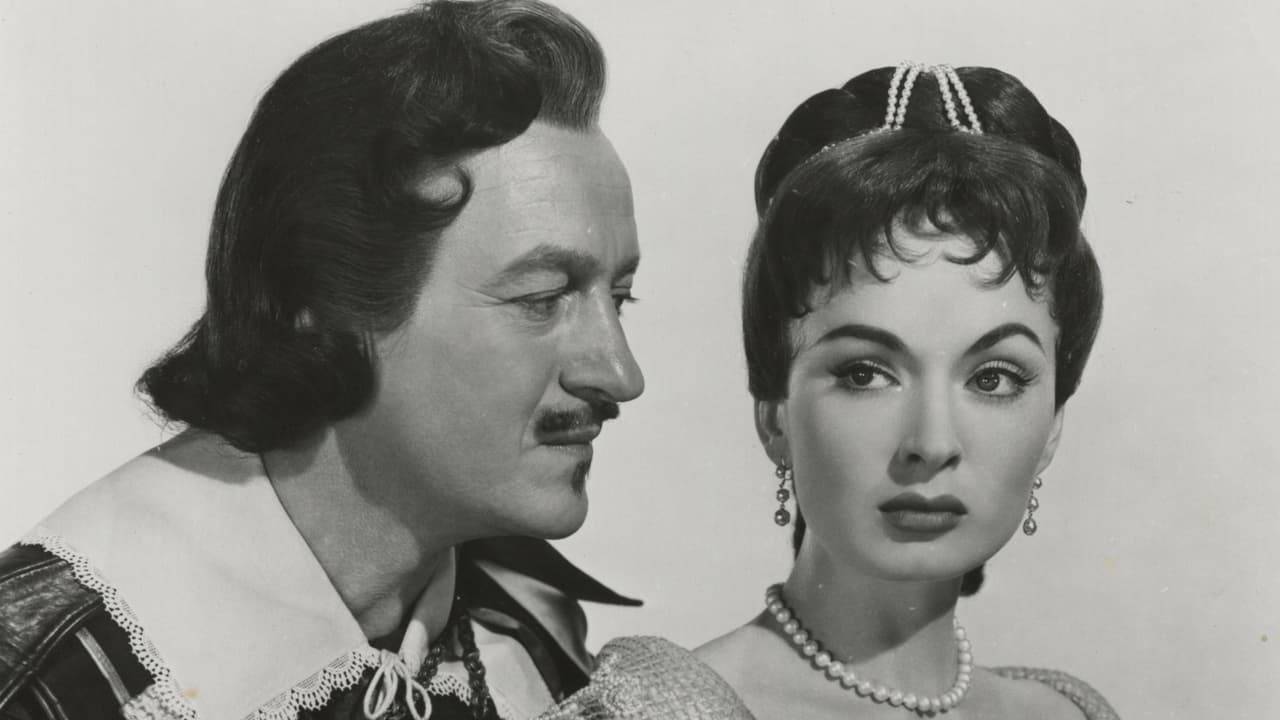
James, the Duke of Brampton, played with practiced ease by David Niven, occupies the ambiguous middle distance between protector and predator. His friendship with Dermott carries the particular warmth of men who have survived things together, though survival has a way of breeding its own debts. Captain Herrick pursues the investigation with the blunt efficiency of a man who believes in order above mercy, and as the circle of accusation tightens, Dermott finds that the alliances he trusted most are the ones most thoroughly corroded.

Framed nominally as a period adventure but functioning with the moral geometry of noir, Thief places its protagonist in a world where guilt is structurally imposed and innocence offers no protection. The film belongs to that strand of MGM production in which costume and setting serve as displacement for contemporary anxieties – the wrong man caught in a machinery he cannot name, let alone dismantle.
Classic Noir

Thief occupies an instructive position on the margins of the noir canon: a period film that uses the Restoration court as a transposed landscape for the genre's central concerns about institutional betrayal, the vulnerability of the honest man, and the corruption that gathers at the top of hierarchies. Robert Z. Leonard, a studio craftsman of long standing, brings no particular visual idiosyncrasy to the material, but he controls tone with discipline – the film never collapses into swashbuckle, and the wrongful accusation plot carries genuine procedural weight. Edmund Purdom, chronically underestimated as a screen presence, gives Dermott a useful stillness: a man who understands that protest is useless and that survival requires performing innocence even when no one is watching. George Sanders as Charles II is the film's sharpest achievement – a king who is also a mechanism, dispensing favor and ruin with the same unhurried hand. Miklós Rózsa's score, characteristically dense, presses the film toward a tension its budget does not always support.

– Classic Noir
3 ★★★☆☆ Notable
Credits

The Crew

DirectorRobert Z. Leonard
ScreenplayRobert Hardy Andrews
MusicMiklós Rózsa
EditingJohn McSweeney Jr.
Art DirectionMalcolm Brown
CostumesWalter Plunkett
ProducerEdwin H. Knopf
Performances

The Cast

Close Reading

The Signature Scene

Thief – scene
The Antechamber Confrontation Shadows Across the Threshold

The camera holds at mid-distance as Dermott is summoned before Herrick in a stone antechamber barely warmed by a single practical source – a torch mounted high on the wall to screen left, casting a diagonal fall of light that bisects the frame. Dermott stands in the lit half; Herrick occupies the darker register, his face partially resolved, his authority legible in posture rather than expression. The composition refuses to grant either man full visibility, which is precisely the point.

The scene condenses the film's central argument: in this world, the judicial gaze is itself obscured, operating from shadow while demanding that the accused stand in the light. Dermott cannot defend himself against what he cannot fully see, and the framing makes that asymmetry not merely political but physical. What the scene reveals about character is that Dermott's restraint in this moment – his refusal to argue – is not passivity but the only rational response to a proceeding in which evidence is secondary to convenience.

Visual Language

The Cinematography

🎞️
Director of Photography – Director of Photography

The cinematographer on Thief remains unconfirmed in surviving production records, which is itself a minor reflection of the film's status as functional studio product rather than prestige commission. Working within MGM's controlled backlot and period sets, the visual approach leans on the architecture of the Restoration setting as a ready-made noir environment – low vaulted ceilings, candlelit interiors, corridors that taper toward darkness. The lighting favors hard sources motivated by practical fixtures, creating the kind of chiaroscuro that reads as period authenticity while satisfying genre convention. Lens choices appear conservative: standard focal lengths that maintain spatial legibility without expressionist distortion, which keeps the film grounded in the procedural rather than the psychological. Rózsa's score does significant work that the image track declines to attempt, and one senses a production in which the visual grammar was asked to stay out of the way of the story's moral logic rather than amplify it.

In the Catalogue

Themes & Motifs

Availability

Where to Watch

Also in the Directory

See Also