Films People Pull a Fast One Night Beat Reading Room On TV Shop
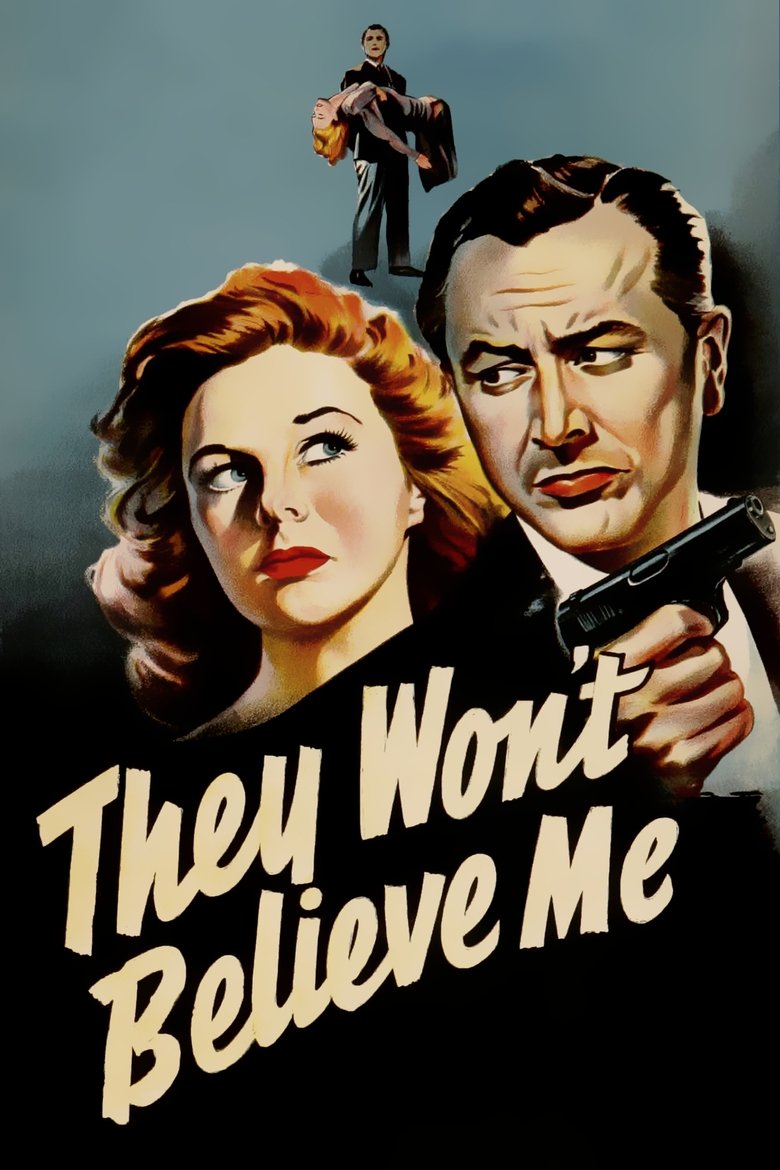
They Won't Believe Me 1947
1947 RKO Radio Pictures
★★★☆☆ Notable
Film Noir · 95 minutes · Black & White

They Won't Believe Me

Directed by Irving Pichel
Year 1947
Runtime 95 min
Studio RKO Radio Pictures
TMDB 6.5 / 10
"A man testifies to his own ruin, and no one in the courtroom is wrong to doubt him."

Larry Ballentine is a man sustained by other people's money and his own vanity. Married to the wealthy Greta, he conducts himself with the easy confidence of someone who has never been forced to account for his appetites. When he becomes infatuated with Verna Carlson, a sharp and self-aware woman who understands exactly what he is, Greta discovers the affair and engineers a solution: she relocates them both to a ranch in California, cutting Larry off from Verna and from the city that suits him. Larry accepts the terms because he has no real alternative, but his compliance is temporary and his character is fixed.

A new infatuation follows, this time with Janice Bell, a woman of quieter disposition who believes, against the evidence, that Larry is capable of change. The web of deception Larry has constructed across two coasts begins to pull tight. Greta dies under ambiguous circumstances; Verna's fate is sealed by catastrophe rather than calculation; and Larry, who has maneuvered through every situation with practiced self-interest, finds himself in a courtroom unable to make his own history credible. The jury hears a story of serial betrayal and convenient death, and the arithmetic is not in his favor.

They Won't Believe Me frames its noir machinery as a trial narrative, using Larry's testimony as the structural spine of the film. The device allows the film to interrogate the reliability of self-reporting and the gap between how men understand their own behavior and how that behavior appears from the outside. Where many noirs position their protagonist as a victim of circumstance or femme fatale, this film is more interested in a subtler and less sympathetic thesis: that a man can arrive at catastrophe through nothing more than habitual weakness.
Classic Noir

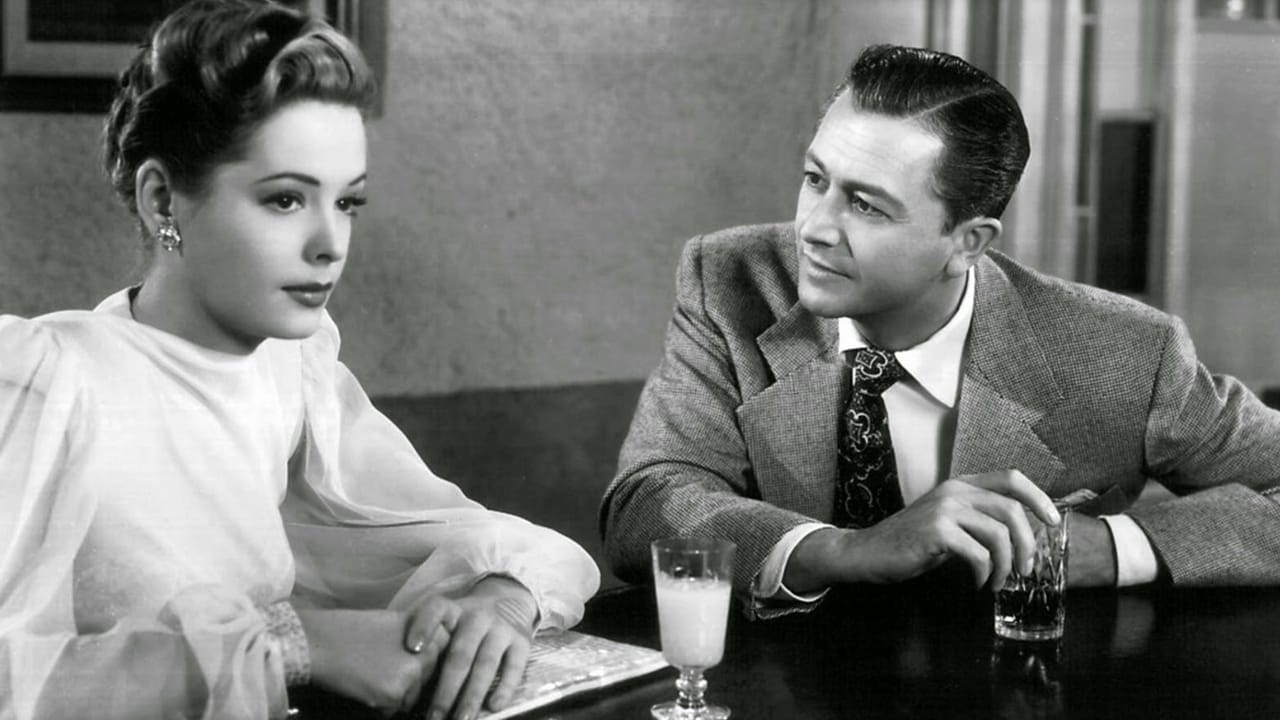
They Won't Believe Me occupies an instructive position in the RKO noir cycle of the late 1940s, less celebrated than Out of the Past, produced the same year at the same studio, but in certain respects more rigorous in its moral logic. Irving Pichel, not a director associated with visual bravura, keeps the film's attention on performance and structure rather than atmosphere, which suits the material. Robert Young's casting is the film's central argument: an actor known from domestic comedy and radio warmth playing a man of genuine moral vacancy. The dissonance is not incidental. Susan Hayward's Verna is given enough interiority to function as something more than a plot mechanism, and Jane Greer, the year's definitive noir presence, brings her characteristic quality of withheld feeling to Janice. What the film achieves is a portrait of masculine self-deception so consistent and so ordinary that it implicates the social conditions that enabled it, without ever stating that case directly. The ending, abrupt and caustic, was reportedly altered under censorship pressure, but what survives retains its force.

– Classic Noir
3 ★★★☆☆ Notable
Credits

The Crew

DirectorIrving Pichel
ScreenplayJonathan Latimer
CinematographyHarry J. Wild
MusicRoy Webb
EditingElmo Williams
Art DirectionAlbert S. D'Agostino
ProducerJoan Harrison
Performances

The Cast

Close Reading

The Signature Scene

They Won't Believe Me – scene
The Courtroom, Late Testimony The Jury Will Not Look

Pichel and cinematographer Harry J. Wild hold Larry in medium close-up as his testimony winds toward its conclusion, the frame tight enough to deny him the courtroom's architecture as context. The lighting is flat and institutional, deliberately without shadow, which is itself a compositional statement: this is a space where the techniques of noir atmosphere are refused. Wild keeps the camera at eye level, neither aggrandizing nor condemning, and cuts to the jury in profile, faces angled slightly away, suggesting a collective withdrawal rather than active judgment.

The scene's function within the film's argument is precise. Throughout the preceding ninety minutes, Larry has moved through shadow and artificial light, in rooms designed by desire and deception, in the grammar of a world that accommodated him. Here the light is even and the faces are closed. The courtroom is not a place of revelation but of accounting, and the film's visual restraint in these final passages makes clear that Larry's story, however truthfully he tells it, was always going to produce this result.

Visual Language

The Cinematography

🎞️
Harry J. Wild – Director of Photography

Harry J. Wild, whose credits across the RKO noir years include His Kind of Woman and Race Street, brings to They Won't Believe Me a controlled and purposeful visual scheme that works largely through contrast rather than accumulation. His night exteriors use hard sources and deep shadow to establish a world in which moral legibility is conditional, but his interior work is more interesting: rooms are lit according to the emotional position of the scene rather than any consistent naturalism, so that Greta's domestic spaces feel enclosed and over-furnished in the frame while the spaces Larry shares with Verna carry a sharper, more declarative light. Wild works almost entirely on studio sets here, which allows him precise control over shadow placement and background depth, and he uses that control to keep the film's geography expressive without becoming schematic. The courtroom sequences represent a deliberate break from this approach, the even institutional light functioning as a kind of visual verdict on everything that preceded it.

In the Catalogue

Themes & Motifs

Availability

Where to Watch

Also in the Directory

See Also