Films People Pull a Fast One Night Beat Reading Room On TV Shop
Suspect 1960
1960 Charter Film Productions
★★★☆☆ Notable
Film Noir · 81 minutes · Black & White

Suspect

Directed by Roy Boulting
Year 1960
Runtime 81 min
Studio Charter Film Productions
TMDB 6.9 / 10
"In a government laboratory, loyalty is the most dangerous compound of all."

At a classified British research facility in the late 1950s, Dr. Robert Marriott is a senior scientist whose quiet professional life begins to fracture when he discovers that someone inside the laboratory is passing sensitive information to a foreign power. The circle of suspects is narrow and intimate – colleagues he has worked alongside for years, people whose habits and temperaments he believes he knows. When a co-worker turns up dead under circumstances the authorities are prepared to call accidental, Marriott understands that the investigation has acquired a more lethal weight.

Dr. Lucy Byrne, a younger researcher drawn into Marriott's orbit, complicates both the inquiry and his emotional equilibrium. Her own observations about their colleagues – particularly the erratic Alan Andrews and the opaque lab orderly Parsons, who operates under an alias – force Marriott to reconsider assumptions he has held too comfortably. The institutional setting, with its controlled surfaces and procedural routines, proves to be a reliable cover for deception; the more methodically Marriott looks, the less certain any conclusion becomes.

Suspect belongs to a strain of British Cold War noir in which the espionage thriller and the procedural murder story converge on the same anxious ground – the workplace as a site of concealed motive and eroded trust. Roy Boulting keeps the film close and interior, and the ensemble cast, which includes Peter Cushing, Donald Pleasence, and Ian Bannen, gives the institutional world a density that simple spy mechanics rarely achieve. The film asks not merely who is guilty but what sustained proximity to guilt costs an honest person.
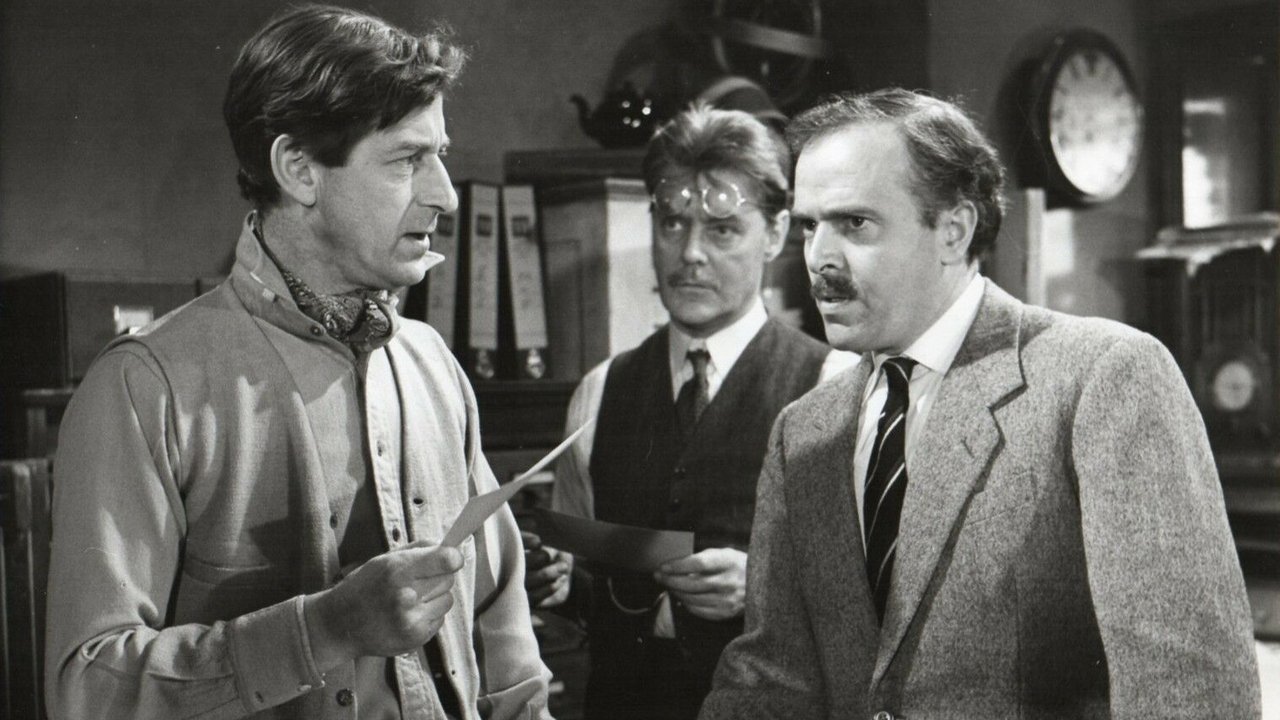
Classic Noir

Suspect arrives in 1960 at the intersection of two British preoccupations: the legacy of real espionage scandals inside the scientific establishment and the postwar unease about institutions that ask for loyalty without offering transparency in return. Roy Boulting, working here without his usual collaborator John, produces a more restrained film than the Boulting Brothers' satires of the same period, and the restraint serves it well. The casting is precise in the way that counts – Donald Pleasence as the man living under a false name and Peter Cushing as the professorial authority figure both work against type just enough to keep the viewer's alignments uncertain. What the film achieves is a portrait of complicity that does not require melodrama: people in proximity to wrongdoing who adjust their moral accounting in small increments until the sum becomes unmanageable. For a production of modest scale and limited international circulation, it captures the specific texture of British institutional anxiety in the nuclear age with more fidelity than several better-remembered films of its moment.

– Classic Noir
3 ★★★☆☆ Notable
Credits

The Crew

DirectorRoy Boulting
ScreenplayRoy Boulting
CinematographyMutz Greenbaum
EditingJohn Jympson
Art DirectionAlbert Witherick
ProducerJohn Boulting
Performances

The Cast

Close Reading

The Signature Scene

Suspect – scene
The Laboratory Corridor, Late Shift A Figure in Fluorescent Light

Cinematographer Mutz Greenbaum frames the corridor in a long, flat perspective that the institutional lighting – overhead fluorescent strips running toward a vanishing point – turns into something colder than ordinary darkness could manage. There is no shadow in the expressionist sense here; instead, the light is merciless and even, and it is precisely that evenness that creates unease. A figure at the far end of the corridor is illuminated at the same intensity as everything else, which means there is nowhere to hide and no visual grammar to signal danger. Greenbaum holds the shot long enough for the composition to register as a statement rather than a transition.

The scene distills the film's central argument about institutional environments: the laboratory is a place of clarity, of measurement and verification, yet it is also the precise location where deception has taken root. The figure in the corridor is either threat or colleague – the frame refuses to differentiate, and that refusal is moral as much as visual. Marriott's world operates by the logic of controlled conditions, and the film uses that logic against him, suggesting that the methods of science offer no protection when the unknown variable is human intention.

Visual Language

The Cinematography

🎞️
Mutz Greenbaum – Director of Photography

Mutz Greenbaum – a German-born cinematographer who had worked in British studios since the 1930s under the anglicised credit Max Greene – brings to Suspect a visual strategy calibrated to the film's institutional settings rather than to conventional noir iconography. Working primarily on studio-built laboratory and office interiors, Greenbaum largely foregoes the deep-shadow chiaroscuro of American noir in favour of controlled, high-key lighting that turns cleanliness itself into something oppressive. The choice is thematically coherent: a government research facility is not a back alley, and Greenbaum refuses to import that grammar where it does not belong. Instead, he uses lens compression on medium shots to flatten spatial relationships between characters, making physical proximity feel ambiguous rather than intimate. Where shadow does appear – in corridors, in transitional spaces between secure zones – it functions as punctuation rather than atmosphere, marking the moments when the film's procedural surface cracks. The result is a visual language that serves the story's argument about how ordinary, well-lit environments accommodate extraordinary moral failure.

In the Catalogue

Themes & Motifs

Availability

Where to Watch

Also in the Directory

See Also