Films People Pull a Fast One Night Beat Reading Room On TV Shop
Singapore 1947
1947 Universal International Pictures
★★★☆☆ Notable
Film Noir · 79 minutes · Black & White

Singapore

Directed by John Brahm
Year 1947
Runtime 79 min
Studio Universal International Pictures
TMDB 6.1 / 10
"A man returns to Singapore for a woman who no longer remembers him."

Matt Gordon, a pearl smuggler, returns to Singapore after the war to retrieve a cache of pearls he had hidden there before the Japanese invasion. The city has changed, and so, apparently, has the woman he loved. Linda, whom he believed killed in the wartime chaos, stands before him very much alive – but she is now Ann Van Leyden, the composed wife of a wealthy Dutch merchant, with no apparent memory of Gordon or their past together.

Gordon refuses to accept the erasure. He presses into Linda's life, risking exposure of his illegal dealings with the local crime figure Mauribus while arousing the suspicion of Deputy Commissioner Hewitt, a methodical colonial official who is investigating a murder connected to the missing pearls. Van Leyden, sensing the threat Gordon represents to his marriage and his composure, moves to neutralize him by more direct means. The web of concealment – romantic, criminal, official – draws tighter around a city already worn thin by occupation and its aftermath.

Singapore works within the postwar exotic-location thriller, a form Universal International favored for its relative economy and its ability to displace American anxieties into foreign settings. The film's central mechanism – a woman whose identity has been surgically severed from her own past – gives it a more unsettling undertow than its surface adventure plotting suggests, pushing it toward the psychological territory that distinguishes the better noir productions of the period.
Classic Noir

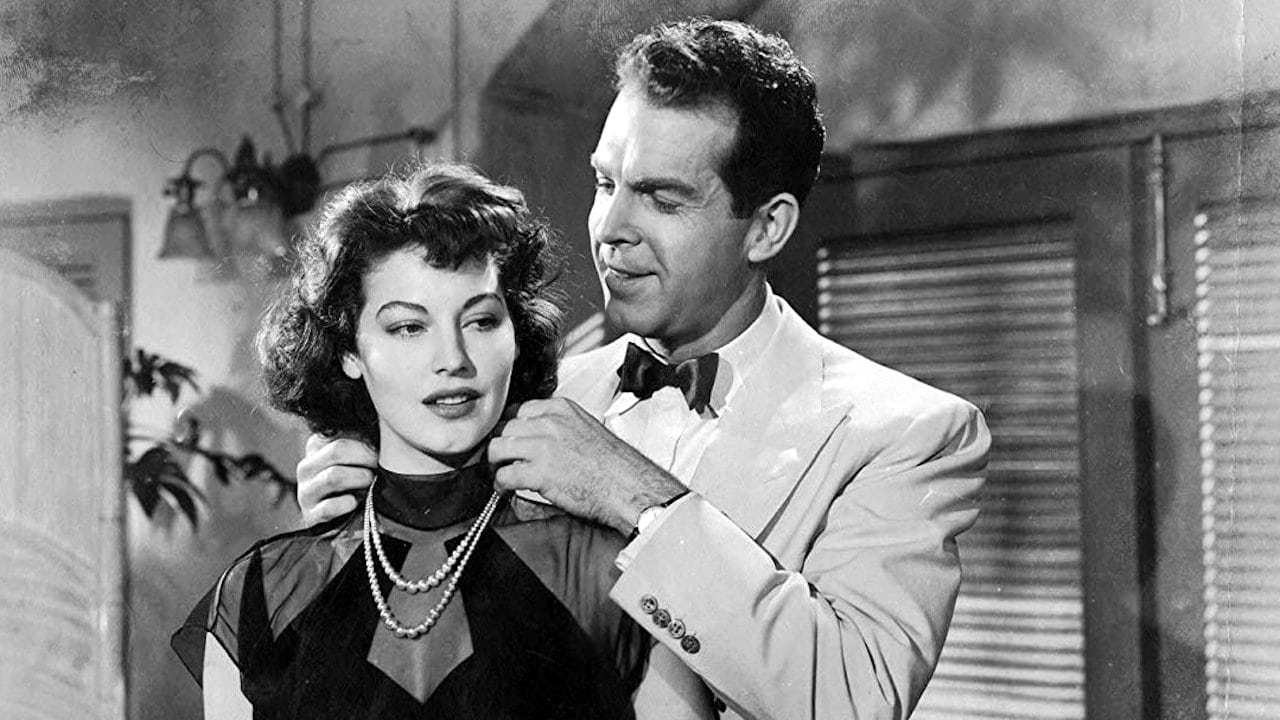
Singapore occupies a specific and honest position in the noir catalogue: not a first-rank achievement, but a film that earns its place through craft and a premise that carries genuine unease. John Brahm, who had already demonstrated his facility with psychological atmosphere in The Lodger and Hangover Square, handles the amnesia conceit with more restraint than the material might invite. Fred MacMurray, still transitioning between studio comedy and the harder register he had found in Double Indemnity, is effective precisely because his persistence reads as obsession rather than romance. Ava Gardner, photographed by Maury Gertsman with a care that anticipates her full-star treatment of the following decade, gives the film its moral ambiguity: her Linda/Ann may be a victim of trauma or an instrument of deception, and the film does not rush to resolve that question. What Singapore ultimately reveals about its era is the postwar anxiety around identity itself – the sense that the self shaped before catastrophe may not survive it intact, and that those who return seeking continuity may be pursuing a fiction.

– Classic Noir
3 ★★★☆☆ Notable
Credits

The Crew

DirectorJohn Brahm
ScreenplayRobert Thoeren
CinematographyMaury Gertsman
MusicDaniele Amfitheatrof
EditingWilliam Hornbeck
Art DirectionBernard Herzbrun
CostumesMichael Woulfe
ProducerJerry Bresler
Performances

The Cast

Close Reading

The Signature Scene

Singapore – scene
The Hotel Recognition Scene A Face From Before the War

Gertsman composes the scene in a tight mid-shot as Gordon first sees Linda across a hotel interior. The light is flat and colonial-institutional, all cream walls and ceiling fans that do nothing to ease the heat implied by the characters' stillness. When the camera moves to Linda's face for her close-up, the light falls from a slightly elevated angle, creating the faintest shadow beneath her eyes – enough to introduce doubt without melodrama. Gordon's reverse shot is held longer than is comfortable, the frame refusing to cut away from his recognition while hers remains absent.

The asymmetry of that exchange – one person carrying the full weight of a shared past, the other offering only a polite social surface – is the film's central argument made visible. Singapore is, at its core, a film about the violence of forgetting, and whether what has been forgotten can be reclaimed by will or whether its absence has already created someone new. The scene does not answer that question; it only makes the stakes legible.

Visual Language

The Cinematography

🎞️
Maury Gertsman – Director of Photography

Maury Gertsman's work on Singapore reflects the disciplined studio cinematography of mid-period Universal International, a house style that prized efficiency without sacrificing atmospheric specificity. Shooting almost entirely on studio sets dressed to suggest colonial Singapore, Gertsman uses overhead fans and louvered light sources to break up otherwise flat interior spaces, casting bar-pattern shadows across walls and faces that carry moral weight without overstatement. His lens choices favor a moderate focal length that keeps backgrounds readable – the colonial architecture, the street markets, the hotel interiors – so that the exotic setting functions as pressure on the characters rather than mere backdrop. The lighting on Gardner is consistently more considered than on the male leads: soft but directional, preserving the ambiguity between warmth and concealment that the role requires. Where the film's narrative leans toward the melodramatic, Gertsman's measured visual grammar keeps it in check, grounding the story's more extravagant psychological claims in the physical textures of a world that looks lived-in and consequential.

In the Catalogue

Themes & Motifs

Availability

Where to Watch

Also in the Directory

See Also