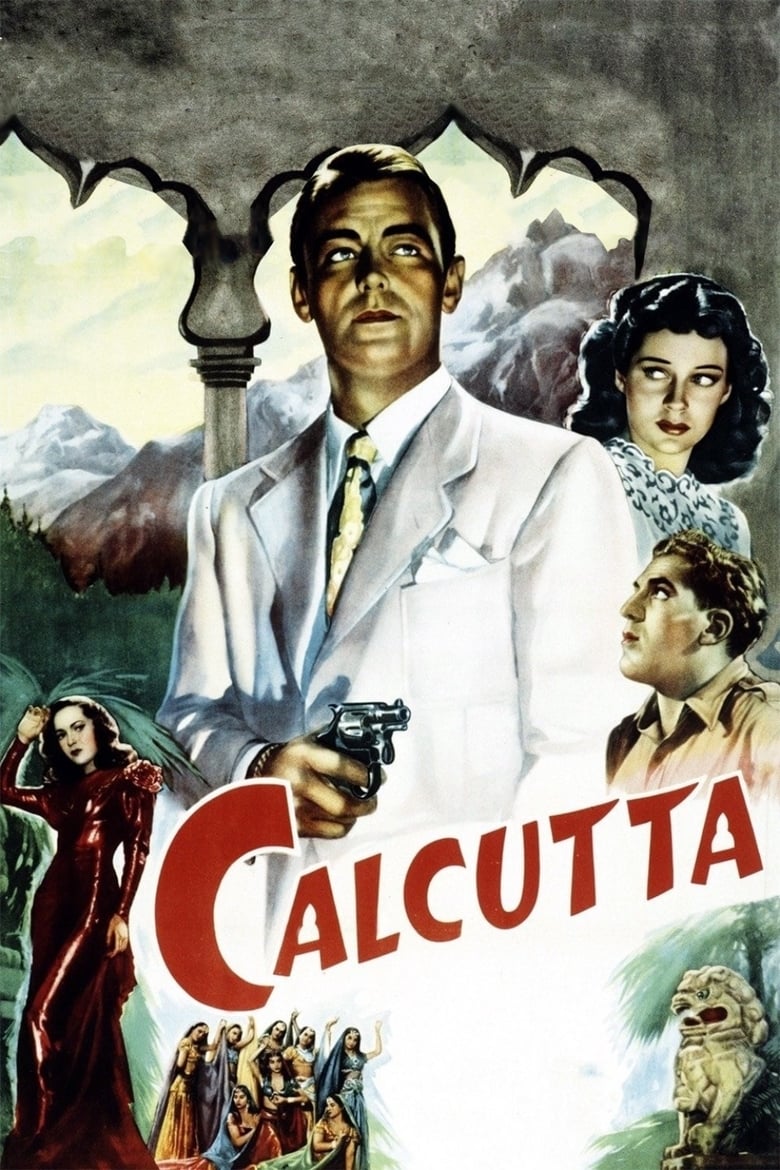
Neale Gordon and Pedro Blake are cargo pilots based in Calcutta, close friends whose easy partnership is shattered when their third man, Bill Cunningham, is murdered the night before he is to marry a woman named Virginia Moore. Gordon, unwilling to let the matter drop, begins asking questions the colonial city would prefer left unasked. Virginia herself is an enigma – beautiful, composed, and in possession of a pearl necklace that connects her to the dead man in ways she refuses to explain.
Gordon's investigation pulls him into a web of jewel smuggling routed through Calcutta's expatriate underworld. Eric Lasser, a smooth and well-positioned European, emerges as a figure of interest, as does the more volatile Marina Tanev, whose attachment to Lasser is freighted with its own dangers. Inspector Kendricks of the local police watches Gordon's freelance inquiry with professional skepticism but little interference, leaving the pilot to press further into territory where alliances shift and the pearl necklace keeps reappearing as a kind of lethal currency.
Calcutta operates within the tradition of the exotic-locale noir, a subgenre that uses unfamiliar geography to externalize moral disorientation. Gordon is a recognizable type – the loyal, straight-dealing man forced into detection by grief – but the film complicates his certainties through Virginia, who may be victim, accomplice, or something the script is not yet ready to name. The back streets and hotel interiors of studio-built Calcutta give the story a sealed, pressurized atmosphere that suits its preoccupation with concealment and mistaken trust.
Calcutta arrives in 1946 as a reliable entry in Paramount's cycle of postwar exotic noirs, built around Alan Ladd at the height of his commercial viability and directed by John Farrow with the efficient economy that characterizes his best genre work. The film does not aspire to the psychological depth of the era's more celebrated titles, but it earns its place through consistency of atmosphere and a genuine structural cunning in how it deploys its MacGuffin – the pearl necklace functions less as a plot device than as an index of moral contamination, passing through the hands of nearly every character before its significance resolves. Gail Russell's performance is calibrated to sustain ambiguity without tipping into either innocence or villainy too soon, and William Bendix provides the film's emotional ballast as the steadier, earthier Blake. What Calcutta reveals about its era is the postwar displacement of American masculine competence onto foreign terrain, where the rules are opaque and loyalty, once broken, cannot be recovered.
– Classic Noir
John F. Seitz lights the corridor in a narrow band of overhead light that catches the pearl necklace as it moves between figures otherwise held in partial darkness. The camera stays at a measured distance, refusing close-up insistence, so that the exchange reads as furtive rather than dramatic – a transaction the frame observes rather than endorses. Doorways on either side of the corridor offer pools of deeper black, and Farrow uses them to suggest routes of escape that no one takes.
The scene crystallizes the film's central argument about visibility and concealment. Gordon, when he eventually learns what the exchange meant, will realize that he was looking at evidence without the interpretive framework to read it. The necklace in shadow stands for everything in Calcutta that is present but illegible to the outsider – the city, the woman, the crime – and the corridor's geometry, with its single vanishing point, quietly insists that the truth has been in the frame all along.
John F. Seitz, whose contributions to Double Indemnity and Sunset Blvd. anchor the canonical visual language of American noir, brings to Calcutta a more restrained but precisely considered approach. Working entirely on Paramount studio sets, Seitz constructs a Calcutta of controlled depth – streets that suggest crowd and commerce without opening into genuine spatial breadth, interiors where the ceiling presses down and the available light seems to have traveled a long way to arrive. He favors mid-range lenses that keep faces legible without flattening the shallow studio depth, and his shadow work is deployed selectively rather than atmospherically: darkness accrues around characters at the moments their motives become most opaque, functioning as a moral annotation rather than decoration. The recurring device of light refracted through louvered shutters casts the European hotel spaces in a grid of shadow that reads as both tropical and imprisoning. Seitz understands that the film's drama is one of misreading, and he constructs each frame so that information is present but not assembled.
Tubi has carried Calcutta as part of its rotating classic noir library and is the most reliably accessible free option for this title in the United States.
Archive.orgFreeAs a Paramount title whose copyright status has been disputed, Calcutta has circulated on Archive.org; check availability, as public domain status for this film is not definitively confirmed.
Amazon Prime VideoRentalAvailable for digital rental through Amazon, which typically offers a cleaner transfer than free streaming alternatives for this period title.