David Starrling, a wealthy and morally careless man, is in the process of leaving his wife Celia for her sister Dell Faring when Celia confronts Dell and a struggle ends in Celia's death. Dell escapes, and David – arriving moments later – is charged with the murder. His young daughter Susan, who witnessed the killing, retreats into a trauma-induced amnesia, unable or unwilling to name what she saw. The child is placed under psychiatric care, and the investigation stalls on the silence of its only witness.
Dr. Caroline Canford, the psychiatrist assigned to Susan, works patiently to draw out whatever the girl's mind has sealed away. Dell, meanwhile, moves through the edges of the case with calculated composure, her guilt protected by Susan's amnesia and the law's fixation on David. The triangle of desire and betrayal that produced the murder continues to press against the surface of the investigation, as those with something to hide work to ensure Susan's memory stays buried.
Shadow on the Wall belongs to a minor but persistent strain of postwar noir in which the threat is domestic and the darkest rooms are not alleyways but parlors and consulting offices. The film draws its tension from the intersection of psychiatric procedure and criminal concealment, using a child's fragile psychology as both the mechanism of suspense and the moral center of the story.
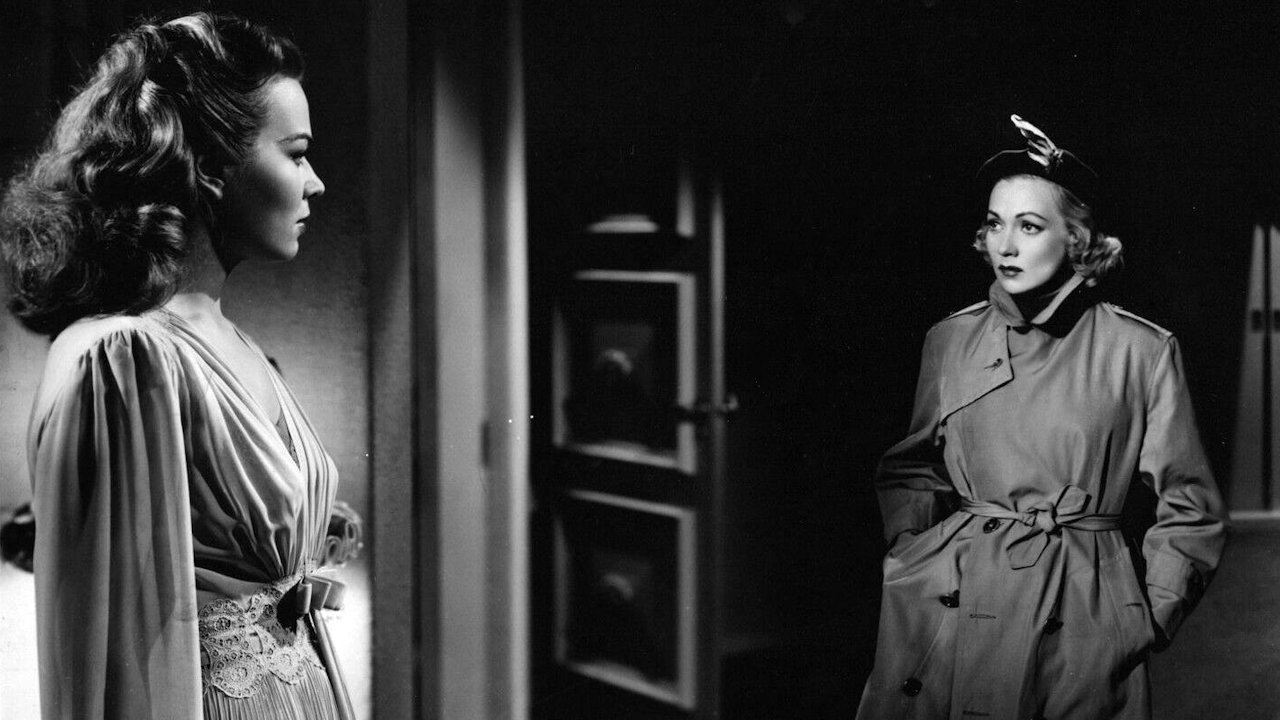
Shadow on the Wall occupies an instructive position in the MGM noir cycle – polished where RKO was expressionist, procedural where Republic was pulpy. Pat Jackson, a British director better known for documentary-inflected realism, brings a measured restraint that suits the material's psychiatric framework without fully exploiting its darker possibilities. The film's most unusual quality is its placement of a child at the axis of guilt and revelation, a structure that anticipates later psychological thrillers while remaining anchored in the period's faith in clinical method. Ann Sothern gives Dell Faring a controlled menace that the script occasionally lets slip away into melodrama, and Zachary Scott does what Zachary Scott reliably did – embody weak men destroyed by appetite. Nancy Reagan, in one of her few substantial film roles, handles the procedural demands of Dr. Canford with competence if not particular depth. As noir, the film is compromised by its studio caution; as a period document about psychology, guilt, and the vulnerability of children to adult violence, it repays serious attention.
– Classic Noir
Ray June frames the scene with Susan at a low table, her small figure centered in a room where the institutional light falls flat and without comfort. The camera maintains an adult eye-level that keeps the child slightly diminished within the space – she is surrounded by a world scaled to her doctors, not to her. When Susan takes up a crayon and begins to draw, June holds on her hand rather than her face, the act of mark-making given the weight of testimony. A shadow falls across the paper at the moment the image becomes legible, the geometry of guilt entering the frame without announcement.
The scene makes the central argument of the film visible: that a child's mind is both the repository of truth and the most fragile container imaginable for it. Susan is not a device but a figure of genuine moral consequence – the one person in the story with nothing to gain from distortion. Her drawing is, within the film's logic, more reliable than any adult account, and the scene's restraint in revealing what she has produced honors that logic rather than exploiting it for shock.
Ray June, whose work for MGM across two decades ranged from musicals to crime pictures, brings to Shadow on the Wall a deliberately subdued visual register. The film was shot entirely on studio sets, and June uses that controlled environment to modulate light with precision – the Starrling house rendered in high-key domesticity that gradually admits shadow as the story's crimes press forward. He avoids the deep-focus expressionism of the harder noir tradition, preferring a shallower field that isolates characters within frames suggesting enclosure and psychological confinement. Lens choices remain conservative, with wide angles reserved for the psychiatric ward sequences, where distortion would be inappropriate to the clinical setting. The shadow work is understated rather than operatic – guilt arrives not as a drowning darkness but as a gradual dimming, which suits the film's argument that domestic violence is ordinary in origin even when catastrophic in consequence. June's restraint is the right tool for this particular story.
TCM remains the most reliable broadcast home for MGM catalogue titles of this era and periodically streams select films through its on-demand service; check current availability.
Amazon Prime VideoRentalAvailable for digital rental in standard definition on Amazon; the transfer quality for this title is adequate for critical viewing though not archivally restored.
Archive.orgFreeA public domain or freely uploaded copy may be accessible here, though provenance and print quality should be verified before citing for research purposes.