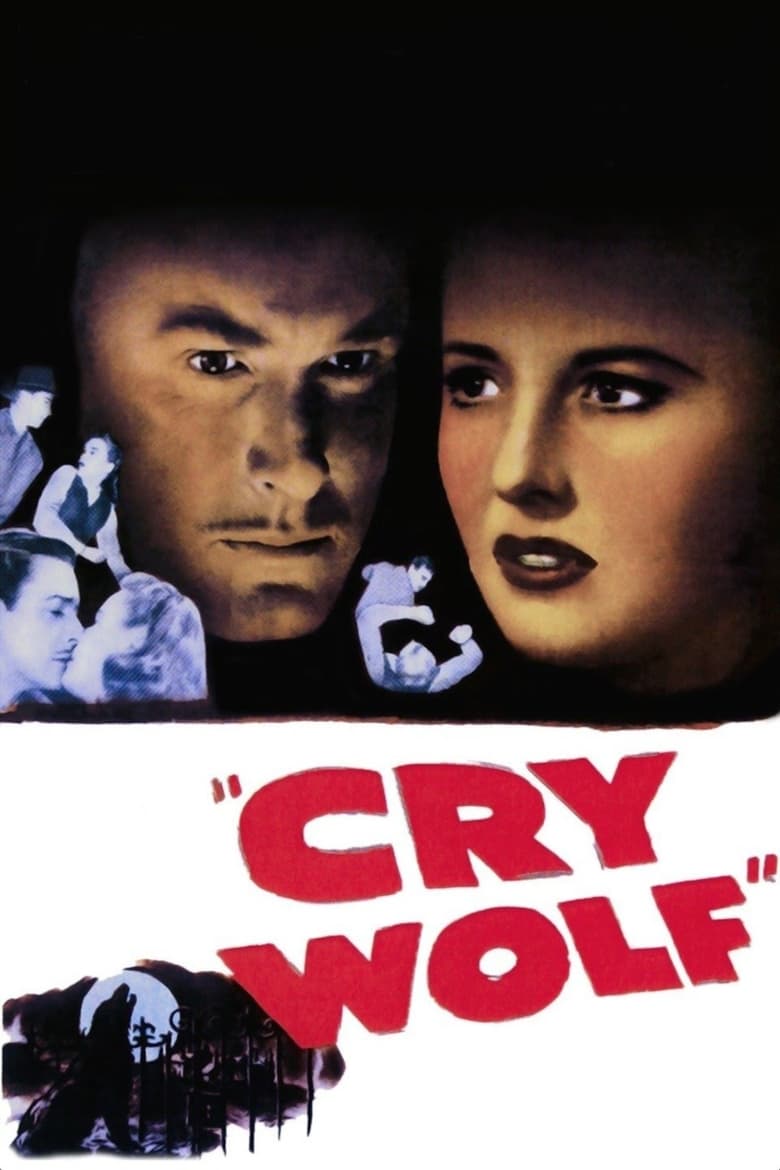
When Sandra Marshall arrives at the remote Caldwell estate to claim the inheritance left by her recently deceased husband, she is met with suspicion and outright hostility from Mark Caldwell, the dead man's uncle and the estate's brooding overseer. Mark insists that Sandra's marriage was invalid, that her husband James is not dead at all, and that she has no legal claim to anything. Sandra, practical and unintimidated, refuses to leave. The house itself seems designed to unsettle her: locked corridors, unexplained noises at night, and a staff that answers to Mark alone.
As Sandra probes further, she discovers that James Caldwell Demarest may indeed be alive, confined somewhere within the estate in a state of mental and physical collapse. The question shifts from inheritance to something more dangerous: whether James is being hidden to protect him or to ensure he cannot speak. Mark's behavior oscillates between cold authority and something approaching genuine grief, and Sandra finds herself uncertain whether she is dealing with a murderer or a man concealing a private catastrophe. Julie Demarest, James's fragile sister, complicates the picture further by appearing to know more than she will say.
Cry Wolf operates at the intersection of the Gothic thriller and postwar noir, drawing on the haunted-house tradition while anchoring its suspense in the specifically 1940s anxieties of property, inheritance, and female autonomy. Stanwyck's Sandra is not a passive victim but an active investigator whose persistence drives the plot, and the film uses the sealed estate as a pressure chamber in which every relationship is tested against concealed motive. The resolution, when it comes, reframes much of what has preceded it without fully releasing the tension the film has spent eighty minutes building.
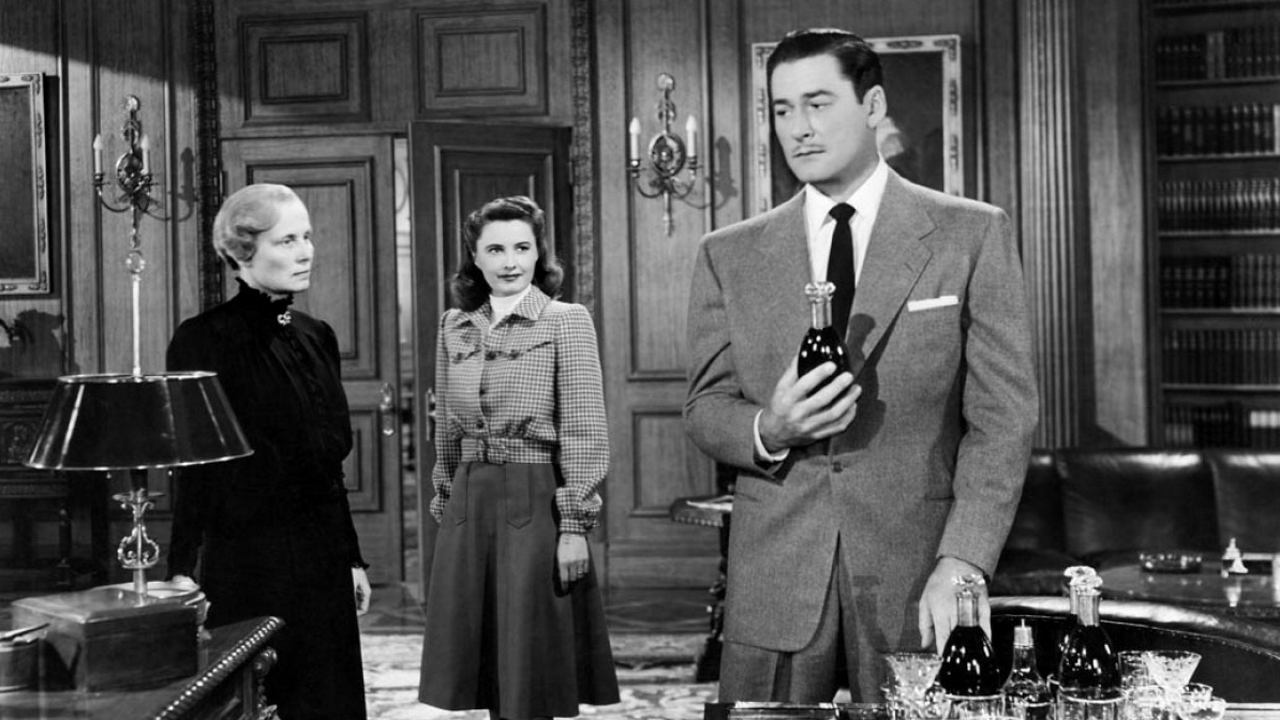
Cry Wolf is a minor but instructive entry in the cycle of Gothic-inflected noir that Warner Bros. produced in the mid-1940s, a cycle that borrowed freely from Rebecca and Gaslight while filtering their paranoia through a distinctly American preoccupation with money and legal standing. Peter Godfrey directs with competence rather than distinction, but he keeps the Caldwell estate credibly oppressive without tipping into pastiche. The casting against type is the film's most interesting gamble: Errol Flynn, stripped of swashbuckling charm, plays Mark Caldwell as a man whose authority conceals something unresolved, and the performance holds more ambiguity than Flynn was usually permitted. Stanwyck, by contrast, is fully in command of a role that demands skepticism rather than vulnerability. What the film ultimately reveals about its moment is the degree to which postwar audiences were willing to accept a thriller in which the heroine's chief weapon is legal and financial tenacity rather than romantic surrender. Franz Waxman's score, characteristically precise in its anxiety, does more atmospheric work than the script always earns.
– Classic Noir
Sandra moves through the upper corridor of the Caldwell house in near-darkness, Carl E. Guthrie lighting the scene so that the walls absorb nearly everything and only the floor registers texture. The camera tracks her at mid-distance, keeping the corridor's perspective lines visible so that the door at the far end reads as both destination and threat. When she reaches it, a thin blade of light escapes from beneath – the only warm source in the frame – and Guthrie holds the shot long enough that the geometry of the threshold becomes the scene's real subject: the known world behind her, the illuminated unknown ahead.
The moment crystallizes the film's central argument about knowledge and danger. Sandra's pursuit of information is not reckless; it is methodical, and the film respects that. But the light under the door is a classic noir trap – the visible answer that may cost more than ignorance. What she finds on the other side will not resolve her situation so much as transform it, and the composition anticipates that irresolution: the door is not yet open, the light is real but partial, and Sandra's silhouette is the only thing in the frame that has any agency at all.
Carl E. Guthrie's work on Cry Wolf is studio-bound in the precise sense: every exterior has the controlled quality of a backlot dressed against its own artificiality, and the interior of the Caldwell house is lit as a series of isolated pools rather than coherent architectural spaces. Guthrie's approach favors hard sources placed at acute angles to faces, so that characters rarely appear fully legible – a technique that reinforces the script's sustained uncertainty about who is concealing what. Shadow is used structurally rather than decoratively: doorframes cast bars across floors, staircases generate geometry that implies entrapment, and windows function as light sources that illuminate without warming. Stanwyck in particular is shot with a precision that flatters neither her features nor her situation, giving Sandra a materially grounded appearance that separates her visually from the Gothic atmosphere around her. The result is a consistent moral logic: clarity of vision is something characters must earn rather than receive.
TCM remains the most reliable broadcast source for Warner Bros. titles of this period; check the schedule for upcoming airings.
TubiFreeTubi has carried public-domain and licensed classic titles from this era and is worth checking for current availability.
Archive.orgFreeIf the title has entered the public domain, Archive.org may offer a watchable transfer at no cost, though print quality will vary.