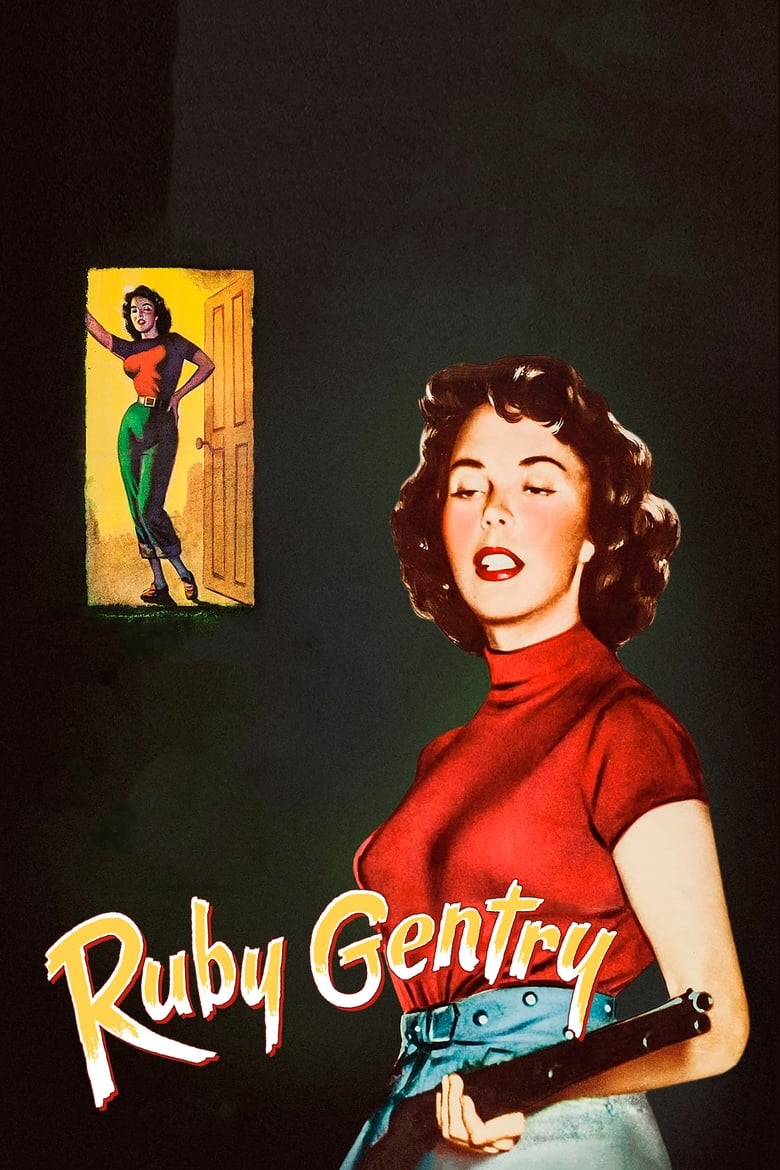
In the Carolina low country, Ruby Gentry (Jennifer Jones) is the daughter of a backwoods family, fiercely intelligent and socially invisible in a town that has already decided what she is. She carries a long attachment to Boake Tackman (Charlton Heston), a land-hungry developer with ambitions that exceed his sentimentality. When Boake chooses to marry into money and respectability instead, Ruby accepts the proposal of Jim Gentry (Karl Malden), a wealthy older merchant who offers stability in place of passion.
Jim's death leaves Ruby in unexpected control of his fortune and, by extension, of the drainage project that determines whether Boake's reclaimed marshland will survive or flood. The town that once dismissed her now fears her, and Ruby uses that fear with the precision of someone who has nothing left to lose. Old alliances harden into enmity, and the line between retribution and obsession becomes increasingly difficult for either Ruby or Boake to locate.
Ruby Gentry belongs to the tradition of the femme fatale reframed as a figure shaped by class injury rather than innate destructiveness. Vidor positions Ruby's choices as the logical consequence of how she has been treated, without softening the damage those choices cause. The film operates in the register of melodrama shading into noir – desire, land, and social exclusion converging on a conclusion that the swamp seems to have been waiting for all along.
Ruby Gentry occupies an instructive borderland in the noir-melodrama spectrum of the early 1950s. King Vidor, who had spent decades navigating between prestige Hollywood and more instinctual filmmaking, brings to the material a genuine feeling for landscape as moral terrain. The Carolina marshes are not backdrop but argument – a space outside the social order where Ruby has always been more at home than the town that judged her. Jennifer Jones gives a performance of controlled volatility, and the film is careful not to reduce Ruby to either victim or predator; she is a woman who has learned to use the weapons available to her, and those weapons happen to be devastating. The period context matters: the film arrives at a moment when postwar prosperity was consolidating new class anxieties, and Ruby's story is in part about who gets to inherit that prosperity and who gets left at the margins. That the film was not entirely trusted by its studio or its era is part of what makes it worth returning to.
– Classic Noir
Russell Harlan shoots the sequence with a wide, flat horizon that reduces human figures to silhouettes against an overcast sky. The camera holds at a distance that refuses intimacy, observing the flooding landscape with the indifference of a document. Light is diffuse and directionless, stripping the scene of shadow and, with it, of any place to hide. The composition is horizontal and deliberate – the water's advance is measured, not dramatic, which makes it more final.
The scene crystallizes the film's central argument: that the social forces Ruby was born into, and the passions she developed in response to them, have found their natural form in the land itself. The marsh does not judge. It simply reclaims. What Boake built – and what he chose over Ruby – disappears into water that has always been there, and Ruby watching from the bank is neither triumphant nor destroyed. She is simply present, which is what the film has always asked of her.
Russell Harlan's work on Ruby Gentry demonstrates how noir visual grammar can be transplanted from the city into an open, humid landscape without losing its moral weight. Harlan, who brought a precise, unsentimental eye to a range of genre films through the 1940s and 1950s, chooses low-contrast exteriors for the marshland sequences that feel deliberately opposed to the deep-shadow studio work of urban noir. The effect is disquieting precisely because the light is so even – nowhere to hide in the open country, no shadows for motive or intention to disappear into. Interior scenes are handled with harder light sources that cast Ruby in isolation against domestic spaces she was never meant to occupy. The lens work keeps Ruby frequently in close-up against backgrounds that recede into softness, emphasizing her clarity of purpose against the blur of social convention surrounding her. It is cinematography that understands the story's argument: that what destroys people in this landscape is not darkness but exposure.
TCM holds this title in regular rotation and is the most reliable source for a clean, uncut broadcast print.
TubiFree (Ad-Supported)Tubi has carried the film in the past, making it one of the more accessible free options, though availability shifts.
Amazon Prime VideoRentalAvailable to rent in standard definition; confirm current availability as catalogue rights for this title move periodically.