Films People Pull a Fast One Night Beat Reading Room On TV Shop
Blanche Fury 1948
1948 Cineguild
★★★☆☆ Notable
Film Noir · 90 minutes · Black & White

Blanche Fury

Directed by Marc Allégret
Year 1948
Runtime 90 min
Studio Cineguild
TMDB 6.2 / 10
"Desire takes root in a house that was never hers to claim."

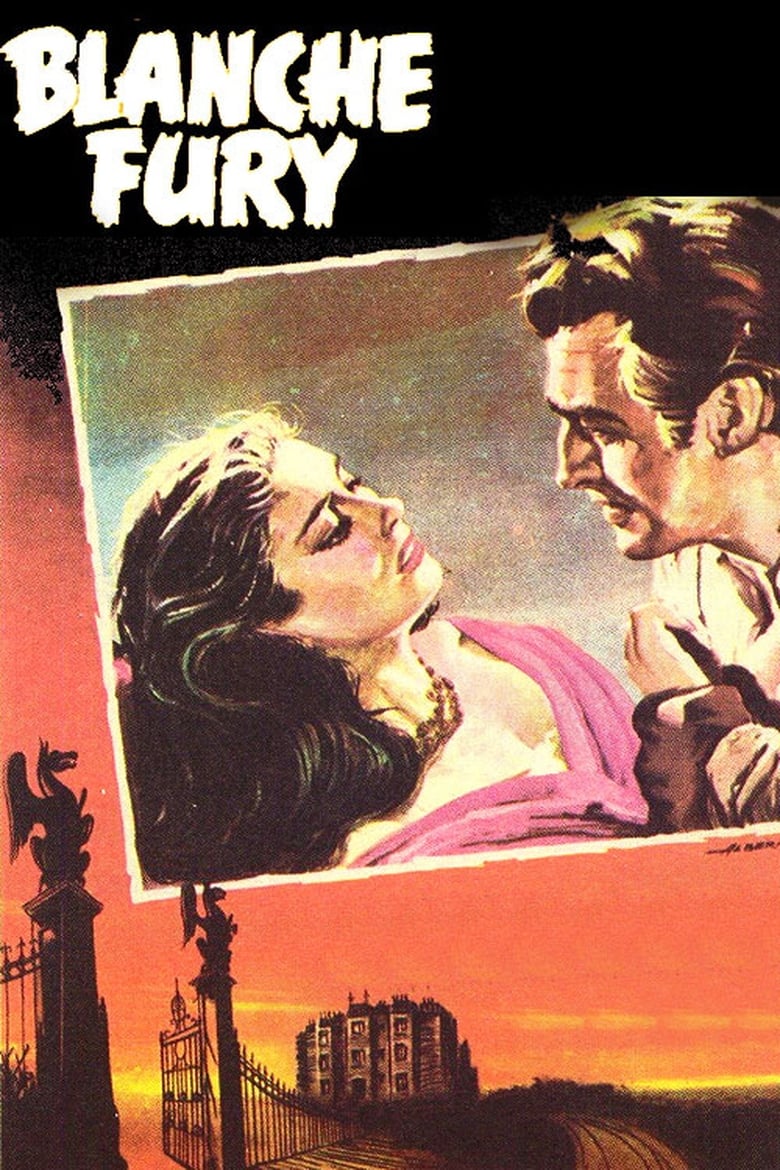
Blanche Fury arrives at Fury's Chase, the crumbling estate of her distant relatives, to take a position as governess to young Lavinia. The household is governed by the autocratic Simon Fury, whose legitimate heir is the weak, possessive Laurence. Blanche is a woman of reduced circumstances but considerable pride, and the estate's faded grandeur matches her own sense of thwarted entitlement. Into this uneasy domestic arrangement comes Philip Thorn, the estate's illegitimate manager, who believes he has a rightful claim to Fury's Chase and makes no effort to conceal his contempt for those who hold it.

When Blanche, under pressure and with few alternatives, accepts Laurence's proposal of marriage, she becomes mistress of the house she coveted – but the arrangement brings neither security nor satisfaction. Her attraction to Philip deepens into something she cannot control, and his own fixation on the estate finds a new instrument in her. What begins as mutual recognition between two people on the margins of respectability hardens into conspiracy, and the violence that follows implicates them both in ways neither fully anticipated.

Blanche Fury belongs to the tradition of the gothic noir, where the mechanisms of inheritance and class perform the same function as the city's back alleys in American crime films – they constrain, corrupt, and ultimately destroy those who cannot escape them. The film is less concerned with the mechanics of crime than with the temperature of obsession, tracing how social exclusion and sexual longing can fuse into something fatal. It stands alongside So Evil My Love and Uncle Silas as a British entry in the postwar noir cycle that locates its darkness not in rain-slicked streets but in the interiors of houses where the past refuses to release its grip.

Classic Noir

Blanche Fury is a film that repays attention precisely because it refuses the clean moral arithmetic of the typical crime picture. Marc Allégret, a French director working within the Cineguild stable that produced Brief Encounter and Great Expectations, brings an outsider's detachment to the English class system, which he regards with neither nostalgia nor satire but with a cool, diagnostic interest. The film understands that the country house is not a refuge from the social tensions of 1948 Britain but their concentrated expression. Valerie Hobson's performance is controlled to the point of opacity – we watch her make each calculation and yet never feel we have full access to her interiority, which is precisely the point. Stewart Granger's Philip Thorn is charismatic in the manner of men whose grievances have calcified into ideology. The film's central argument – that the desire for property and the desire for another person are not easily distinguished – gives it a thematic weight that lifts it above the costume melodrama it superficially resembles.

– Classic Noir
3 ★★★☆☆ Notable
Credits

The Crew

DirectorMarc Allégret
ScreenplayAudrey Erskine-Lindop
CinematographyGuy Green
MusicClifton Parker
EditingJack Harris
Art DirectionWilfred Shingleton
ProducerAnthony Havelock-Allan
Performances

The Cast

Close Reading

The Signature Scene

Blanche Fury – scene
The Stable Yard at Dusk Two Figures, One Shadow

Guy Green lights the scene with a last horizontal light that catches the stone walls of the stable yard and leaves the ground in near-darkness. Blanche and Philip stand at an oblique angle to each other, the camera holding a medium two-shot that refuses the conventional intimacy of a closer frame. Neither figure is centred; both are caught between architectural verticals – a doorpost, a gatepost – that divide the screen into sections and give the composition the quality of a trap already sprung. When Philip moves toward her, the camera does not follow but stays fixed, so that he crosses out of the light and into shadow before he reaches her.

The blocking makes explicit what the script keeps implicit: Philip's movement toward Blanche is simultaneously a movement away from legibility, from the social world that monitors and judges. The fixed camera position functions as the film's moral conscience – it sees, it records, it does not intervene. That Blanche does not step back, does not reframe herself into the light, tells us everything about where her choices are tending. The scene is the film's pivot, the moment at which attraction ceases to be passive and becomes a form of intent.

Visual Language

The Cinematography

🎞️
Guy Green – Director of Photography

Guy Green, who would win an Academy Award for his work on Great Expectations the previous year, brings to Blanche Fury a visual strategy rooted in the tension between the film's Technicolor palette and its fundamentally noir moral universe. Working largely on studio-constructed sets at Pinewood, Green uses the period interiors not as decorative backgrounds but as moral environments: the deeper the characters move into Fury's Chase, the more the lighting contracts, with fill light progressively withdrawn until the faces of the principals are half-masked in shadow even in ostensibly domestic scenes. His lens choices favour moderate focal lengths that keep background architecture in focus, ensuring the house is always present as a force rather than a backdrop. The Technicolor process, often associated with warmth and surface pleasure, is here calibrated toward amber and brown with deliberate restraint, so that the colours feel like something decaying rather than something vivid. The result is a film that looks like a period romance but is composed like a confession.

In the Catalogue

Themes & Motifs

Availability

Where to Watch

Also in the Directory

See Also