
Films People Pull a Fast One Night Beat Reading Room On TV Shop
Rough and the Smooth 1959
1959 George Minter Productions
★★★☆☆ Notable
Film Noir · 96 minutes · Black & White

Rough and the Smooth

Directed by Robert Siodmak
Year 1959
Runtime 96 min
Studio George Minter Productions
TMDB 6.3 / 10
"A man of science falls into a woman he cannot read, and cannot leave."

In late-1950s London, Mike Thompson, an archaeologist with respectable prospects and a steady relationship with Margaret Goreham, becomes fatally distracted by Ila Hansen, a Danish woman of uncertain means and magnetic opacity. Their encounter is brief enough to seem accidental and prolonged enough to suggest design. Reg Barker, an American with an investigative instinct and a proprietary interest in Ila's past, watches from the margins, tracking what Mike cannot bring himself to question.

As Mike's obsession deepens, the architecture of his life begins to give way. Margaret, composed and perceptive, recognizes the shift before Mike acknowledges it. Ila, meanwhile, operates across several registers at once – intimate, evasive, genuinely damaged – and the film refuses to settle her into the role of simple predator. Lord Drewell and the peripheral figures around Ila complicate her history further, introducing threads of exploitation and dependency that suggest her origins are less glamorous than her surface.

Rough and the Smooth belongs to a strand of late-period noir in which the femme fatale is examined with some psychological seriousness rather than mere formal convention. Robert Siodmak, working in British production, applies the architectural rigour of his Hollywood years to a London milieu that is simultaneously familiar and slightly foreign, producing a study in compulsion that holds its genre commitments and its character ambitions in productive tension.
Classic Noir

Robert Siodmak's return to the thriller form with Rough and the Smooth arrives nearly a decade after his definitive Hollywood work, and the distance shows in both useful and limiting ways. The film carries the structural confidence of a director who understands how desire functions as a narrative engine, but it operates within the more constrained emotional register of late British noir, where psychological realism is valued over expressionist intensity. Nadja Tiller's performance as Ila Hansen is the film's primary asset: she withholds enough to sustain ambiguity without tipping into inscrutability. Tony Britton's Mike is credibly undone rather than heroically tragic, which suits the film's sceptical tone. William Bendix brings a worn, procedural authority to Barker that anchors the investigative strand. Otto Heller's cinematography keeps the London locations in a condition of controlled shadow, never quite naturalising them. The film does not fully resolve the tension between its genre mechanics and its interest in damaged psychology, but that irresolution is itself period-accurate – a quality that makes it a document as much as a drama.

– Classic Noir
3 ★★★☆☆ Notable
Credits

The Crew

DirectorRobert Siodmak
ScreenplayAudrey Erskine-Lindop
CinematographyOtto Heller
MusicDouglas Gamley
EditingGordon Pilkington
Art DirectionKen Adam
ProducerRobert Siodmak
Performances

The Cast

Close Reading

The Signature Scene

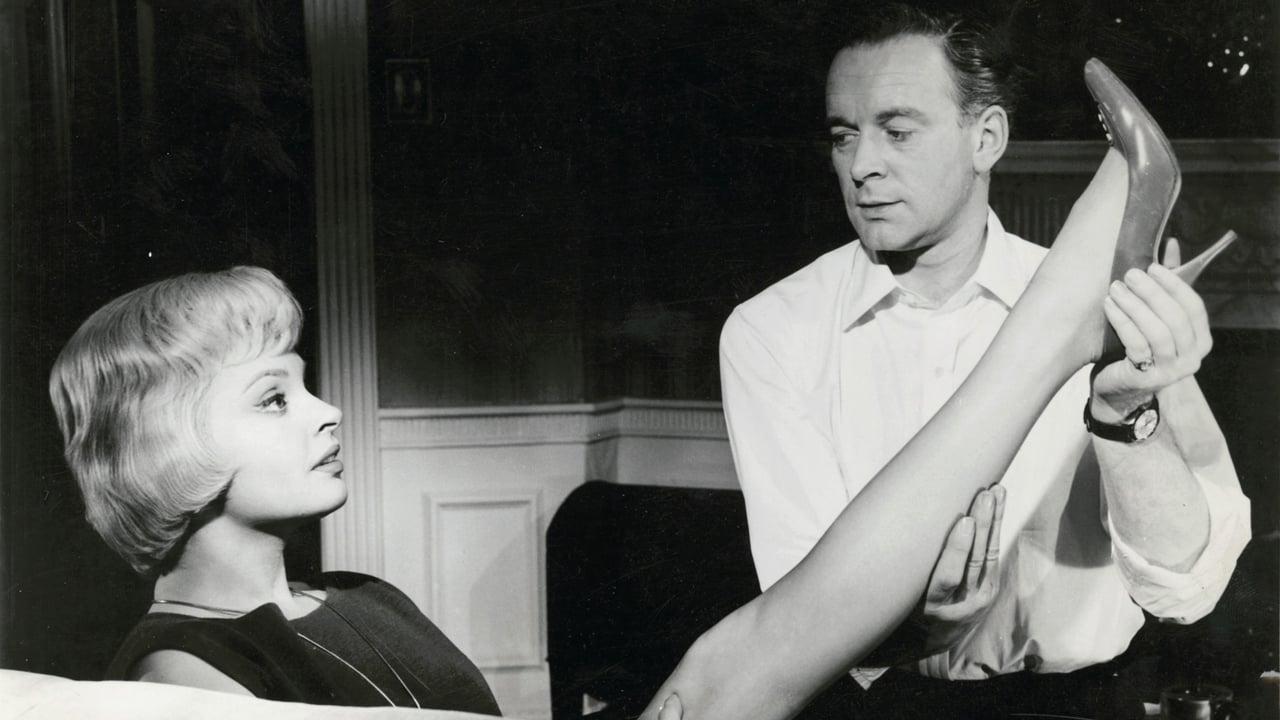
Rough and the Smooth – scene
The Apartment, Night Light Across Her Face

Heller positions the camera at a slight remove, framing Ila in three-quarter profile against a window whose curtains admit a narrow band of exterior light. The source is ambiguous – streetlamp or passing vehicle – and its intermittent quality means her expression shifts without her moving. Shadow gathers along the jaw and beneath the eyes while the forehead and cheekbone catch the available light, producing a face that seems to be composing and decomposing simultaneously. Mike occupies the foreground, partially out of focus, his back to us.

The composition encodes the scene's argument: he is watching a woman he cannot fully see, and the film is watching him watch. Ila's opacity is not performed for his benefit but is presented as a condition of her existence, something prior to and independent of his attention. The scene refuses to grant him the readability he wants and refuses to grant the audience more than he receives – a formal statement about the limits of knowledge when desire is doing the looking.

Visual Language

The Cinematography

🎞️
Otto Heller – Director of Photography

Otto Heller, a cinematographer whose career moved fluently between European and British production, brings to Rough and the Smooth a lighting grammar rooted in continental noir tradition rather than the harder-edged American model. His preference here is for graduated shadow – fill light used sparingly, practical sources motivated by domestic fixtures and city windows – which gives the interiors a quality of partial illumination that suits the moral logic of the story. Heller avoids the compositional extremism of German Expressionism but retains its understanding that ambivalence can be rendered spatially. Lens choices favour a moderate focal length that keeps backgrounds present without reducing them to abstraction, allowing London locations to function as legible environments rather than atmospheric blur. The studio sequences and location work are integrated with enough care that the seams rarely show. Shadow, in Heller's scheme, does not simply signify menace – it signifies withheld information, which is precisely what the film is about.

In the Catalogue

Themes & Motifs

Availability

Where to Watch

Also in the Directory

See Also