Films People Pull a Fast One Night Beat Reading Room On TV Shop
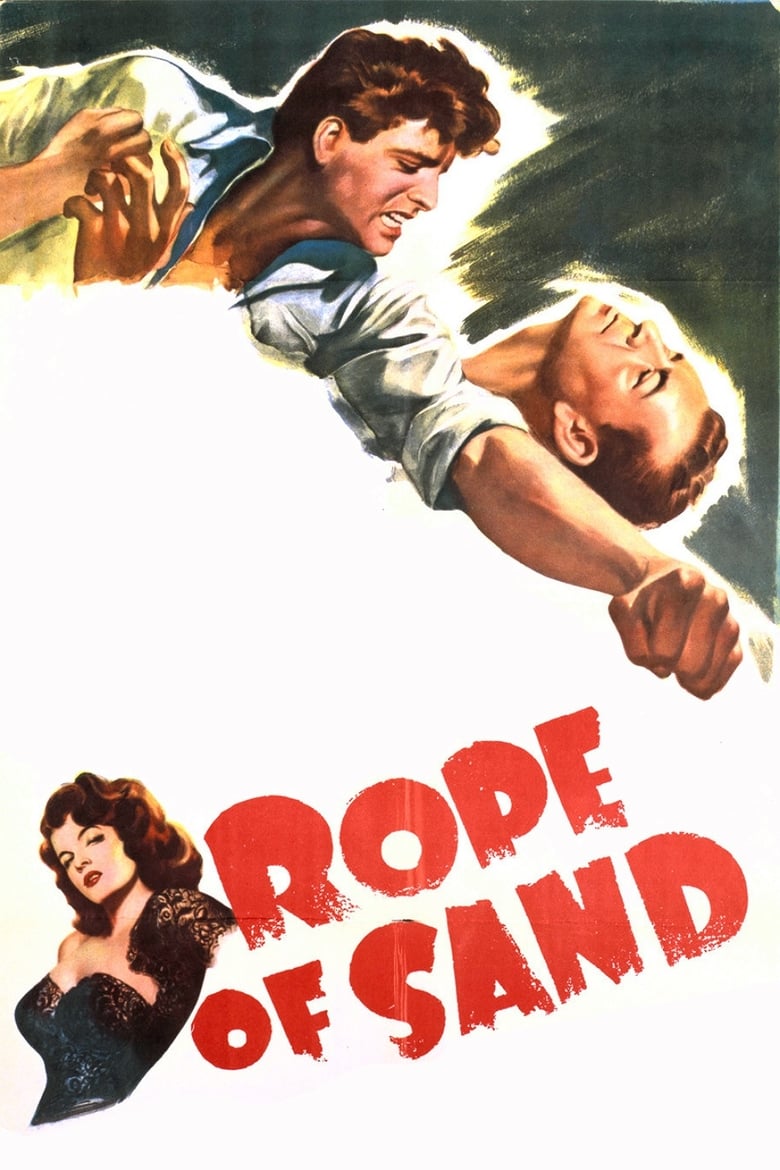
Rope of Sand 1949
1949 Paramount Pictures
★★★☆☆ Notable
Film Noir · 104 minutes · Black & White

Rope of Sand

Directed by William Dieterle
Year 1949
Runtime 104 min
Studio Paramount Pictures
TMDB 5.7 / 10
"A fortune buried in desert sand draws men who have already lost everything worth keeping."

In the diamond fields of South West Africa, administered by a brutal colonial authority, Mike Davis (Burt Lancaster) returns to the territory where he was once tortured and left for dead by Commandant Vogel (Paul Henreid), the sadistic head of security. Davis knows the location of a cache of uncut diamonds – worth a small fortune – hidden in the desert after a previous, ill-fated smuggling run. What he lacks is the means and the cover to retrieve them. Into this arrangement steps Arthur Martingale (Claude Rains), a smooth, self-serving expatriate fixer who operates in the grey zones of colonial commerce, and Toady (Peter Lorre), Martingale's watchful, morally flexible associate.

Martingale imports Suzanne Renaud (Corinne Calvet), a young Frenchwoman with a complicated past, to serve as bait and distraction – a human instrument in a scheme that assigns her no agency of her own. But Suzanne develops something closer to genuine feeling for Davis, and the triangular pressure among Davis, Martingale, and Vogel begins to strain every alliance. Vogel, who rules the territory through systematic intimidation and a monopoly on violence, is determined to recover the diamonds himself, and he uses every instrument at his disposal – including the threat of renewed brutality – to force Davis into the open.

Rope of Sand belongs to the cycle of late-1940s noirs set in exotic or colonial locales, where the heat and the landscape function as extensions of moral corruption rather than mere backdrop. The film works less as a heist picture than as a study of power: who holds it, who is broken by it, and what a man will accept in exchange for the chance at one clean score. Lancaster's physicality anchors the picture against a cast of polished, calculating antagonists, and the film's refusal to sentimentalise its central romance gives the plot an unusually dry tension.

Classic Noir

Rope of Sand is a more considered picture than its reputation as a Burt Lancaster programmer suggests. William Dieterle – a director whose career ran from Weimar-era German cinema through the prestige productions of Warner Bros. – brings a European sense of moral ambiguity to material that could easily have been routine adventure. The casting is the film's most deliberate achievement: Paul Henreid, Claude Rains, and Peter Lorre, three figures whose associations with Casablanca (1942) are impossible to ignore, are here stripped of any residual sympathy and placed in service of naked self-interest. The colonial setting is not incidental. The diamond fields and their administrative machinery represent a system in which violence is institutionalised and the individual has no recourse. Franz Waxman's score is spare where it might have been insistent, and Charles Lang's cinematography keeps the studio-bound African interiors in a state of controlled shadow that signals entrapment as clearly as any dialogue. The film does not resolve its moral questions so much as exhaust them.

– Classic Noir
3 ★★★☆☆ Notable
Credits

The Crew

DirectorWilliam Dieterle
ScreenplayWalter Doniger
CinematographyCharles Lang
MusicFranz Waxman
EditingWarren Low
Art DirectionHans Dreier
CostumesEdith Head
ProducerHal B. Wallis
Performances

The Cast

Close Reading

The Signature Scene

Rope of Sand – scene
The Interrogation Compound Vogel Extends the Lamp

Commandant Vogel sits at a desk positioned deep in the frame while Davis stands in the foreground, partially obscured by shadow. Lang lights the scene from a single hard source – a desk lamp that Henreid tilts and redirects with quiet deliberateness, as though adjusting the instrument of an examination. The light tracks across Lancaster's face without ever fully resolving it, keeping the subject in a condition of partial exposure. The camera remains at mid-distance, denying the scene any of the expressionistic distortion that a less controlled director might have imposed. The composition is architectural: walls, bars of shadow, the geometry of the desk all partition the frame into zones of authority and subordination.

The scene makes visible the film's central argument about power. Vogel does not need to raise his voice or reach for a weapon. The lamp is enough – a reminder of what has already been done to Davis and what can be repeated at will. Lancaster holds the frame through physical stillness rather than reaction, which is the correct choice: Davis's resistance is not expressed but suppressed, and that suppression is what the film is actually about. The scene establishes that the contest between these two men is not one of equal force but of a man trying to outlast an institution.

Visual Language

The Cinematography

🎞️
Charles Lang – Director of Photography

Charles Lang's work on Rope of Sand is disciplined in a way that suits the film's argumentative structure. Shooting on Paramount sound stages dressed to suggest South West African colonial interiors, Lang avoids the temptation to impose a jungle-picture visual grammar. Instead, he works in controlled mid-tones with hard shadow edges, using low-key setups that owe something to the German studio tradition Dieterle brought with him from his Weimar years. Key lighting is kept narrow and directional, so that characters move in and out of legibility as the scene demands. Calvet's introductory sequence is shot with a slightly longer focal length than the rest of the film, flattering and isolating her in a way that reflects her function in the plot – she is being presented, not revealed. The desert exteriors, such as they are, use high-contrast lighting to flatten depth, making the landscape feel less like a setting than a condition. Lang would go on to similar work in later noirs, but the restraint here is particularly well-matched to Dieterle's cool, analytical direction.

In the Catalogue

Themes & Motifs

Availability

Where to Watch

Also in the Directory

See Also