Detective Sergeant Christopher Kelvaney works both sides of the law in an unnamed American city, accepting payments from mob boss Dan Beaumonte in exchange for information and interference that keeps the syndicate's operations intact. Kelvaney has rationalized the arrangement into a kind of equilibrium – he takes money, causes no deaths, and keeps a careful distance from conscience. That equilibrium collapses when his younger brother Eddie, a uniformed officer of uncompromised integrity, witnesses a syndicate killing and is marked for elimination.
Beaumonte's offer is characteristically direct: deliver Eddie's silence or watch him die. Kelvaney, caught between the organization that owns him and the brother whose decency he has long envied, moves through a city where every ally is contingent and every relationship has a price attached. Karen Stephanson, a nightclub singer entangled with Beaumonte's world, and Nancy Corlane, the dead gangster's girlfriend, each complicate Kelvaney's calculations in ways that push him toward a reckoning he has spent years avoiding. Father Ahearn, Eddie's confessor and moral anchor, stands as the film's quiet reproach to everything Kelvaney has become.
Rogue Cop belongs to the cycle of mid-1950s noirs that turned corruption inward, locating the genre's menace not in the criminal but in the institutions meant to contain him. The film traces the arc of a man who has confused survival with accommodation, and asks at what point compromise becomes its own form of crime. Where earlier noirs placed the femme fatale at the center of moral collapse, this film puts the corrupted institution itself – the badge, the city, the arrangement – in that structural role.
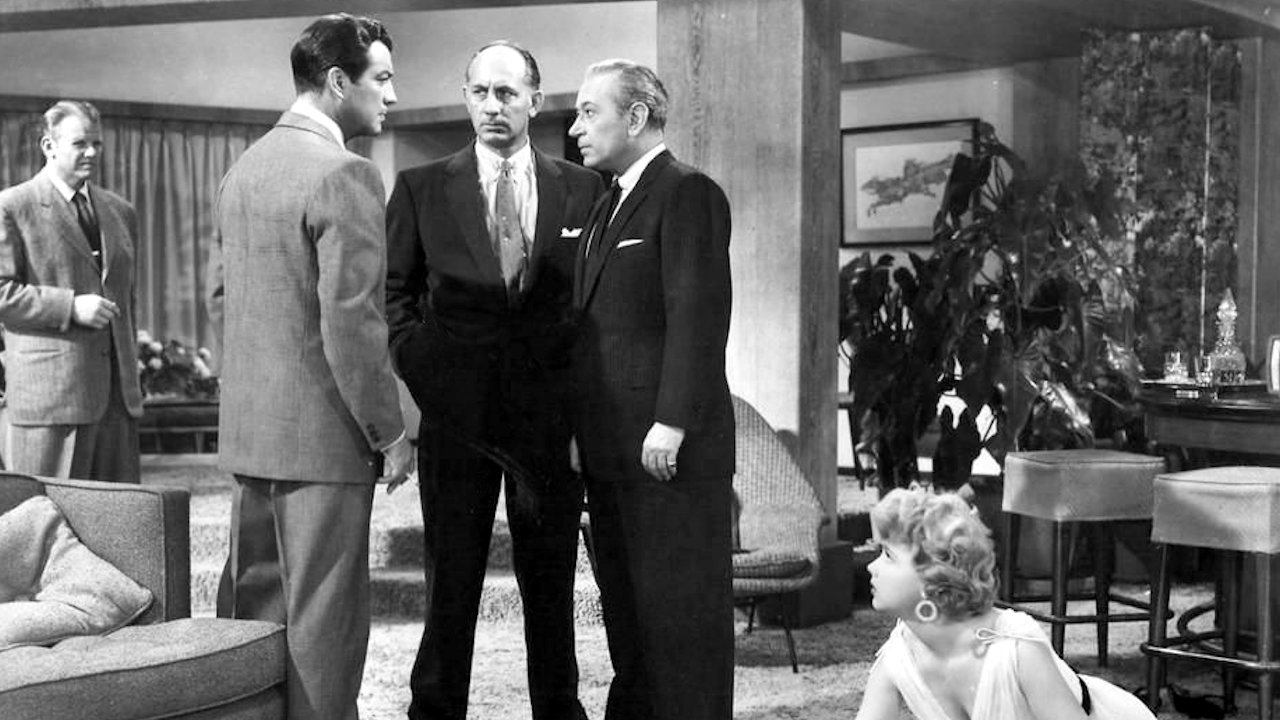
Rogue Cop arrives in 1954 at a moment when American noir was interrogating its own civic mythology with increasing directness. Roy Rowland is not a stylist of the first rank, but he manages the film's central tension with restraint, trusting Robert Taylor to carry ambiguity in a performance that resists easy sympathy. Taylor's Kelvaney is not a tragic figure in the classical sense – he has made his choices with open eyes – which gives the film a harder edge than most redemption narratives of the period. George Raft, playing Beaumonte with habitual economy, provides a villain whose menace is largely administrative: he issues instructions the way a manager issues memos. The film's critique of institutional rot anticipates the police procedural disillusionment that would become common currency in American cinema a decade later. MGM's involvement gives the production a glossier surface than the poverty-row noirs of the late 1940s, but John F. Seitz's cinematography carves sufficient shadow into the studio-polished frame to keep the moral atmosphere appropriately compromised.
– Classic Noir
Seitz frames Kelvaney in a tight medium shot against the geometry of dock pilings and industrial darkness, the key light raking across Taylor's face at a steep angle that splits his expression into shadow and half-illumination. The background dissolves into an undifferentiated blackness, collapsing any sense of civic space around him. The camera holds rather than cuts, allowing the composition to accumulate pressure rather than release it through movement. What light exists seems to come from somewhere just off the moral axis of the scene – present but unearned.
The scene makes visible what the script has been arguing in dialogue: Kelvaney exists in a perpetual condition of partial exposure. He is neither fully in the dark nor fully in the light, and Seitz's refusal to resolve the lighting into clarity is the film's most economical statement of its theme. The frame argues that corruption is not a fall into darkness but a negotiated position at the edge of illumination, where a man can see just enough to keep choosing badly.
John F. Seitz, whose work on Double Indemnity and Sunset Boulevard established a benchmark for noir expressionism, operates here within MGM's studio apparatus, and the tension between that institutional context and his instinct for hard shadow gives Rogue Cop its visual character. Seitz deploys low-key setups with selective fill, allowing faces to drop partially into darkness rather than committing to the full expressionist contrast he achieved at Paramount. The studio interiors are lit with an attention to practical sources – lamps, windows, neon bleed from implied exteriors – that gives the artificial sets a degree of environmental plausibility. His lens choices favor moderate wide angles at close range, which compresses the space around characters and reinforces the film's argument that its world offers no room to maneuver. Where the script permits ambiguity, Seitz enforces it in the frame: no character in a morally unclear moment receives clean, neutral lighting. The cinematography functions as a second system of moral accounting, running parallel to the narrative and arriving at the same conclusions.
TCM holds reliable broadcast rights to MGM library titles of this period and is the most consistent source for Rogue Cop in its correct aspect ratio; check the TCM schedule or the Max platform, which carries TCM content on demand.
Amazon Prime VideoRental / PurchaseA digital rental or purchase is available through Prime Video's transactional storefront and offers reasonable print quality for a film that has not received a dedicated restoration.
TubiFree / Ad-SupportedTubi has carried MGM library titles in rotating availability; confirm current listing before seeking it out, as catalog access can shift without notice.