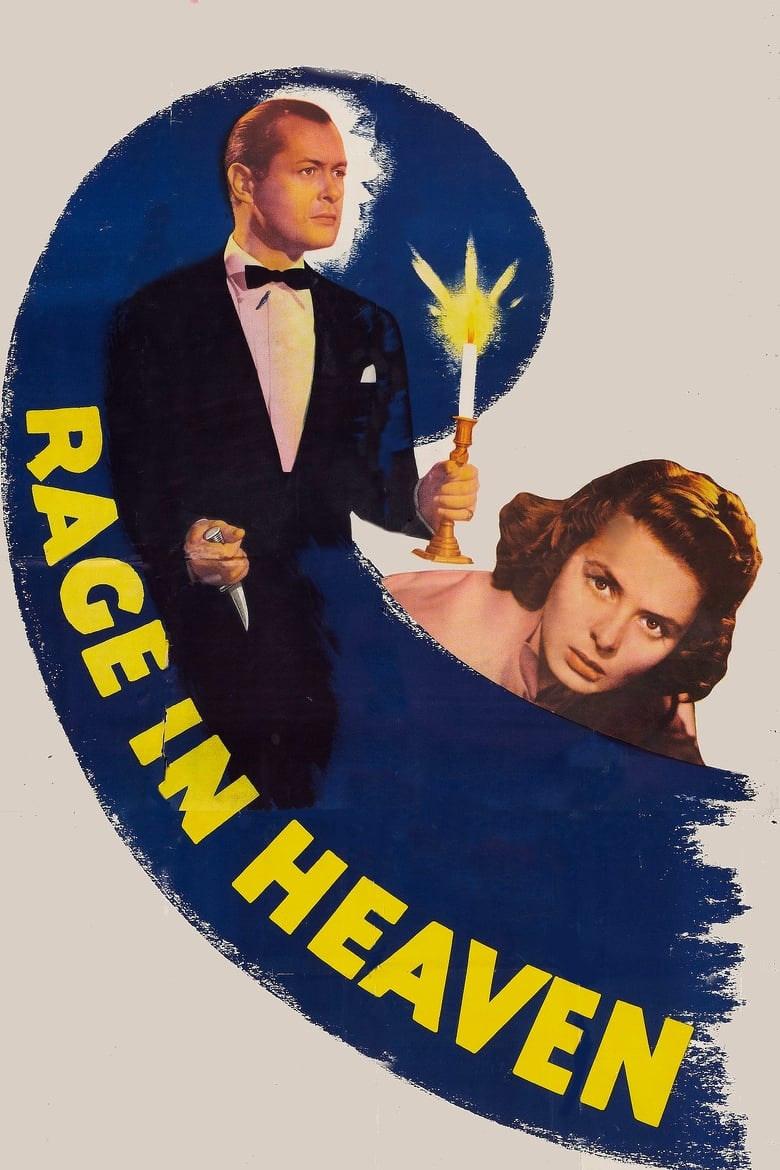
Philip Monrell (Robert Montgomery), heir to a wealthy English estate, has spent years in a French sanatorium under the care of Dr. Rameau (Oskar Homolka), whose diagnosis of a severe psychological disorder has been kept from Philip's possessive mother (Lucile Watson). Fleeing the institution, Philip travels to Paris under an assumed name, where he meets and befriends Ward Andrews (George Sanders), a steady, good-natured engineer. The two men return to England together, and Philip gradually reveals his true identity. Ward is absorbed into the Monrell household, and the family's ward, Stella Bergen (Ingrid Bergman), who has long endured Mrs. Monrell's suffocating control, finds in Ward a measure of warmth and candor she has been denied.
Philip, recognizing the mutual attraction between Stella and Ward, moves quickly to foreclose it – marrying Stella himself before the attachment can deepen. The marriage is not driven by love but by something closer to ownership, and Philip's behavior grows increasingly erratic. Jealousy calcifies into obsession. He fabricates evidence of an affair between Stella and Ward, and when his paranoid architecture collapses under scrutiny, his rage turns inward and then outward. Dr. Rameau arrives from France, having tracked his escaped patient, and confirms what the household has begun to suspect: Philip's grip on reality is tenuous and dangerous.
Rage in Heaven belongs to the cycle of psychological noir that flourished in Hollywood's early 1940s, before the genre had fully named itself. It is less concerned with crime as such than with the slow dissolution of a mind and the damage that dissolution inflicts on those nearest to it. The film draws on the era's fascination with psychoanalytic frameworks while filtering that interest through the conventions of the Gothic domestic thriller, situating its menace not in shadowed streets but inside a house where the walls have always been closing in.
Rage in Heaven occupies an uneasy position in the noir canon, arriving in 1941 before the genre's visual and moral grammar had fully crystallized, yet anticipating many of its central preoccupations. The film is less a crime picture than a study in psychological deterioration rendered through the conventions of the Gothic domestic. Robert Montgomery delivers a genuinely unsettling performance, suppressing the charm audiences expected from him and leaving something colder in its place – a man whose surface civility is a membrane, not a character. Ingrid Bergman, still finding her footing in Hollywood, grounds the film in something recognizably human. George Sanders does what Sanders always does: he makes decency look like a form of intelligence. Director W.S. Van Dyke, better known for efficient studio programmers, handles the material with more restraint than flair, which is perhaps the correct instinct here. The film's central argument – that madness is not visibly monstrous but quietly domestic – gives it a durability beyond its individual weaknesses.
– Classic Noir
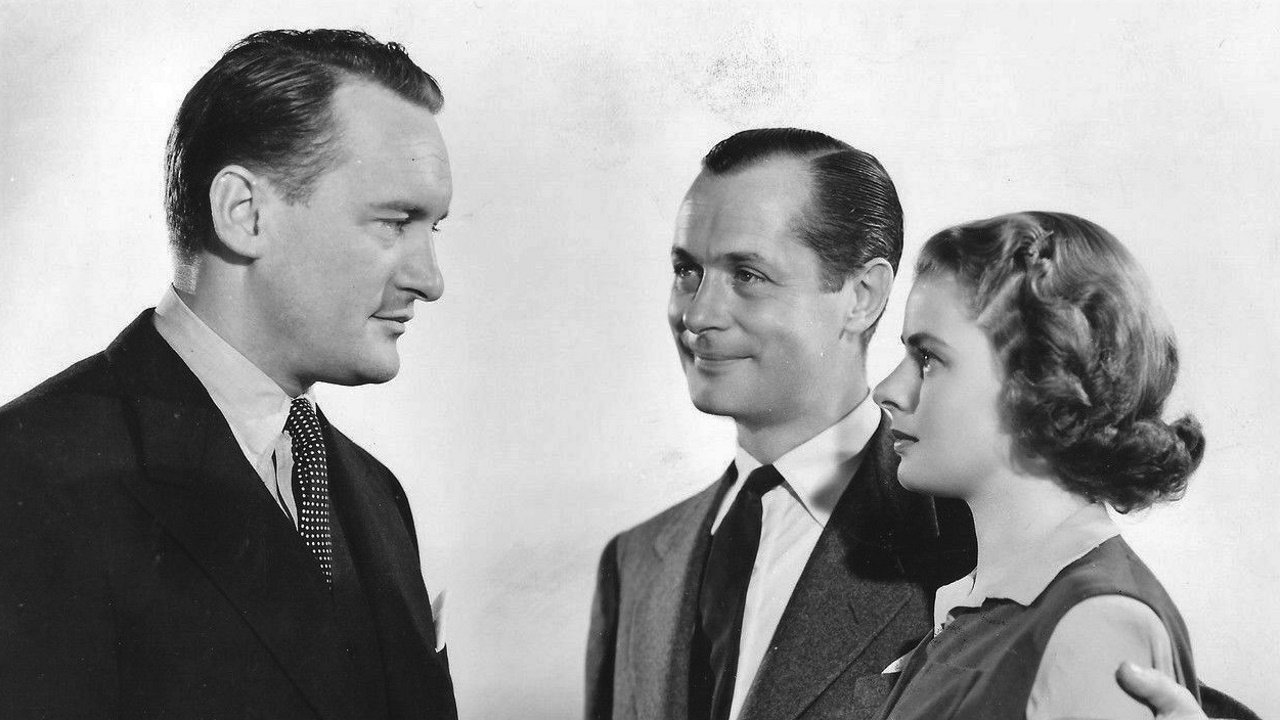
The scene is staged in the Monrell study, a room dressed with the accumulated weight of old money – dark wood, heavy drapes, a fireplace that provides the scene's dominant light source. Oliver T. Marsh keeps the frame asymmetrical, placing Philip slightly off-center while Ward occupies the margins. The fire throws long shadows across the walls and catches the edges of both men's faces, leaving motivation literally half in darkness. When Philip turns to deliver his accusations, the camera holds steady rather than cutting to a reaction – a choice that forces the viewer to read the scene across the full width of the frame, tracking both speaker and witness simultaneously.
The staging reveals what the script only implies: Philip is not confronting Ward so much as performing his grievance for an audience that includes himself. He needs the accusation to be real, and the scene's visual language – the unsteady firelight, the cluttered background, the refusal of clean close-ups – suggests a mind that can no longer distinguish between what it has seen and what it has constructed. The film's central argument, that pathology is indistinguishable from conviction when both wear the same face, finds its clearest expression here.
Oliver T. Marsh, a veteran MGM contract cinematographer whose career extended back to the silent era, brings a precise if studio-bound visual intelligence to Rage in Heaven. Working almost entirely on constructed interiors, Marsh uses the controlled environment to enforce the film's claustrophobia rather than simply record it. His lighting setups favor practical sources – fireplaces, desk lamps, the ambient glow of English overcast filtering through tall windows – which allows shadows to behave with the irregularity of real light rather than the geometry of studio convention. The Monrell house reads as a sealed system, and Marsh reinforces this by keeping wide shots rare and midrange compositions dominant, shrinking the apparent volume of each room as the narrative tightens. There is no stylistic flourish for its own sake; the cinematography operates in service of psychological logic, making the visual field feel progressively more confined as Philip's mental state deteriorates. The film stops well short of German Expressionist excess, which is the correct call for a story whose horror depends on the ordinary.
TCM is the most reliable home for MGM catalog titles of this era and periodically programs Rage in Heaven within thematic noir or Golden Age studio blocks.
Archive.orgFree StreamingA public domain print has circulated on Archive.org, though transfer quality is variable and should be treated as a fallback rather than a preferred viewing option.
KanopyFree via LibraryKanopy's classic Hollywood holdings include select MGM titles; availability depends on your library system's licensing agreements.