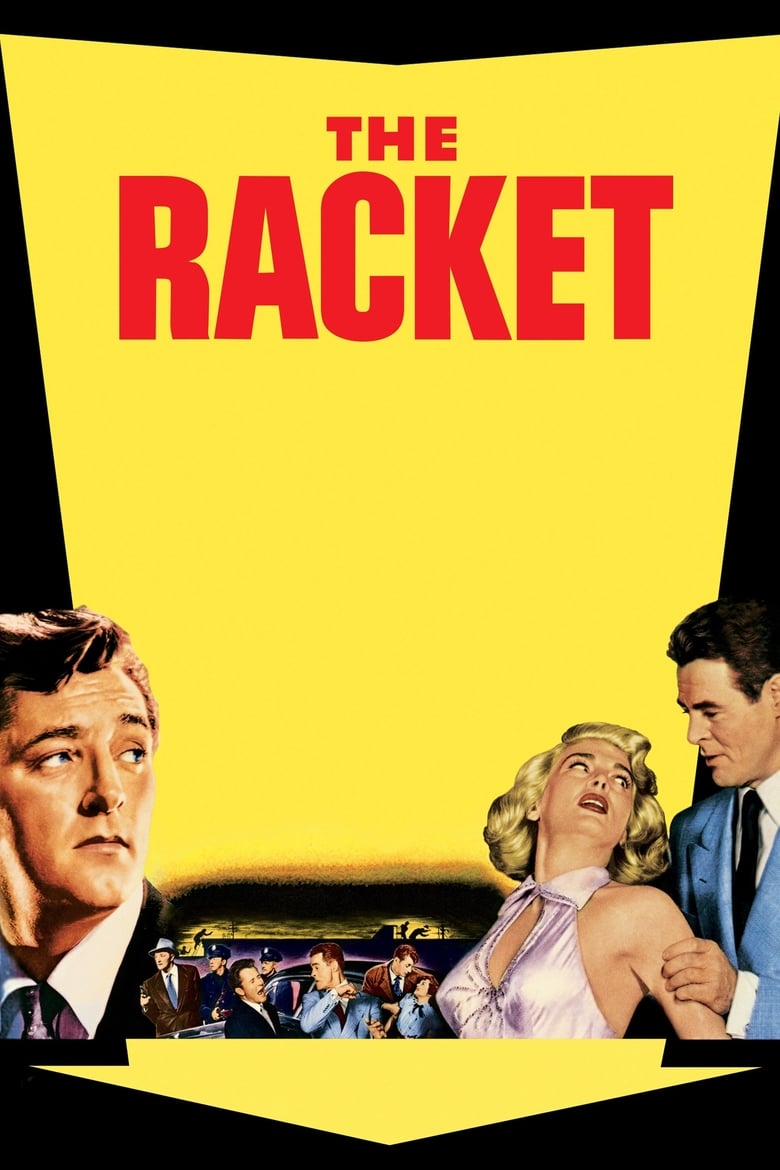
In an unnamed American city ruled by a sprawling criminal syndicate, Captain Thomas McQuigg is a police officer who still believes the law means something. Transferred repeatedly by corrupt superiors who find his integrity inconvenient, McQuigg finds himself once more in conflict with Nick Scanlon, a volatile mob enforcer he has pursued across years and precincts. The syndicate's political fixer, the smoothly corrupt Mortimer Welsh, works to keep Scanlon useful and McQuigg contained, while nightclub singer Irene Hayes moves uneasily between the world of respectable ambition and the criminal orbit she cannot quite escape.
When a young reporter named Dave Ames begins pressing too close to the syndicate's operations, and Scanlon's erratic violence threatens to destabilize the organization's carefully maintained arrangements, the film's allegiances grow complicated. Johnson, a police officer whose loyalties are divided, and his wife Lucy find themselves drawn into the machinery of institutional corruption. Welsh maneuvers to sacrifice Scanlon before the violence becomes a public liability, and McQuigg discovers that the enemy he can see – Scanlon – may be less dangerous than the one wearing a suit in city hall.
The Racket situates itself within the postwar cycle of films that treat organized crime not as romantic outlawry but as bureaucratic infrastructure. McQuigg's battle is less against individual criminals than against a system designed to make crime invisible, and the film's central tension is whether a single honest man inside that system can accomplish anything at all. The story proceeds with the procedural gravity of a case file, resisting the temptations of melodrama in favor of something closer to institutional portrait.
The Racket arrives in 1951 at the precise moment when Senate hearings were pulling the curtain back on organized crime's integration into American civic life, and John Cromwell's film registers that political atmosphere with unusual directness. Robert Mitchum brings his characteristic stillness to McQuigg, a man whose stubbornness reads less as heroism than as professional habit – he persists because he has no other mode. Robert Ryan, operating at the opposite register, gives Scanlon a volatility that makes him both dangerous and, crucially, expendable to the syndicate that employs him. The film's genuine subject is not the confrontation between these two men but the machinery that uses and discards both of them. Ray Collins's Welsh is the film's most pointed character – corruption not as passion but as administration. The Racket is not a first-rank noir, but it is an unusually honest account of how power actually circulates, and its procedural sobriety feels earned rather than merely restrained.
– Classic Noir
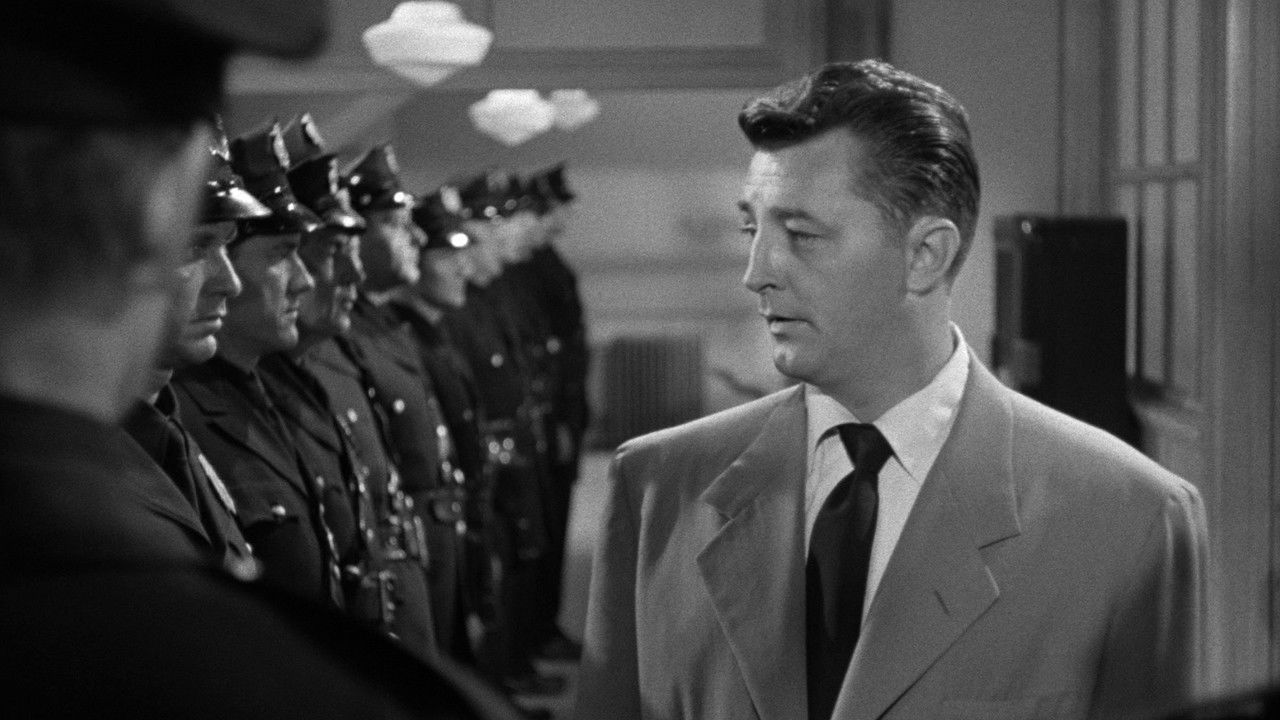
Cromwell and cinematographer George E. Diskant compose the scene with the station's institutional architecture doing much of the moral work. A single hard source drops down on Scanlon from above and slightly to the right, carving one side of his face into deep shadow while leaving the other in a cold, bureaucratic wash. The frame keeps McQuigg at the edge, almost peripheral, while Scanlon occupies the center – spatially dominant but surrounded by the geometry of walls and bars that make his position precarious. Diskant's camera holds its distance, refusing the close-up that would make the moment intimate.
The staging makes visible what the script argues throughout: Scanlon believes himself to be the center of the operation when he is in fact its most disposable element. His violence, so useful to the syndicate in the shadows, becomes intolerable under the station's unforgiving light. The scene functions as a visual thesis statement – that exposure, not confrontation, is what finally threatens men like Scanlon, and that institutions can use their own ugliness as a weapon.
George E. Diskant, who brought comparable severity to On Dangerous Ground and The Narrow Margin, shoots The Racket with a preference for hard light sources that refuse atmospheric romanticism. His setups tend toward institutional geometry – corridors, offices, precinct interiors – where shadow functions not as concealment but as moral designation. Welsh and the syndicate's political apparatus are photographed in softer, more diffuse light that signals their insulation from consequence, while Scanlon operates in the harder, more exposed zones of the frame. Diskant works largely on studio sets, using that control to enforce rigorous tonal consistency: the city outside exists mostly as sound and implication rather than location footage, which keeps the film's world feeling enclosed and procedural rather than documentary. His lens choices favor a slightly compressed middle ground that flattens space without distorting it, placing characters in relation to their environments in ways that consistently undercut any illusion of individual autonomy.
TCM holds deep RKO catalog rights and is the most reliable broadcast source for The Racket, often screening it in the context of Ryan or Mitchum retrospectives.
TubiFreeTubi has carried the film as a free ad-supported stream; availability shifts, but it appears regularly given the film's public domain status.
Archive.orgFreeThe film circulates on Archive.org in transfers of variable quality; adequate for reference viewing, though no restoration is currently available.