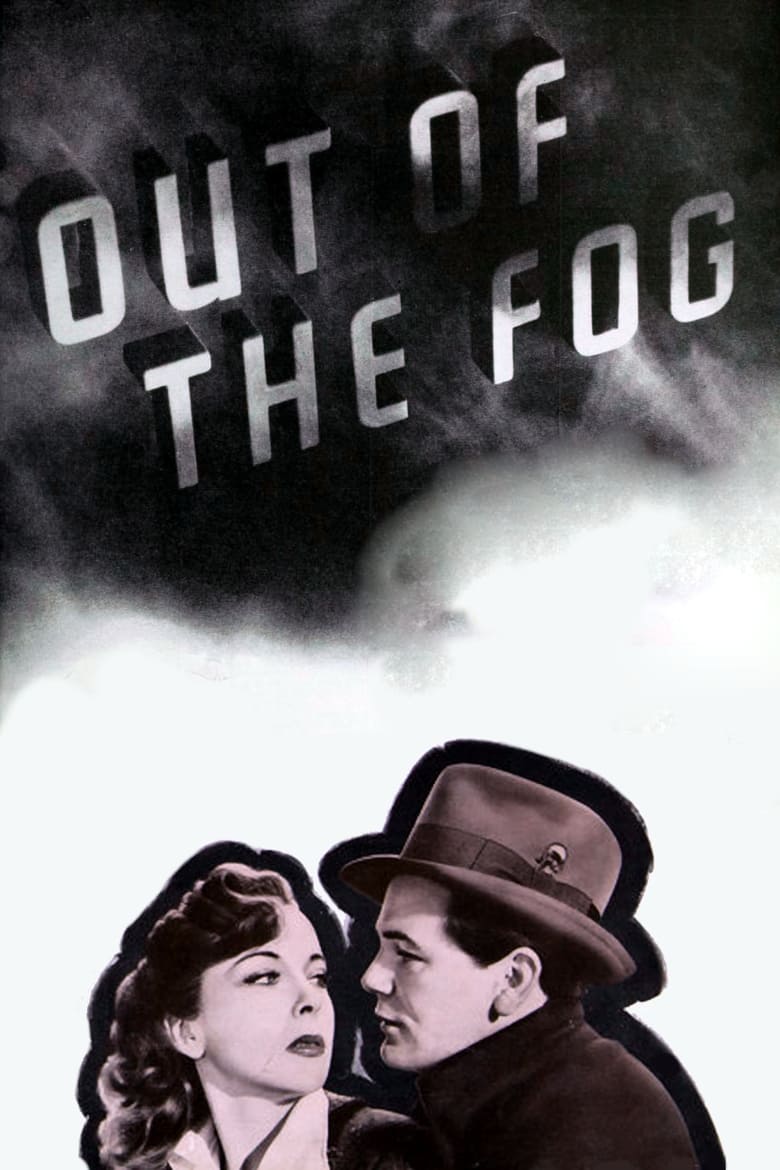
In the Sheepshead Bay neighborhood of Brooklyn, two aging working men – Jonah Goodwin, a tailor, and Igor Propotkin, a short-order cook – spend their evenings fishing off the pier, a ritual that gives their modest lives what little peace they have. Into this quiet world steps Harold Goff, a young racketeer of no great ambition but considerable menace, who discovers the men's small savings and begins extracting money from them through simple, sustained intimidation. Jonah's daughter Stella, caught between loyalty to her father and an attraction to Goff she cannot entirely suppress, becomes the human hinge on which the story turns.
Goff's hold over the two men tightens as George Watkins, Stella's decent and patient suitor, proves powerless against the extortionist's casual brutality. The film traces how ordinary men, conditioned by a lifetime of compliance and economic precarity, find themselves unable to call on institutions – police, law, community – for relief. Stella's ambivalence about Goff shades into something darker and more self-aware as she begins to understand that his power over her father is partly a projection of broader social arrangements that have always kept men like Jonah small.
Adapted from Irwin Shaw's play The Gentle People, the film belongs to the strand of early noir concerned less with crime as spectacle than with coercion as a social condition. Litvak frames Sheepshead Bay not as exotic underworld territory but as the kind of place where respectability and vulnerability are indistinguishable, and where violence, when it finally arrives, carries the weight of accumulated humiliation rather than melodrama.
Out of the Fog occupies an instructive position in the early history of American noir. Released in 1941, before the genre had consolidated its visual grammar into self-consciousness, the film works from a Group Theatre source – Irwin Shaw's 1939 stage play – and carries that lineage in its concern with class, powerlessness, and the predatory logic of small-scale capitalism. John Garfield's Goff is not a figure of tragic grandeur; he is opportunistic, thin-souled, and finally banal, which is precisely what makes him effective. The film's moral argument is not that evil is seductive but that it is structurally enabled by the docility of decent people. Thomas Mitchell's Jonah, bewildered and diminished, is the film's true subject. Ida Lupino resists the femme fatale conventions the role might invite, playing Stella as a woman whose attraction to Goff is a form of self-knowledge she finds disturbing. The result is a film that earns its darkness not through shadows alone but through a clear-eyed account of how intimidation functions in ordinary life.
– Classic Noir
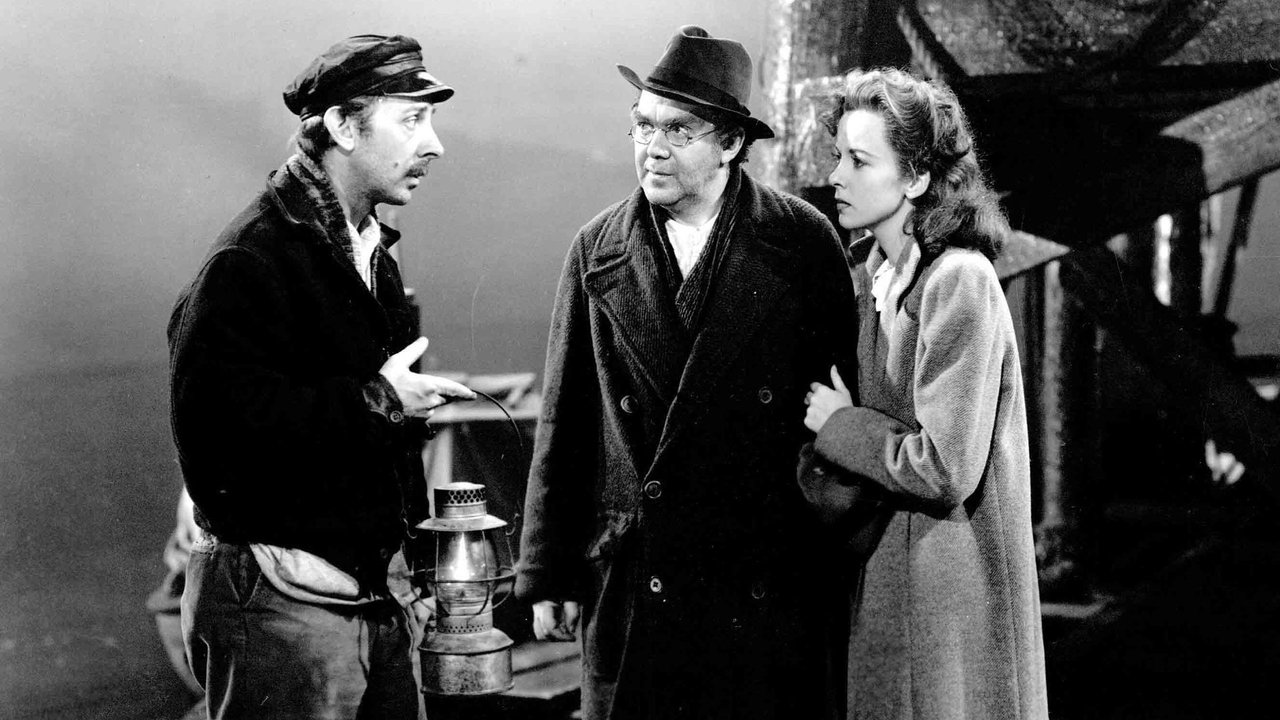
James Wong Howe photographs the nighttime pier sequences with a sustained attention to tonal gradation that resists the high-contrast expressionism more commonly associated with the period. The water surface catches diffuse ambient light, creating a shallow luminous band beneath an otherwise dense frame. Jonah and Igor are rendered as silhouettes against this pale strip – figures defined by their smallness within the composition, the pier railing functioning as a horizontal bar that anchors them to a world of fixed positions. Howe's camera holds at a slight distance, refusing close-up intimacy, so that the men's conversation arrives as something overheard rather than confided.
What the scene establishes is the quality of peace that Goff is destroying – not prosperity, not happiness in any large sense, but a calibrated sufficiency that two men have built against the pressure of their working lives. The framing makes clear that this peace is contingent and fragile, existing only in the margin between the city behind them and the water ahead. When violence eventually returns to this location, Howe's visual grammar ensures that the geography carries the full weight of what has been lost.
James Wong Howe's work on Out of the Fog demonstrates how noir lighting can operate through restraint rather than excess. Rather than imposing the hard-edged chiaroscuro that would become generic in the mid-1940s, Howe calibrates the Brooklyn locations – shot on studio-constructed sets that replicate working-class neighborhood exteriors with documentary particularity – through a graduated system of half-lights and soft falloff. Fog, whether atmospheric or manufactured, functions not as atmosphere for its own sake but as a moral diffuser: it erodes clean lines of causality and makes accountability uncertain. Interior scenes use practical sources anchored within the frame – a kitchen lamp, a window from the street – so that characters inhabit their own moral illumination rather than being lit from outside their world. The effect is that shadow, when it appears, carries narrative information rather than simply genre signal. Howe's lens choices favor middle-focal-length work that keeps foreground and background in legible relation, reinforcing the film's argument that private suffering occurs within, not apart from, a social environment.
TCM is the most reliable broadcaster for this title and often presents it in a restored print with contextual programming.
MaxSubscriptionAvailable through the Warner Bros. catalog on Max, though availability may vary by region and should be confirmed before seeking.
Archive.orgFreePublic domain versions of uncertain provenance circulate here; picture quality varies considerably and no restoration is guaranteed.