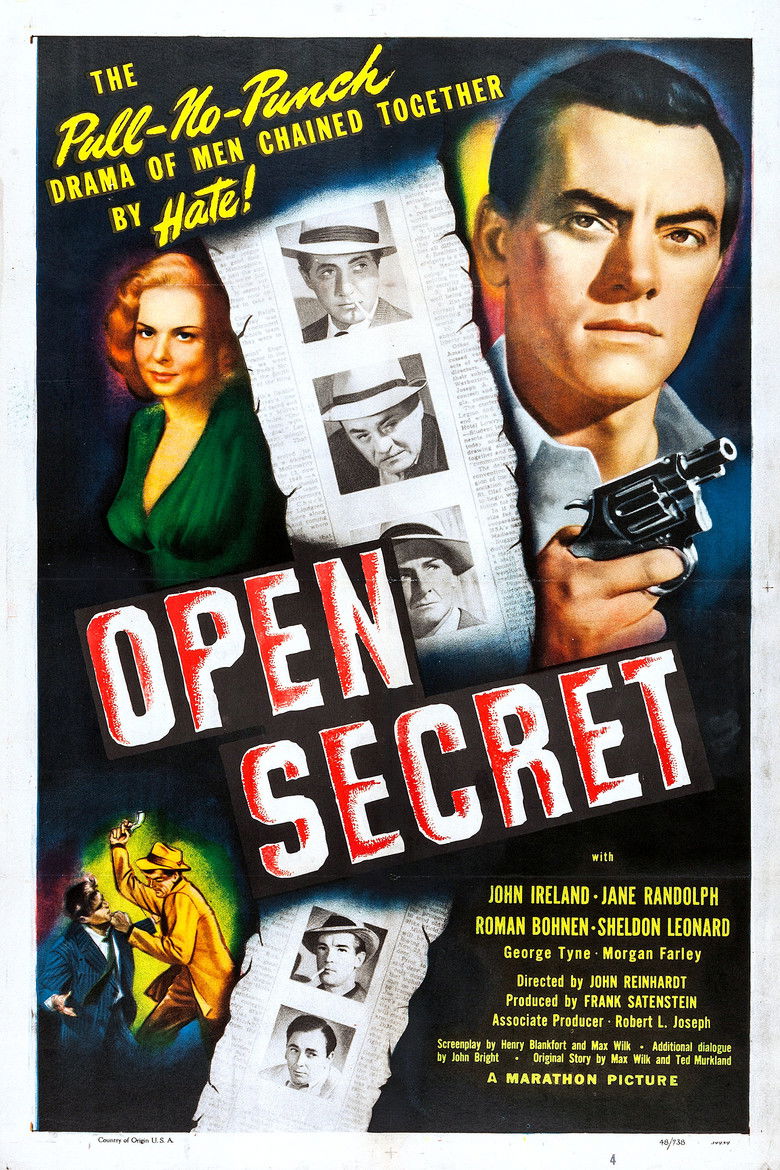
Paul Lester and his wife Nancy arrive in a small American town hoping to reconnect with an old friend, only to discover that he has vanished without explanation. The community offers polite evasions and closed doors. Local detective Sergeant Mike Frontelli is cordial but noncommittal, and the social fabric of the neighborhood–outwardly ordinary, inwardly rigid–begins to show its seams almost immediately.
As Paul digs further, the disappearance reveals itself as one thread in a larger pattern. A network of men bound by shared prejudice and mutual protection has been operating in plain sight, enforcing conformity through intimidation and, it emerges, violence. Neighbors who seemed merely reserved turn out to be complicit, and the line between bystander and perpetrator grows difficult to locate. Nancy's safety becomes a pressure point, and Paul finds that asking the right questions in the wrong company carries a cost.
Open Secret belongs to a small but pointed cluster of late-1940s noirs that treat antisemitic persecution not as backdrop but as the explicit engine of its plot. Where much of the genre displaces social anxiety into abstraction, this film names its antagonist directly. It works within the tight economy of a B-picture–68 minutes, a modest cast, no wasted scenes–to make that directness felt.
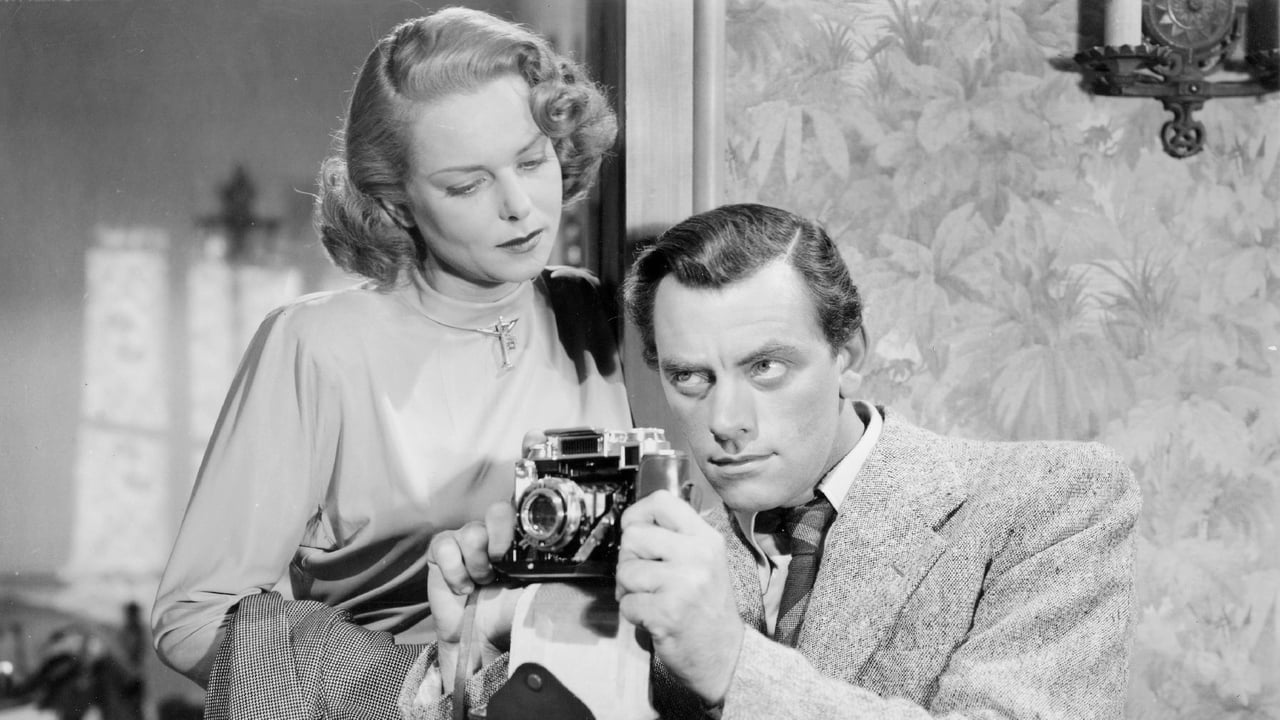
Open Secret arrived in 1948, the same year as Crossfire and Gentleman's Agreement, and shares their willingness to address organized antisemitism as a lived American phenomenon rather than a wartime aberration. Director John Reinhardt, working within the severe constraints of a Marathon Pictures budget, keeps the film spare to the point of austerity, and that restraint serves the material. The horror is not spectacular; it accumulates in handshakes, in the way a room goes quiet, in favors extended and withheld. John Ireland brings a credible, unshowy anxiety to Paul Lester, a man whose instinct for decency repeatedly outruns his capacity for self-protection. Sheldon Leonard's Frontelli is more ambiguous than the role initially suggests, an institutional figure whose allegiances are not fixed. The film's argument–that hatred organizes itself through community structures, through fraternal bonds and neighborhood networks–remains one of the more honest things American genre cinema produced in the decade following the war.
– Classic Noir
Reinhardt and cinematographer George Robinson frame the scene from a position of enforced distance: Paul observes the gathering through a window, the glass imposing a cold divide between the watcher and the watched. Robinson lights the interior warmly–lantern tones, wood-paneled walls–so that the group inside reads as wholesome, civic, fraternal. The exterior where Paul stands is dim, his face caught in the spill of light from within, his expression caught between recognition and dread. The composition does not editorialize; it simply places the two worlds in the same frame and lets the geometry speak.
What the scene establishes is the film's central irony: the institution that poses the greatest threat is also the one most confident in its own legitimacy. Paul is not looking at something hidden; he is looking at something performed in plain view, and the performance is the point. The warmth of that interior light is precisely what makes it dangerous. The scene argues, without dialogue, that violence in this context is not an aberration from community but a function of it.
George Robinson brings to Open Secret a visual economy befitting its budget and its subject. Working largely on tight interior sets, Robinson favors close source lighting–practical lamps, window spill, a single overhead–that flattens any sense of sanctuary. Faces are lit to emphasize legibility rather than glamour; there is little of the chiaroscuro romanticism that marks the prestige noir of the period. This is deliberate. Robinson's setups suggest a world in which nothing is hidden because concealment is unnecessary: the town looks exactly like itself, and that is the threat. When shadow does appear, it tends to fall on the protagonist rather than the antagonist, inverting the genre's usual moral shorthand. The lens work stays at a middle distance during group scenes, refusing to isolate individuals from their social context, which reinforces the film's argument that culpability here is collective. For a 68-minute B-picture, the visual logic is unusually coherent.
Open Secret is in the public domain and available in full on the Internet Archive, though print quality varies across uploads.
TubiFreeTubi has carried public domain titles of this vintage; availability may shift, but it is worth checking for a more stable streaming presentation.
Amazon Prime VideoSubscriptionPublic domain prints sometimes surface here through third-party channels; verify the source before committing to a rental or purchase.