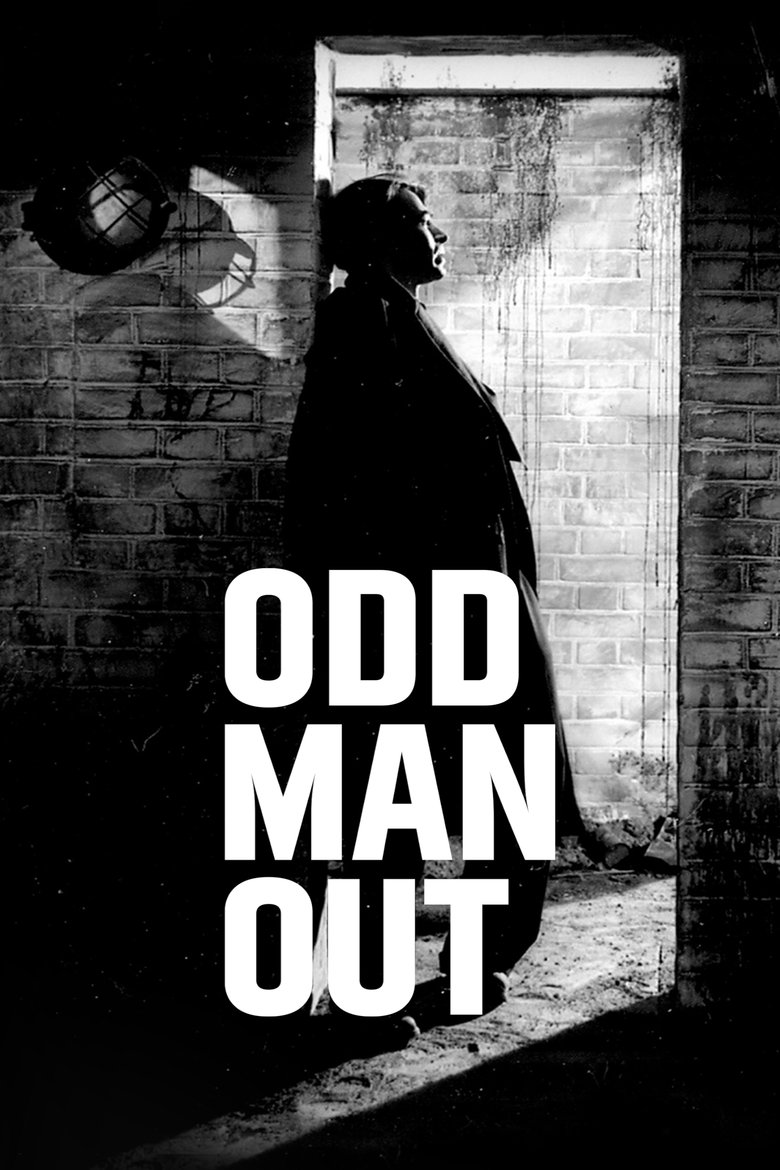
In a divided Belfast, Johnny McQueen (James Mason) leads a small republican cell planning a mill robbery to fund their cause. Wounded during the operation and separated from his comrades, Johnny vanishes into the city's back streets and tenements, barely conscious, dependent on the indifferent mercy of strangers. His devoted companion Kathleen Sullivan (Kathleen Ryan) moves through the city in the opposite direction, searching for him before the police close in.
What follows is less a chase film than a moral cartography of a city under pressure. Each figure Johnny encounters – Shell (F.J. McCormick), a furtive street scavenger who sees profit in the fugitive; Lukey (Robert Newton), a painter obsessed with capturing the dying man's eyes; Rosie (Fay Compton), a pragmatic woman navigating her own arrangements with the law – reflects a different accommodation to a world without reliable allegiances. Father Tom (W.G. Fay) offers grace; the city offers very little else.
Odd Man Out belongs to that postwar strain of noir in which the pursuit narrative is a vehicle for something closer to elegy. The cause Johnny fights for is never valorized or condemned; the film is interested in what violence costs a man's inner life, and what loyalty demands of those left to pick up the pieces. It sits at the intersection of British social realism and American noir without being entirely claimed by either.
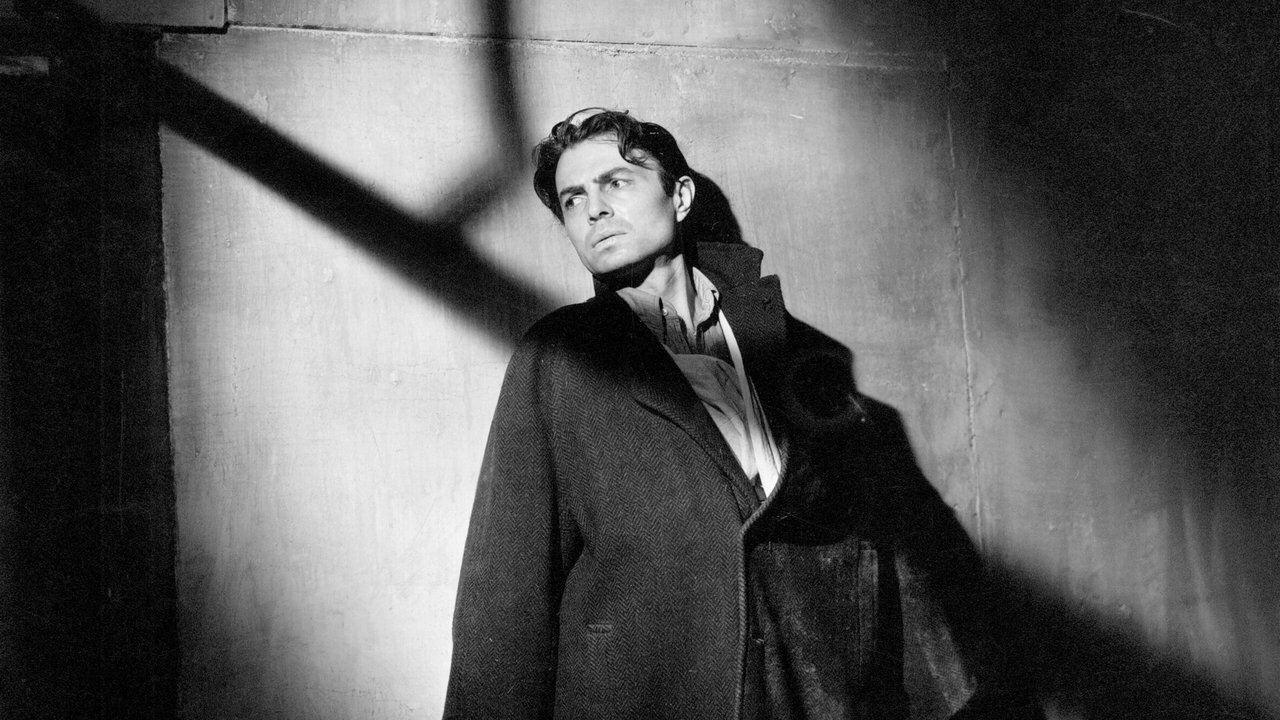
Carol Reed's film arrived two years before The Third Man and established the visual and moral grammar Reed would refine in Vienna. Working from F.L. Green's novel, Reed and cinematographer Robert Krasker construct a Belfast that functions as a psychological landscape rather than a documentary location – its cobbled streets, fogbound yards, and cramped interiors expressing the narrowing options available to a man whose wound is both literal and symbolic. James Mason gives one of the period's most physically committed performances, his body registering the progress of dying with an economy that refuses sentiment. The film refuses the genre's usual consolations: there is no investigation to be solved, no femme fatale to distrust, no moral ledger that balances. What Reed is examining is the cost of commitment to any cause when that cause has already spent the man who carried it. In this sense the film speaks directly to a Britain sorting through the wreckage of its own certainties in 1947, uncertain what the sacrifice of the preceding decade had purchased.
– Classic Noir
Krasker frames the final sequence in a wide, near-empty street dusted with snow, the light source low and lateral, throwing long shadows across the ground. The whiteness of the snow functions as both compositional counterweight to the film's prevailing darkness and as a kind of exposure – there is nowhere left to hide. The camera holds distance, refusing to sentimentalize proximity, as the two figures resolve into a single point in the frame.
The scene enacts the film's central argument: that the cause has long since receded, leaving only two individuals in a space that will not accommodate them. Johnny is beyond choice; Kathleen's choice is the only action left, and Reed frames it without judgment. The shot does not grieve so much as it records – which makes the grief considerably heavier.
Robert Krasker, who would win the Academy Award for The Third Man two years later, develops his signature expressionist language throughout Odd Man Out in ways that directly anticipate that later work. Shooting on location in Belfast as well as on studio sets at Denham, Krasker uses canted angles and extreme chiaroscuro not as decoration but as a systematic rendering of Johnny's deteriorating consciousness – the world tilts as he does. Deep-focus compositions keep foreground figures sharp while backgrounds dissolve into uncertain grey, isolating characters in a moral as well as spatial sense. The nocturnal sequences rely on hard, directional sources – a single lamp, a pub window, a gas flame – creating pools of visibility surrounded by genuine darkness rather than the diffused studio night common to Hollywood noir of the period. Krasker's work here demonstrates that British noir, when it chose to, could match American genre cinematography for shadow architecture while bringing to it a colder, more documentary texture.
The Criterion Channel presents a clean, high-contrast transfer that honors Krasker's shadow work and is the most reliable streaming source for this title.
MUBISubscriptionMUBI periodically carries the film as part of Carol Reed retrospective programming; availability rotates, so check the current schedule.
Archive.orgFreeA public-domain transfer exists on Archive.org, though contrast and detail are inferior to subscription-platform versions.