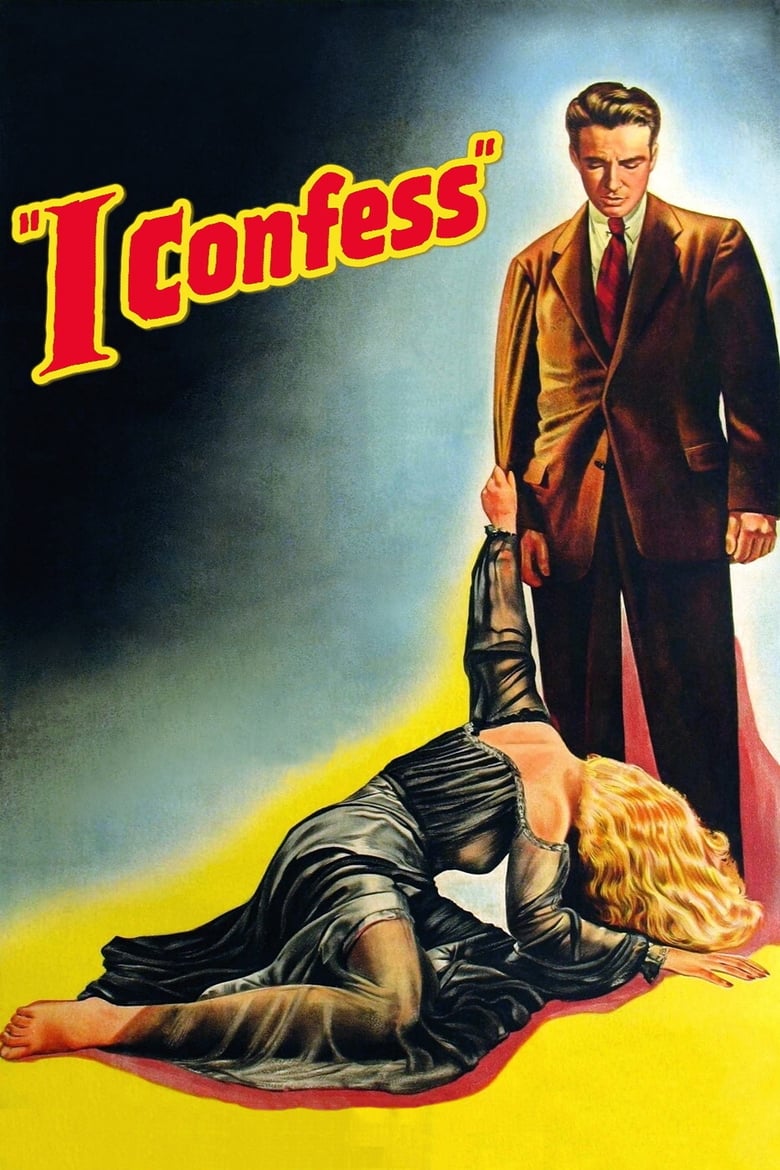
In Quebec City, a German immigrant named Otto Keller murders a blackmailer named Villette and, seeking absolution, confesses the crime to Father Michael Logan, the Catholic priest at whose rectory he works. The seal of confession binds Logan to absolute silence. When Inspector Larrue begins investigating Villette's death, circumstantial evidence and a buried personal history draw suspicion directly onto the priest himself.
Logan's past complicates his position further. Years before his ordination, he had a wartime romance with Ruth Grandfort, now married to a prominent politician. Ruth had visited Villette on the night of the murder, and her account of that visit – intended to protect Logan – instead deepens the suspicion against him. Keller, watching the investigation tighten around the priest, does nothing to correct it. His wife Alma grows increasingly unstable under the weight of what she knows.
The film structures itself around an almost unbearable moral constraint: the one man who knows the truth is prohibited by his vows from speaking it. That architecture places I Confess in noir's territory of the trapped individual, but the trap here is not circumstance or desire – it is conscience. Hitchcock uses the guilt-saturated streets and churches of Quebec to press the protagonist toward a public reckoning that the genre's conventions make feel inevitable without being routine.
I Confess occupies an unusual position in both Hitchcock's filmography and in American noir of the early 1950s. It is one of the few films in either tradition to take religious obligation seriously as a structural mechanism rather than as atmosphere. The wrong-man premise, which Hitchcock would revisit more commercially in The Wrong Man three years later, is here given a theological inflection: Logan cannot be saved by revelation because revelation itself is forbidden to him. Montgomery Clift's performance, interior and resistant to easy sympathy, suits the film's refusal to sentimentalize its protagonist's predicament. Robert Burks's use of Quebec's stone architecture – its convents, its steep streets, its institutional weight – turns the city into an extension of Logan's confinement. The film was not a commercial success in its time, partly because audiences found its pacing austere and its resolution unsatisfying. That austere quality is precisely what makes it durable as a document of noir's engagement with postwar moral anxiety and institutional authority.
– Classic Noir
As Logan emerges from the courthouse into the open air following the trial's verdict, Burks's camera holds him in a medium shot against the grey expanse of the Saint Lawrence River. The crowd closes in from the frame's edges, faces turned toward him with the flat hostility of people who have decided. Light falls without drama – an overcast exterior that refuses the expressionist relief of shadow – and the composition keeps Logan isolated at center, the architecture behind him offering no shelter. The camera does not move aggressively; it simply records the diminishing space around him.
The sequence argues something specific about public guilt and private truth. Logan has been acquitted in law but condemned in social perception, and the film shows that the two forms of judgment operate on entirely separate logics. His vow has protected Keller and destroyed the priest's standing in the community he serves. The scene makes visible the film's central contention: that moral integrity, in noir's world, does not produce safety – it produces exposure.
Robert Burks, who served as Hitchcock's principal cinematographer across much of the 1950s, approaches I Confess with a restraint that matches the film's theological subject. Rather than reaching for the expressionist contrasts common to American noir of the period, Burks largely works with the natural tonal weight of Quebec's stone exteriors and institutional interiors. Location shooting gives the film a physical gravity that studio-bound productions of the era rarely achieve; the city's churches, convents, and government buildings are photographed with a flatness that removes glamour and replaces it with permanence. Interior sequences use directed low-key light to define Logan's isolation without rendering it theatrical – shadows fall across Clift's face in ways that suggest enclosure rather than menace. The lens choices favor middle distances that keep characters embedded in their environments rather than abstracted from them. This approach serves the film's moral argument directly: in a world of institutional weight and social surveillance, the individual is never free of the frame.
Available as part of the Warner Bros. library on Max, the most reliable current home for this title in North America.
TCMBroadcast/StreamingTCM airs I Confess periodically as part of its Hitchcock and classic noir programming; scheduling can be confirmed through the TCM website.
TubiFree (Ad-Supported)Availability on Tubi varies by region and licensing period; verify current status before relying on this option.