Tony Cochrane is a homicide detective with a stable marriage and a quiet domestic life he is slowly suffocating inside. On a night he should not be where he is, parked at a lovers' lane with Jill Merrill – a wealthy, dangerous woman who has taken hold of him – Tony witnesses a man beat a young woman to death at the roadside. He says nothing. He cannot say anything without confessing the affair, without dismantling the life his wife Martha has built her trust around.
The case lands on Tony's desk anyway. As the investigation tightens around Douglas Loring, a suspect whose guilt is far from certain, Tony finds himself steering evidence away from the truth he alone possesses. Jill offers no solidarity – she is self-preserving and contemptuous, and her hold over Tony shifts from desire to coercion. The detective meant to serve justice becomes its quiet saboteur, and the moral distance between the two roles closes faster than he can manage.
Night Editor frames its central thriller as a tale told in retrospect, narrated by a night editor at a newspaper who uses Tony's case to illustrate the wages of weakness. That framing device gives the film a parable's structure without blunting its psychological edge. The corruption here is not criminal in origin but domestic and carnal – the noir trap sprung not by greed or ambition but by a man's inability to leave a woman who is clearly, methodically, pulling him apart.
Night Editor is a minor-key entry in Columbia's mid-forties noir output, but it earns its place in the canon through the precision of its moral geometry rather than any visual extravagance. The framing device – a night editor narrating a cautionary tale to a colleague – is borrowed from radio drama and shows its seams, yet it also gives the film an unusual candor: we are told from the outset that this is a story about a man who chose badly and suffered for it. William Gargan plays Tony Cochrane with a convincing, unglamorous guilt; his is not the tortured romanticism of a Bogart protagonist but something lower and more recognizable – the exhaustion of a man who knows what he has done and keeps doing it anyway. Janis Carter's Jill Merrill is the film's sharpest achievement: a femme fatale stripped of glamour's alibi, predatory in ways the Production Code permits only by indirection. At 68 minutes, the film wastes nothing and asks the genre's central question – how far will a man compromise to protect a lie – with disciplined economy.
– Classic Noir
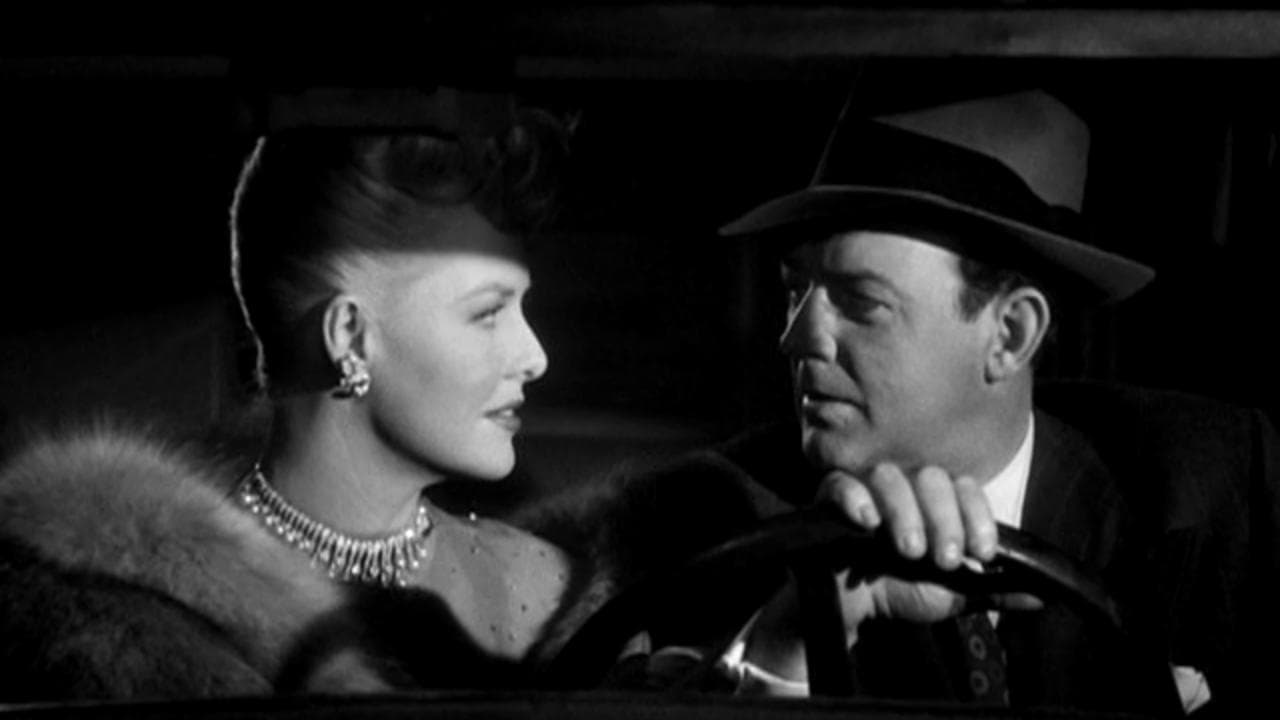
Burnett Guffey keeps the camera close on Tony inside the parked car, the windshield functioning as a proscenium through which the murder occurs at a remove. Light is minimal and lateral – a smear of pale illumination from a distant road source that catches the glass without penetrating the interior, leaving Tony's face in a half-shadow that is less expressionist than practical, the darkness of a man who has chosen not to be present. The violence outside is rendered in partial glimpses, the frame withholding the full geometry of the act in the same way Tony withholds his testimony.
The scene establishes the film's governing logic: complicity through passivity. Tony does not participate in the murder and does not prevent it, and Guffey's framing insists on that middle position – the man in the car is neither innocent bystander nor agent, but something more compromised than either. The glass between Tony and the crime becomes the film's central metaphor, a barrier that protects nothing and proves nothing except the distance a person will maintain from his own conscience when desire is on the other side of the seat.
Burnett Guffey, who would go on to shoot In a Lonely Place and From Here to Eternity, was already a disciplined architectural thinker with shadow and confined space by the time he took Night Editor. Working on a short schedule and within Columbia's modest B-unit budgets, Guffey relies on controlled interior setups that use low-key source lighting – lamps, street light through venetian blinds, the naked bulb of a precinct room – to map moral condition onto physical space. Tony's domestic interiors are flat and adequately lit, the home rendered visually neutral to underscore its emotional insufficiency. The scenes with Jill pull the key light down and harden the shadows, not to romanticize but to implicate. There is no beauty in these moments, only a kind of tonal gravity. Guffey avoids wide establishing shots in the film's tensest passages, keeping focal lengths tight enough to deny characters the context of their surroundings – a technique that isolates each figure inside their own poor decision.
Night Editor has circulated on Tubi as part of its classic Columbia holdings; verify current availability as catalogue titles rotate.
Archive.orgFreeA public domain print is available on Archive.org – quality varies but the film is complete and freely streamable.
KanopyFree via LibraryKanopy occasionally carries Columbia B-titles of this era through library partnerships; check with your local library card.