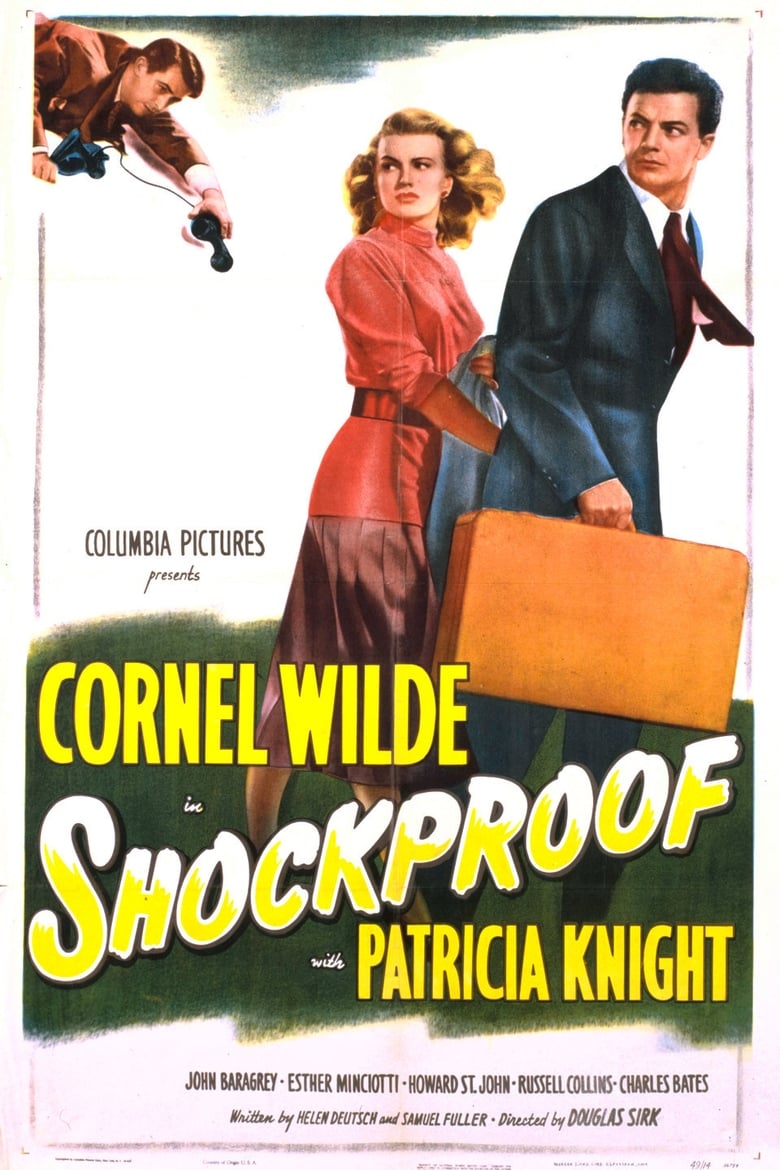
Griff Marat is a Los Angeles parole officer with a reputation for straight dealing and a blind spot for the work he believes in. When Jenny Marsh is released from prison after serving time for the murder of a man who had wronged her, Griff is assigned her case. She is guarded, quietly defiant, and already moving toward the margins of the city where the old life waits. Griff sees something he cannot name and makes a decision he cannot easily justify.
Jenny's former associate Harry Wesson reappears – slick, patient, and certain she will come back to him – and the pull he exerts is not merely criminal but emotional. Griff, meanwhile, begins to cross lines that his position and his judgment forbid: he installs Jenny in his mother's house, finds her work, watches her more closely than the law requires. His mother, Mrs. Marat, reads the situation with clear eyes. The balance of power between Griff and Jenny shifts in ways neither fully controls, and what began as a professional obligation tilts toward something that institutional authority cannot contain.
Shockproof works along the fault line that American noir returns to repeatedly: the question of whether character is fixed or can be remade, and what it costs to believe that it can. Sirk, working within Columbia's constraints, turns a rehabilitation narrative into a study of professional integrity collapsing under personal pressure. The film is less interested in crime as event than in crime as consequence – of self-deception, of desire that outruns judgment, and of a system that leaves its subjects very little room to change.
Shockproof occupies an instructive middle position in Douglas Sirk's American career – after his early Columbia programmers, before the Universal melodramas that secured his later reputation. The script, by Samuel Fuller and Helen Deutsch, carries Fuller's blunt moral arithmetic but is softened at the studio's insistence into something more equivocal. Sirk works within that tension productively. The film's real subject is institutional authority and its discontents: Griff Marat is not a corrupt man corrupted further but a principled man whose principles are revealed as self-interest in formal dress. Patricia Knight, then Wilde's wife, brings a specific opacity to Jenny – she is neither the grateful rehabilitant nor the scheming femme fatale the genre defaults to, but someone genuinely uncertain which way she will fall. What Shockproof reveals about its era is the postwar American anxiety about rehabilitation itself: whether forgiveness is a social mechanism or a personal risk, and who pays when the calculation fails.
– Classic Noir
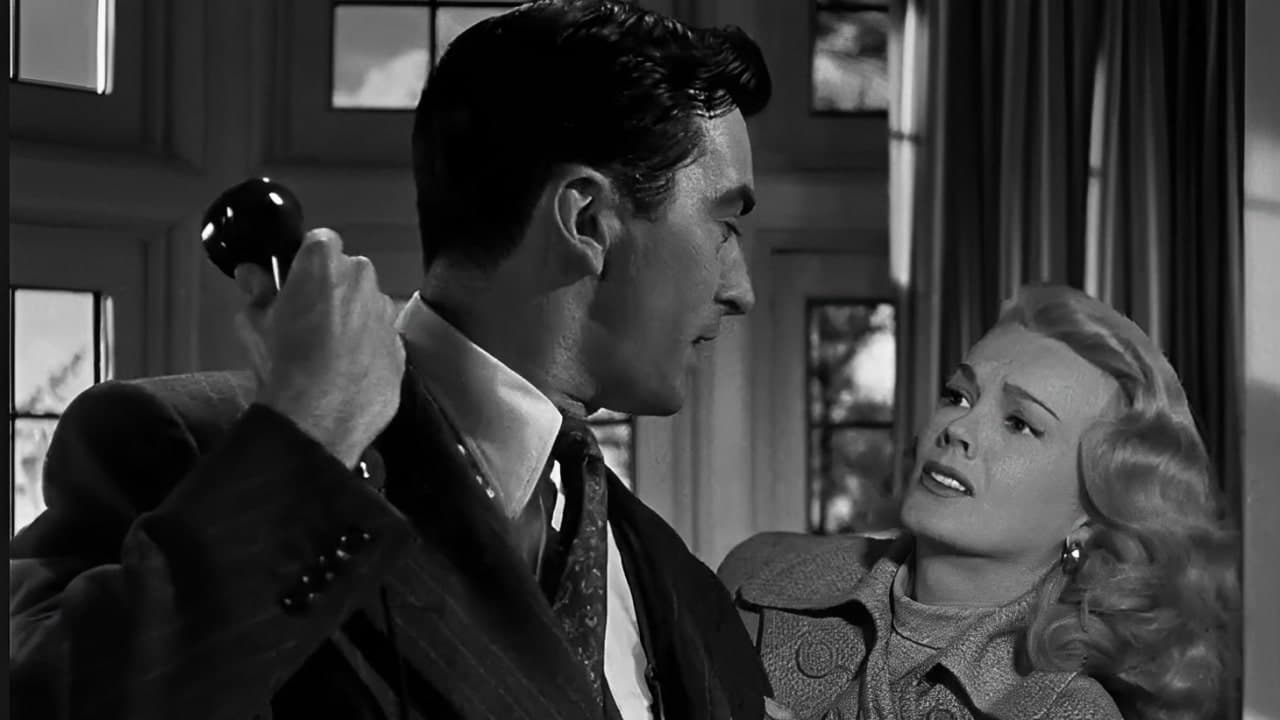
Sirk and Lawton stage the scene with the camera low and close, the kitchen's overhead practical casting a hard cone of light onto the table between Griff and Jenny. The frame is divided by shadow with deliberate geometry: Griff in partial light, Jenny at the edge of darkness, the composition refusing to settle either figure into full visibility. Lawton does not move the camera; the tension is carried by what the frame withholds rather than what it shows.
The scene makes the film's central argument in spatial terms. Griff occupies the institutional light – the world of records, responsibilities, and visible accountability – while Jenny inhabits the penumbra where motives remain unverified. The distance between them across the table is not romantic hesitation but moral uncertainty, and Sirk uses the geometry of the room to suggest that crossing it is not a gesture of love so much as a resignation from one way of understanding the world.
Charles Lawton Jr. was a reliable craftsman at Columbia who rarely received the critical attention given to the studio's higher-profile productions, but his work on Shockproof is precise in its moral calibration. Shooting largely on studio sets, Lawton constructs a Los Angeles of controlled shadows and narrow pools of light – the geography of a city where movement is surveilled and space is conditional. His lighting setups favor hard single-source arrangements that produce stark shadows without expressionist excess, keeping the film grounded in a recognizable urban realism while sustaining the genre's characteristic moral ambiguity. Exterior sequences, including the film's late-picture flight, are handled with a newsreel flatness that deliberately undercuts the melodramatic momentum Sirk is building – the world outside looks indifferent rather than threatening, which is its own kind of menace. Lawton's lens choices stay conservative, resisting wide-angle distortion in favor of a compressed middle distance that keeps characters pressed together even when the story pulls them apart.
The most likely home for a curated presentation of Sirk's Columbia-era work; check current availability as rights rotate.
TCMSubscriptionTCM periodically airs Shockproof in the context of Sirk retrospectives or Cornel Wilde showcases; scheduling is irregular.
Archive.orgFreePublic domain prints have circulated on Archive.org; image quality is variable and should be treated as a last resort.