Films People Pull a Fast One Night Beat Reading Room On TV Shop
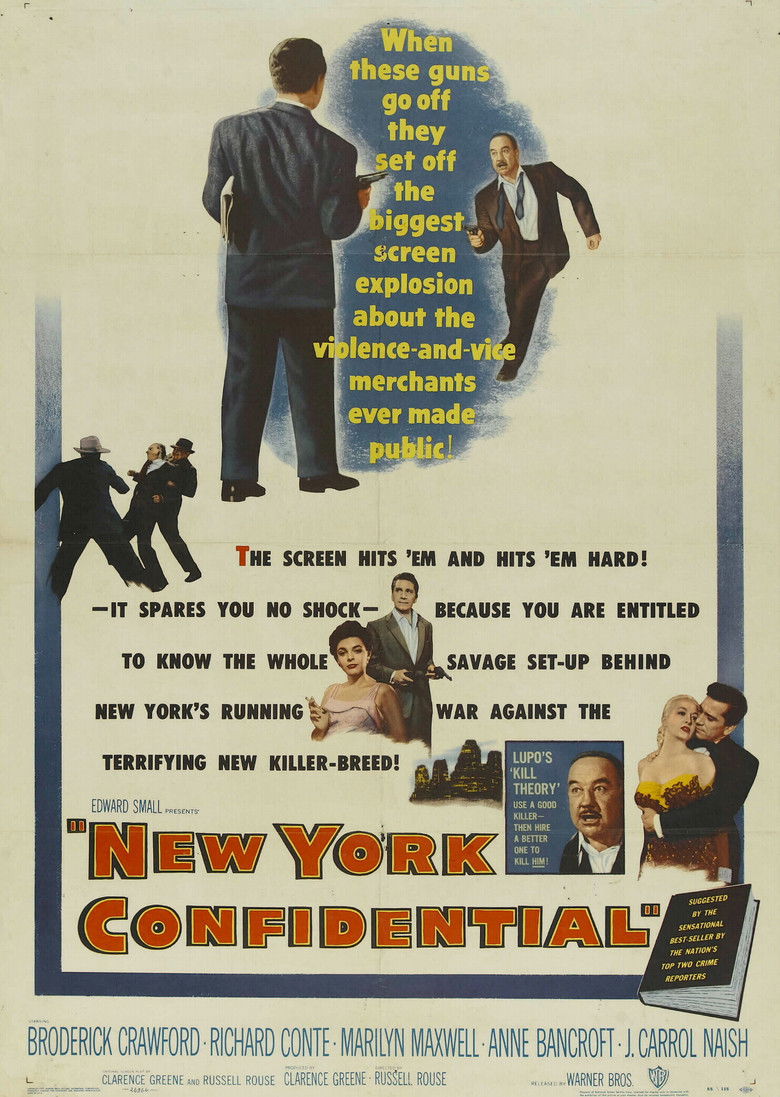
New York Confidential 1955
1955 Edward Small Productions
★★★☆☆ Notable
Film Noir · 87 minutes · Black & White

New York Confidential

Directed by Russell Rouse
Year 1955
Runtime 87 min
Studio Edward Small Productions
TMDB 6.0 / 10
"When the syndicate runs the city, loyalty is just another commodity with a price."

In postwar New York, Charlie Lupo operates as the respectable face of a national crime syndicate, conducting murder-for-hire through boardroom protocol and coded telephone calls. His organization functions with the cold efficiency of a corporation, and Lupo himself projects the manner of a legitimate businessman – until the syndicate's distant directors require a killing he cannot sanction without personal cost. Into this world arrives Nick Magellan, a professional assassin of precise habits and no visible conscience, hired to carry out the syndicate's contracts with surgical detachment.

Magellan is drawn into the Lupo household, where Charlie's daughter Kathy watches the men around her with a clarity neither her father nor his employers possess. Iris Palmer, Lupo's mistress and a woman who has long understood the transactional nature of her position, moves through the film as a figure who has made her peace with the world she inhabits. When a contract implicates Lupo's own circle, the syndicate's impersonal machinery turns inward, and Magellan finds himself at the intersection of professional obligation and something approaching human feeling.

New York Confidential belongs to the cycle of mid-1950s syndicate pictures that treat organized crime as a bureaucratic apparatus rather than a realm of operatic violence – a lineage running from the Kefauver hearings directly onto the screen. Russell Rouse frames the story less as a thriller than as a procedural study in institutional loyalty and its limits, positioning Magellan and Lupo as two men defined entirely by a system that has no use for sentiment.
Classic Noir

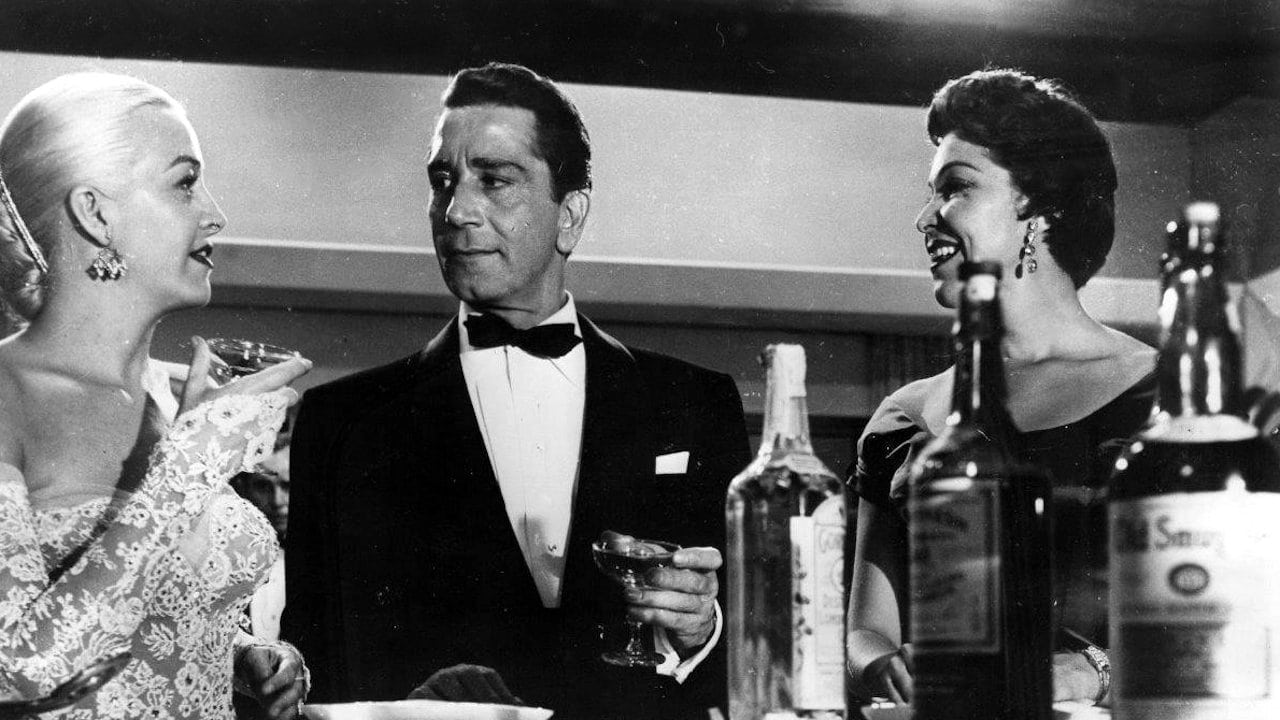
New York Confidential arrives in the immediate wake of the Kefauver Committee hearings and belongs to a specific strand of noir that treats the American underworld as a mirror of legitimate corporate culture. Russell Rouse, working from a screenplay he co-wrote with Clarence Greene, drains the material of romantic glamour: the syndicate here is a filing cabinet, a telephone, a vote taken in a back room. Broderick Crawford, whose bulk carries an almost geological weariness, plays Lupo not as a villain but as a middle manager trapped between his principals and his conscience. Richard Conte's Magellan is the film's cold center – competent, quiet, and without illusion. Anne Bancroft, in a role that the film does not fully use, brings an intelligence to Kathy that sharpens every scene she enters. The picture's argument – that the organization will always consume the individual – is made without melodrama, which in 1955 was itself a kind of moral statement. The film is not flawless, but it is honest about what it is examining.

– Classic Noir
3 ★★★☆☆ Notable
Credits

The Crew

DirectorRussell Rouse
ScreenplayRussell Rouse
CinematographyEddie Fitzgerald
MusicJoseph Mullendore
EditingGrant Whytock
CostumesErnest Newman
ProducerClarence Greene
Performances

The Cast

Close Reading

The Signature Scene

New York Confidential – scene
The Syndicate Boardroom Men Voting on Death

Rouse and cinematographer Eddie Fitzgerald frame the syndicate council as a long table in shallow focus, faces at the far end receding into a controlled grey haze. The camera holds at a slight remove, refusing close-ups that might individualize the participants, so that the men voting on a contract killing read as a collective rather than a collection of characters. Light falls flat and even, the bureaucratic opposite of the expressionist shadow that the genre usually deploys for moral weight. A telephone sits at the table's center, lit as though it were the room's only source of authority.

The scene strips assassination of its drama and relocates it inside routine procedure, which is precisely the film's thesis. By photographing murder as administration, Rouse argues that the syndicate's real horror is not its violence but its normality – the ease with which men in suits ratify death and return to their coffee. For Magellan, who watches this process and participates in it, the scene establishes the moral environment he has chosen, and against which any later hesitation must be measured.

Visual Language

The Cinematography

🎞️
Eddie Fitzgerald – Director of Photography

Eddie Fitzgerald's photography resists the deep-shadow expressionism that 1940s noir had made familiar, and the choice is deliberate. New York Confidential is lit for a world of offices and conference rooms, where fluorescent logic has replaced the pooled streetlamp as the dominant source. Fitzgerald favors middle-grey tonal ranges and compositions that suggest surveillance rather than poetry – the camera positioned as though documenting rather than dramatizing. Exteriors, mostly shot on location in Manhattan, carry a newsreel flatness that reinforces the syndicate-as-corporation conceit; the city is not menacing so much as indifferent. Interior framings use modest wide-angle coverage that keeps multiple figures in roughly equal focus, preventing the isolation of any single moral protagonist. Shadow, when it appears, falls on objects as often as on faces – a filing cabinet, a telephone receiver, the edge of a desk – directing the eye toward institutional apparatus rather than individual guilt. The visual grammar throughout serves Rouse's argument that crime at this scale is a matter of systems, not of souls.

In the Catalogue

Themes & Motifs

Availability

Where to Watch

Also in the Directory

See Also