Films People Pull a Fast One Night Beat Reading Room On TV Shop
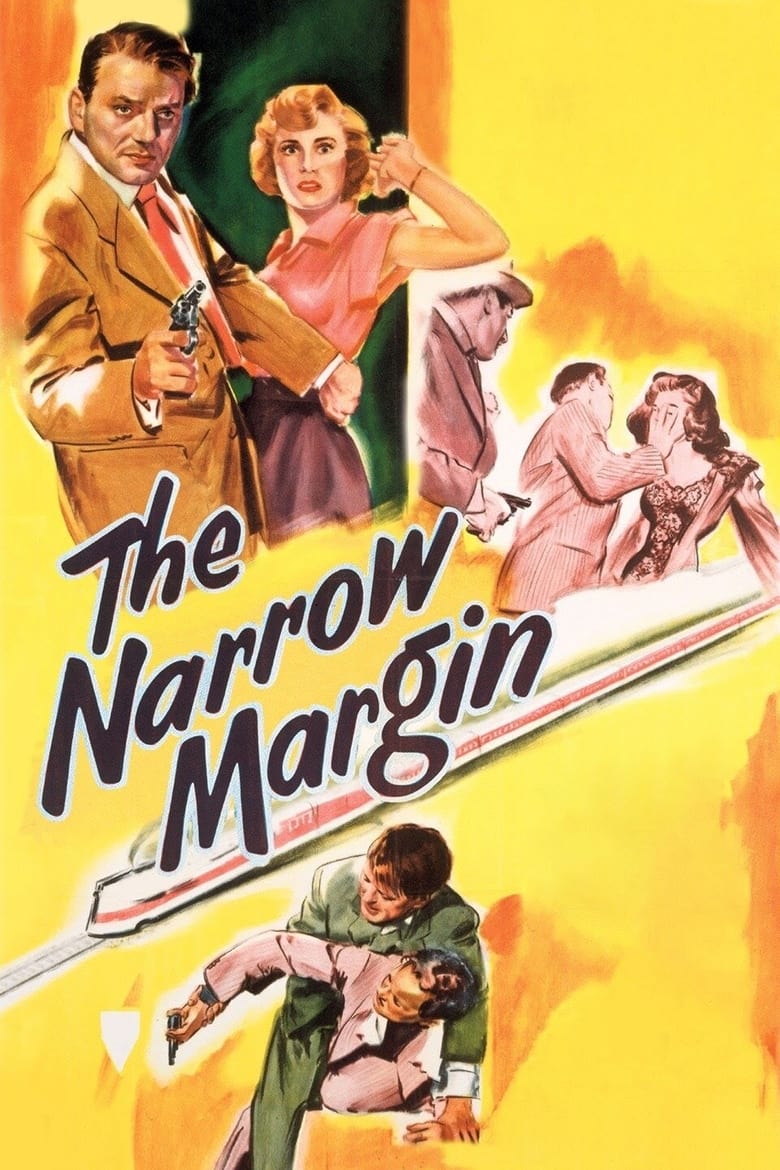
Narrow Margin 1952
1952 RKO Radio Pictures
★★★★☆ Recommended
Film Noir · 72 minutes · Black & White

Narrow Margin

Directed by Richard Fleischer
Year 1952
Runtime 72 min
Studio RKO Radio Pictures
TMDB 7.3 / 10
"A witness, a train, and no way off before the end of the line."

Los Angeles detective Walter Brown and his partner Gus Forbes are assigned to escort Mrs. Frankie Neall, the widow of a syndicate bookkeeper, from Chicago back to Los Angeles, where she is to testify before a grand jury. The assignment is unglamorous and Brown resents it. Before they even reach Mrs. Neall's rooming house, Forbes is shot dead in the stairwell, and Brown finds himself alone, responsible for a woman he dislikes, on a cross-country train with killers already aboard.

Confined to the narrow corridors and compartments of the moving train, Brown must keep Mrs. Neall hidden while identifying which passengers are syndicate gunmen and which are simply travelers. He strikes up a cautious acquaintance with Ann Sinclair, a calm and self-possessed widow traveling with her young son Tommy. The killers, meanwhile, apply pressure through intermediaries, offering Brown a bribe to give up Mrs. Neall's location. As the train closes on Los Angeles, the question of who can be trusted – and who already knows too much – becomes the film's central tension.

Narrow Margin works as a nearly pure example of the confined-space thriller, a form that noir adapted from the theatrical tradition and pushed toward its mechanical limit. The film's moral stakes are straightforward on the surface – a cop doing his duty, criminals trying to stop him – but the screenplay quietly undermines that clarity, using the claustrophobic setting to ask how long a person can sustain principle under sustained, intimate pressure. The resolution arrives not as triumph but as a correction of the frame.

Classic Noir

Narrow Margin is lean to the point of severity: seventy-two minutes, one location for nearly all of its running time, and a budget that left director Richard Fleischer with almost nothing to spend on spectacle. What remains is craft under constraint, and the film is more interesting for it. Fleischer uses the train's physical geometry – corridors wide enough for one person, compartment doors that open inward, windows that show only darkness – as a precise correlative for the detective's narrowing options. Charles McGraw, whose voice alone could carry a scene, plays Brown without warmth or concession; he is not a hero who rises to the occasion so much as a professional who refuses to fail. Marie Windsor, cast against the expectation that her character will be worth protecting, brings exactly the right quality of calculated exposure to Mrs. Neall. The film belongs to RKO's cycle of tightly budgeted, procedurally minded noirs, a cycle that understood economy as a formal discipline rather than a limitation. Its twist is less a surprise than a structural argument about the nature of duty.

– Classic Noir
4 ★★★★☆ Recommended
Credits

The Crew

DirectorRichard Fleischer
ScreenplayEarl Felton
CinematographyGeorge E. Diskant
EditingRobert Swink
Art DirectionAlbert S. D'Agostino
CostumesAdele Balkan
ProducerStanley Rubin
Performances

The Cast

Close Reading

The Signature Scene

Narrow Margin – scene
Corridor Confrontation Two Men, One Passage

The camera holds in a low, tight position in the train corridor, compressing the available depth until the two walls seem to press inward against McGraw's shoulders. George Diskant shoots with a wide lens at close range, which stretches the receding perspective behind Brown while keeping his face in unsparing focus. Light comes from the overhead strip fixtures standard to Pullman cars, harsh and directionless, leaving no shadow for either man to use as cover. When the gunman advances, Fleischer does not cut away; the frame holds, and the geometry itself becomes the threat.

The scene distills the film's central argument: that in a space this confined, neither courage nor cunning provides much advantage, and survival is largely a matter of who flinches first. Brown's position – physically, morally – is the same throughout the film. He has nowhere to retreat to and no angle from which to approach the problem obliquely. The corridor sequence makes that condition literal, and the fact that Brown walks away from it unchanged, neither shaken nor emboldened, is the film's quiet insistence that duty is not the same as drama.

Visual Language

The Cinematography

🎞️
George E. Diskant – Director of Photography

George Diskant's cinematography on Narrow Margin is a study in working within imposed limits and finding that those limits clarify rather than diminish. Shooting on constructed train sets at RKO, Diskant had no access to the wide establishing compositions that location work might have provided, and he turned this to advantage. He favored short focal lengths in close quarters to exaggerate depth and compress lateral space, making the train feel simultaneously endless in length and impossible in width. His lighting setup rejects the expressionist pools of shadow common to the period in favor of the flat, institutional fluorescence of transit spaces – an unglamorous choice that keeps the film honest about its environment. Faces are lit without flattery. The effect is procedural rather than atmospheric, which suits a film whose protagonist operates on procedure alone. Diskant's work here, as on earlier noirs including Roadblock and Kansas City Confidential, demonstrates a consistent understanding that visual style in noir is not decoration but argument: the way a frame is built tells you something about the world the characters are trapped inside.

In the Catalogue

Themes & Motifs

Availability

Where to Watch

Also in the Directory

See Also