Detective Sergeant Steve O'Malley is assigned to investigate the death of a man whose wife, Lilly Richards, stands to collect on a substantial insurance policy. The case appears straightforward until O'Malley encounters Joyce Fitzgerald, a young woman with her own reasons for interest in the deceased, and Warren Richards, a husband whose grief seems calibrated rather than felt. The small-time world O'Malley moves through – bars, modest apartments, the margins of respectable life – is one where money is always the motive and loyalty is always for sale.
As O'Malley digs deeper, the figure of Joe Martola, known as Candy, surfaces with the kind of history that puts him at the intersection of every dirty transaction in the case. Allegiances between the principals shift as the investigation reveals that the victim's death was not the first crime committed in this circle, nor likely to be the last. Joyce, positioned between O'Malley's questions and the danger represented by Martola, becomes both a source of information and a liability the detective cannot afford to ignore.
Murder Without Tears operates within the tight economy of the B-noir procedural, where the detective's persistence substitutes for complexity and the moral architecture is clear even when the facts are not. The film belongs to a cycle of early-1950s independent productions that treated crime not as aberration but as the ordinary underside of postwar domestic life – insurance fraud, marital deception, and casual violence arranged around the furniture of the everyday.
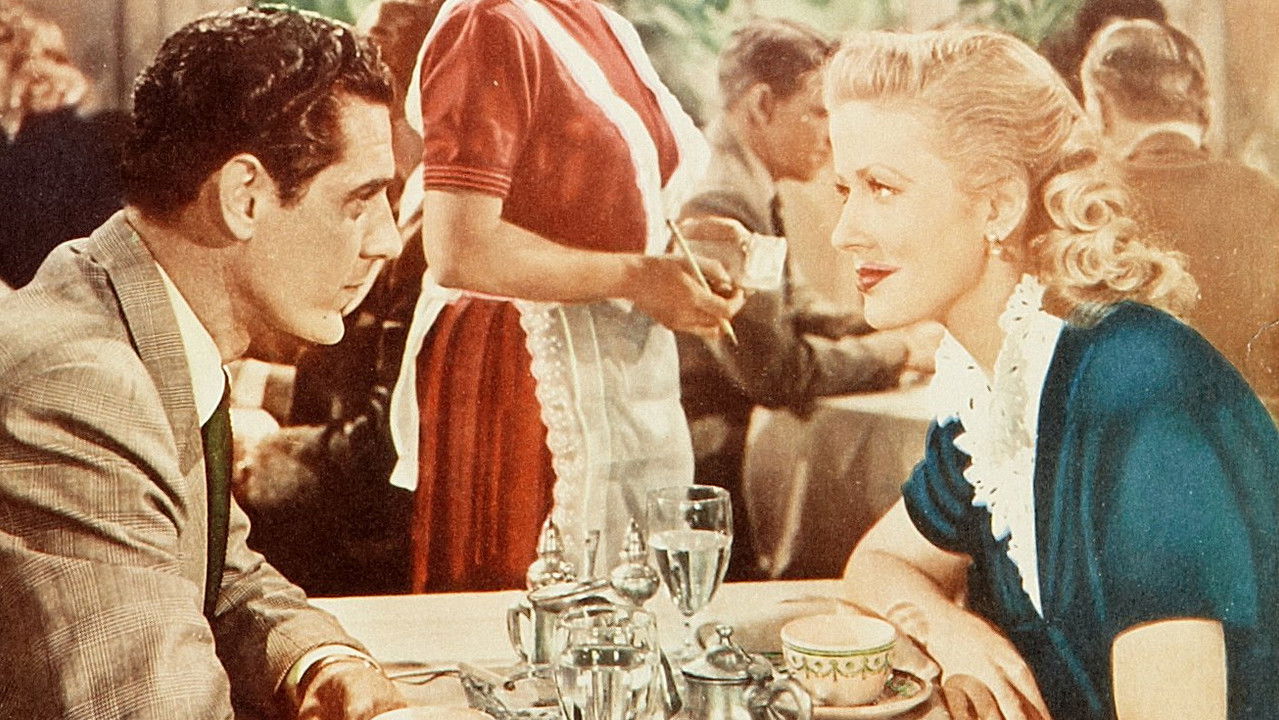
Murder Without Tears is a minor but serviceable entry in the B-noir cycle that flourished under independent producers like William F. Broidy in the early 1950s. At 65 minutes it makes no claim to ambition it cannot support, and director William Beaudine – a figure of industrial prolificacy whose output ranged from poverty-row westerns to horror programmers – here exercises the same functional competence that defined his best journeyman work. Craig Stevens, a year before Perry Mason would define him on television, carries O'Malley with a measured authority that the film does not always earn through its writing. Richard Benedict's Candy Martola is the more interesting performance: a supporting menace who suggests a genuine criminal psychology within a very limited screen economy. The film is most useful now as a sociological document – its insurance-fraud premise, its distrust of domestic surfaces, and its refusal of sentimentality around the female lead reflect a postwar moment in which American crime fiction was systematically dismantling the pretense of middle-class safety. It does not transcend its budget, but it does not embarrass it either.
– Classic Noir
The camera holds at a medium distance as Martola enters the bar, Virgil Miller allowing the practical light from the back bar to carve the actor's face into planes of highlight and shadow. The foreground is soft and dark; Martola walks into definition rather than being introduced by it. Jim the bartender occupies the right edge of the frame, a compositional anchor that keeps the space from collapsing into pure menace – the ordinary world holds its position even as something threatening moves through it.
The scene does the work that the script needs without announcing itself. Martola's ease in the space – his ownership of the light, his casual relationship with the bartender – establishes that the threat in this film is not external to the social fabric but woven into it. O'Malley, when he appears, must enter a room that already belongs to the wrong man, and the visual grammar of the shot has already told us that before a word is spoken.
Virgil Miller, whose career stretched back to silent-era cinematography, brings to Murder Without Tears the disciplined low-key approach that defined the B-noir house style without the expressive excess of the A-picture. Working within the constraints of an independent production – studio interiors, limited locations, minimal lighting rigs – Miller relies on hard single-source light to do the moral geometry of the genre: faces are seldom evenly lit, and the space behind characters tends toward undifferentiated black. Lens choices stay conservative, with the occasional close-up used not for psychological intensity but for information, cutting in when the script requires certainty rather than atmosphere. The result is a visual language that is functional rather than lyrical, which suits a film whose argument is essentially procedural. Shadow work in the bar and apartment sequences is the most accomplished element, using the angle of practical sources to suggest a world in which the light has retreated to the corners and left the center of domestic life in ambiguity.
As a public domain title, this film is available for free streaming and download on Archive.org, making it the most accessible option for most viewers.
TubiFreeTubi periodically carries public domain B-noir titles of this era; availability may vary but is worth checking as a free ad-supported option.
Amazon Prime VideoSubscriptionBudget noir titles from independent 1950s productions occasionally appear in Prime's free-with-subscription catalog, though availability should be verified.