Casey Martin (Frank Lovejoy) is a small-time hood who cuts a deal with federal agents: testify against the syndicate that employs him, and walk away clean. It is not a heroic decision. It is a calculation, made by a man who has looked at the odds and chosen survival. The federal contact, Jim Rogers (William F. Leicester), wants the organization dismantled from the inside, and Martin is the instrument available. Dutch Becker (Forrest Tucker), the syndicate's regional enforcer, is the primary target – a man whose authority rests on the credible promise of violence.
Martin's position becomes untenable almost immediately. His cooperation with the government is a secret that cannot hold indefinitely, and the syndicate operates on suspicion as much as evidence. Gladys Baker (Peggie Castle) enters as a woman whose loyalties are divided between genuine feeling and the pragmatic instinct for self-preservation that the criminal world demands. Lou Terpe (Timothy Carey), Becker's enforcer, provides the film's most unsettling presence – a man for whom violence is not a tool but a disposition. The allegiances around Martin shift, and his informant role places him in the precise position of danger he was trying to escape.
Finger Man belongs to a cycle of mid-1950s crime films that approached the informant figure with neither contempt nor celebration, recognising the moral ambiguity built into a system that requires betrayal as a mechanism of law. The film works within the conventions of the B-crime picture – compressed runtime, limited locations, functional dialogue – while using those constraints to maintain a low, sustained pressure that more expensive productions sometimes dissipate.
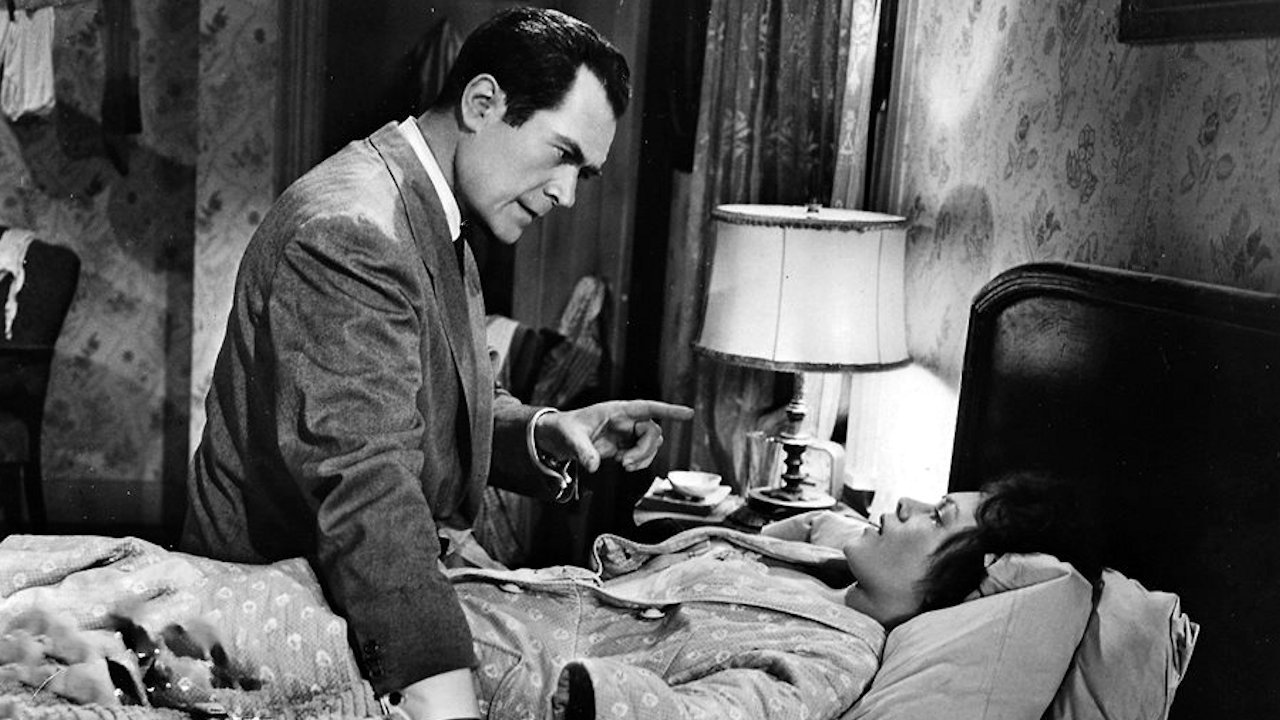
Finger Man arrives in 1955, at the moment when the syndicate film had become its own identifiable subgenre – shaped partly by the Kefauver hearings of the early 1950s, which had placed organised crime on television and made it legible to a mass audience as a systemic rather than individual problem. Harold D. Schuster's direction is economical without being anonymous; he understands that the informant narrative generates tension not through action but through the sustained uncertainty of who knows what. Frank Lovejoy brings the same compressed, watchful quality he carried through several strong noir performances, and his Martin reads as a man constitutionally unsuited to trust yet forced to extend it. The significant element is Timothy Carey, whose Lou Terpe anticipates the kind of feral, barely contained menace Carey would continue to project through the decade. The film does not resolve its central moral question cleanly, which is precisely what keeps it relevant as a document of an era when civic cooperation and personal survival were framed as compatible – and often were not.
– Classic Noir
The camera holds at a low angle as Terpe enters a partially lit warehouse space, the light source positioned high and to one side so that his figure casts a long diagonal shadow across the concrete floor before he is fully in frame. William A. Sickner keeps the background deliberately underexposed, flattening the depth so that the space reads as airless and bounded. Martin is positioned against a structural column, and the editing cuts between his face – in a tight, neutral medium close-up – and Terpe's approach, which the camera renders as unhurried and therefore more threatening than speed would allow.
The scene externalises the film's core argument about power: Terpe does not need to raise his voice because the architecture of the situation has already done the work. Martin's informant status has placed him in a position where institutional protection is abstract and the physical threat is immediate. Sickner's framing denies Martin any compositional escape – the column behind him, the shadow in front, the frame edge on either side. It is a visual statement about the limits of the deal he has made.
William A. Sickner shoots Finger Man with the disciplined pragmatism of a cinematographer who had spent years working within the tight budgets and schedules of independent and B-unit production. The lighting setups favour hard, directional sources – single key lights that produce strong shadow geometry on faces and locations alike – rather than the diffused, graduated work that larger studio productions could afford. This is not a deficiency; the harshness suits the film's moral register. Sickner uses deep focus sparingly, preferring to restrict depth and confine the viewer to the immediate spatial situation of the characters. Interior locations, which dominate the film, are treated as oppressive rather than neutral: low ceilings, narrow corridors, and windows that admit light without providing egress. The visual language consistently reinforces the narrative logic of entrapment – every room Martin enters reads, through the lens, as a room he may not be able to leave. The result is a film whose cinematography does not call attention to itself but performs its function with precision.
Tubi has carried a number of Allied Artists and independent B-crime titles from this period; check current availability as catalogues shift.
Archive.orgFreePublic domain status makes Archive.org a reliable fallback for mid-1950s independent productions of this kind, though print quality varies.
Amazon Prime VideoSubscriptionPrime's rotating catalogue of classic crime films occasionally includes Allied Artists titles; availability should be confirmed at time of viewing.