Films People Pull a Fast One Night Beat Reading Room On TV Shop
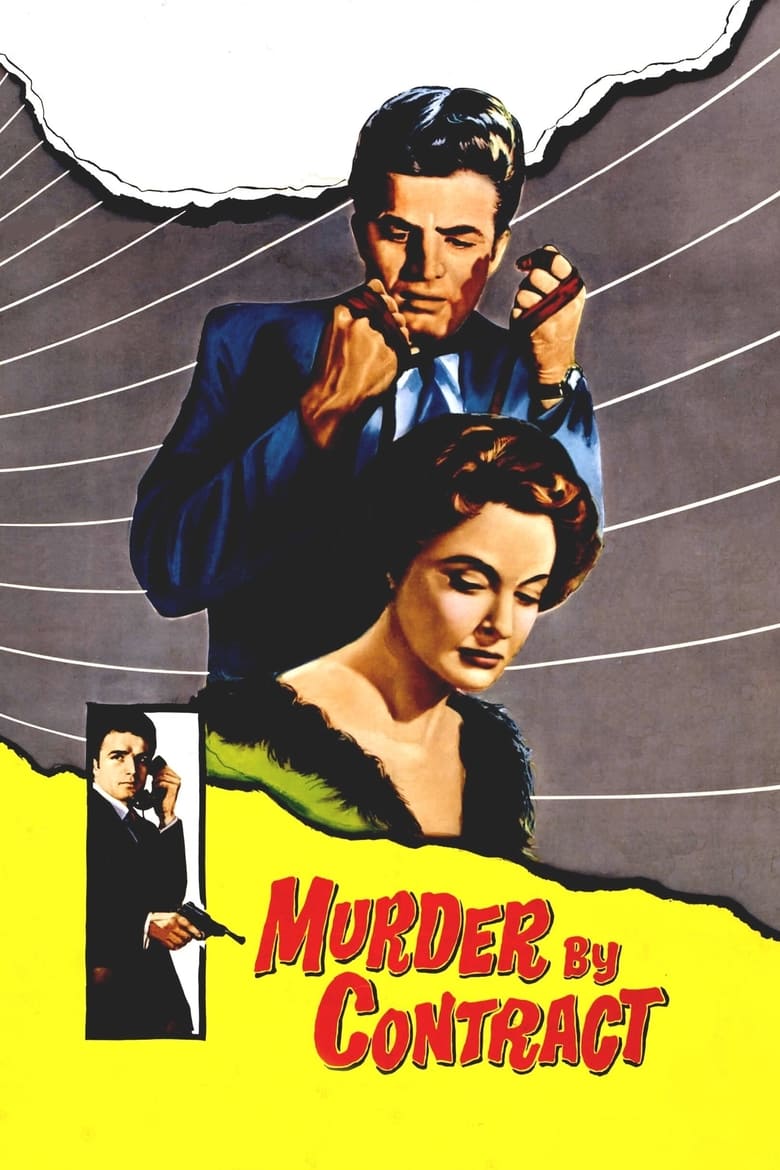
Murder by Contract 1958
1958 Orbit Productions
★★★☆☆ Notable
Film Noir · 81 minutes · Black & White

Murder by Contract

Directed by Irving Lerner
Year 1958
Runtime 81 min
Studio Orbit Productions
TMDB 6.8 / 10
"A man reduces killing to routine, then discovers the one variable he cannot calculate."

Claude is a young man of deliberate ambition and no apparent conscience. He takes a series of menial jobs, saves his money with monastic discipline, and eventually approaches a criminal organization with a proposition: he will kill for hire. After proving himself with two efficient, uncomplicated contracts, he is assigned to Los Angeles in the company of two low-level syndicate handlers, Marc and George, who are there to manage logistics and keep him on schedule.

The target is Billie Williams, a witness scheduled to testify against a syndicate figure. The complication is that she is a woman – a fact Claude receives as a professional objection rather than a moral one. He claims women are unpredictable, that they disturb the clean geometry of his method. Marc and George grow restless as Claude stalls, fills his waiting hours with guitar playing and long swims, and refuses to be hurried. The tension between the three men tightens into something close to mutual contempt, and the handler-asset relationship inverts.

Murder by Contract belongs to a strain of late-1950s noir concerned less with crime's violence than with its bureaucratic logic – the hitman as a study in professional detachment pushed to its limit. Lerner frames Claude's psychology as a kind of American pathology: the self-made man stripped of every motive except self-interest, moving through a sun-bleached Los Angeles that refuses to cooperate with his need for clean lines and predictable outcomes.
Classic Noir

Murder by Contract arrived in 1958 at the tail end of classical noir, and its spareness reads less like poverty of means than like a considered aesthetic position. Shot in under two weeks on a minimal budget, Irving Lerner's film anticipates the European hitman pictures of the following decade – Melville's Le Samouraï in particular – in its portrait of a killer whose professionalism is both his identity and his undoing. Vince Edwards plays Claude with a flat, unhurried quality that keeps the character consistently unsettling: there is no menace in the conventional sense, only a vacancy where feeling should be. Perry Botkin Sr.'s guitar score, often cited as the film's most distinctive element, functions as an ironic counterpoint – lyrical, almost casual – against material that is anything but. Lucien Ballard's location photography drains Los Angeles of glamour, presenting it as a city of waiting rooms and empty afternoons. The film's central argument – that the market logic of postwar America finds its purest expression in a man who has monetized death – retains a cold relevance that its low-budget origins do nothing to diminish.

– Classic Noir
3 ★★★☆☆ Notable
Credits

The Crew

DirectorIrving Lerner
ScreenplayBen Maddow
CinematographyLucien Ballard
MusicPerry Botkin Sr.
EditingCarlo Lodato
Art DirectionJack Poplin
ProducerLeon Chooluck
Performances

The Cast

Close Reading

The Signature Scene

Murder by Contract – scene
The Swimming Pool Claude Adrift in Still Water

Ballard holds the camera at pool level, the frame nearly flat against the water's surface, so that Claude's floating body becomes a horizontal line bisecting the composition. The California light is bright and directionless – no shadows fall dramatically here, no venetian-blind geometry. The overexposure is deliberate: the scene is too open, too legible, a refusal of the noir visual grammar that would otherwise signal threat. Marc and George watch from the deck, their agitation making them the frame's restless elements while the man who is supposed to be doing a job drifts in apparent contentment.

The scene encodes the film's central tension without a word of dialogue. Claude's stillness is not rest; it is control asserted against the handlers' pressure, a demonstration that he operates on his own clock. But Lerner and Ballard also allow the image to suggest something else: a man who has achieved a kind of peace that is indistinguishable, from the outside, from emptiness. The pool sequence positions the audience to read Claude's detachment as either supreme competence or a symptom of whatever has been excised from his inner life – and the film declines to arbitrate between those readings.

Visual Language

The Cinematography

🎞️
Lucien Ballard – Director of Photography

Lucien Ballard, working here in the same year as his collaboration with Kubrick on Fear and Desire's follow-up projects, brings to Murder by Contract a visual strategy that inverts standard noir convention. Rather than using darkness as the film's primary moral register, Ballard shoots much of the Los Angeles location work in flat, indifferent daylight – a choice that refuses the genre's usual equation of shadow with danger. The effect is a kind of affectless brightness that suits Claude's psychology precisely: this is a world from which the chiaroscuro of guilt or consequence has been bleached away. Interior scenes use available-light approaches that flatten depth, keeping Claude at a social and perceptual distance from the other figures in the frame. Ballard's lens selection favors slight telephoto compression in the surveillance sequences, collapsing the space between hunter and hunted in a way that feels bureaucratic rather than predatory. The visual language throughout serves Lerner's thesis: that violence, rationalized into procedure, loses the texture that might make it visible as violence at all.

In the Catalogue

Themes & Motifs

Availability

Where to Watch

Also in the Directory

See Also