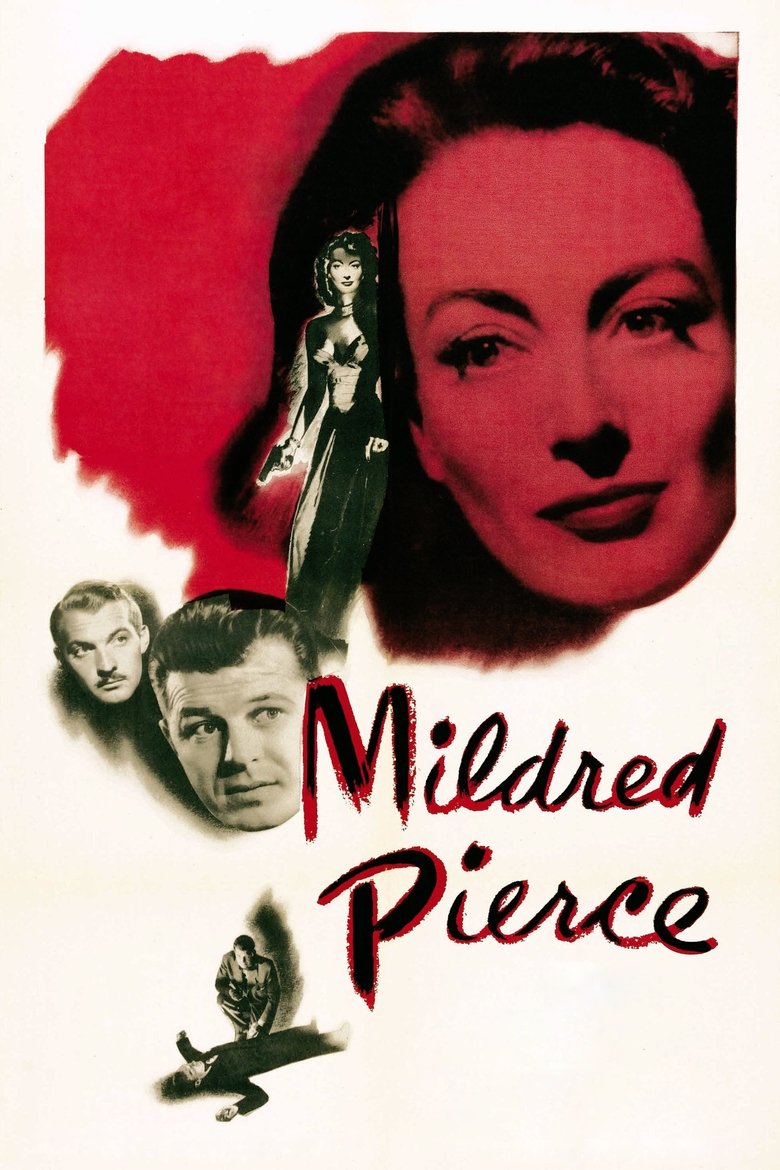
On a rain-soaked night in Malibu, a man is shot dead and a woman in a fur coat walks toward the sea. Mildred Pierce, a self-made restaurateur from Glendale, California, is brought in for questioning by Inspector Peterson. The body belongs to Monte Beragon, a charming, dissolute socialite whom Mildred has recently married. What follows is her account, told in flashback: the collapse of her first marriage to the steady but limited Bert Pierce, her years waiting tables to keep her household afloat, and her slow, determined ascent into business ownership.
Mildred's drive is inseparable from her devotion to her elder daughter Veda, a coldly ambitious young woman whose appetite for refinement and status Mildred can never quite satisfy. Around Mildred orbit Wally Fay, a glad-handing business associate with motives of his own, and Ida Corwin, her sardonic, loyal manager. When Monte enters Mildred's life as a partner and eventual husband, the arrangement serves everyone's interests until the boundaries between need, manipulation, and genuine feeling dissolve. Veda's contempt for her mother and her attraction to everything Mildred has purchased for her drive the film toward its violent resolution.
Adapted from James M. Cain's 1941 novel, the film grafts a murder investigation onto what is fundamentally a story about class anxiety, maternal obsession, and the cost of ambition in postwar America. Curtiz frames Mildred's rise and ruin within a flashback structure that positions every act of generosity as a step toward catastrophe, raising questions the genre handles with particular economy: who is responsible, who is complicit, and whether confession is ever the same thing as truth.
Mildred Pierce occupies an uncertain but productive position in the noir canon. It arrives wearing the genre's structural clothes – the murder framing device, the confessional flashback, the corrupt romantic entanglement – while its emotional core belongs to the maternal melodrama, a form Warner Bros. had been refining for over a decade. That tension is not a weakness. The film derives much of its intelligence from the friction between modes: Mildred is simultaneously the noir protagonist undone by a fatal attachment and the melodrama heroine punished for wanting too much. Joan Crawford's performance, her first at Warner Bros. after her MGM years, does not resolve that tension so much as inhabit it with controlled precision. Ann Blyth's Veda is one of the period's most unsettling supporting performances, less a character than an embodiment of the class resentment Mildred has inadvertently cultivated. The film is most honest about its era when it examines what upward mobility costs and who, inevitably, is made to pay.
– Classic Noir
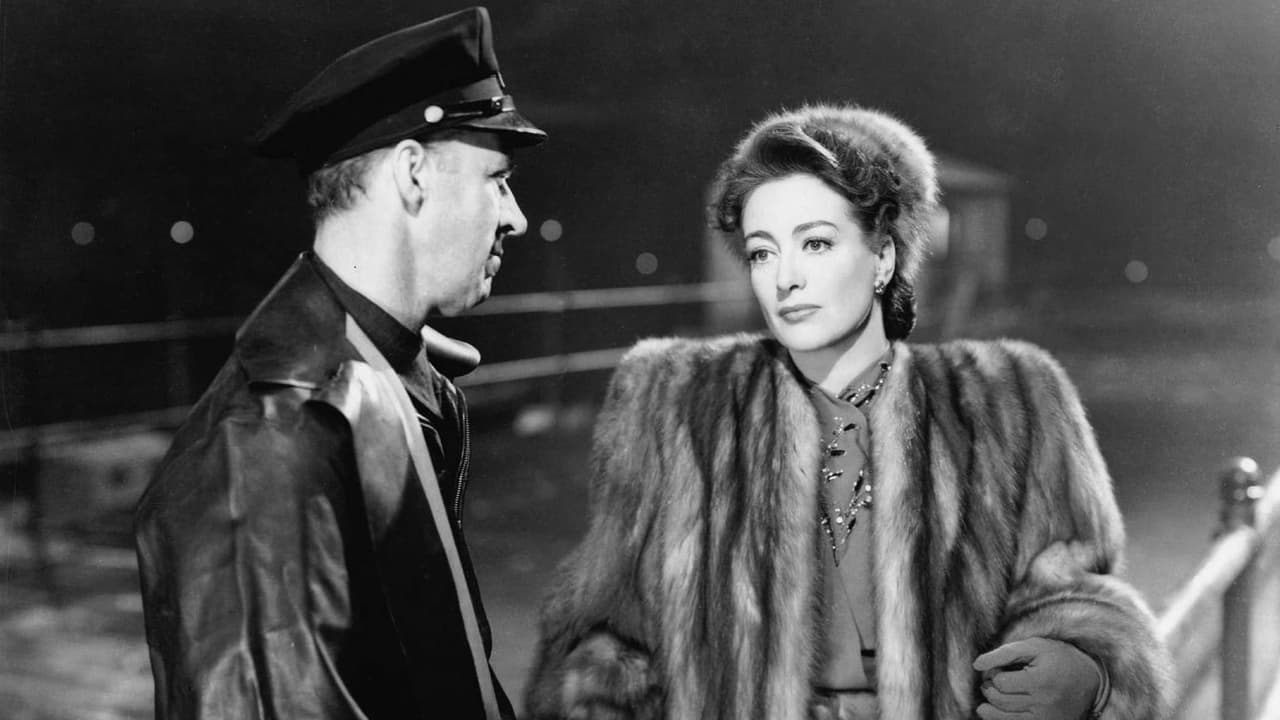
Ernest Haller opens the scene in near-total darkness, the Pacific invisible beyond the frame except as sound. The beach house interior is lit in hard, isolated pools – a lamp catching Crawford's face from below, the rest of the room receding into shadow. When Mildred steps onto the pier, Haller widens to a high angle, reducing her to a small figure against the flat black of the ocean. The rain diffuses what little ambient light exists, giving the frame a surface that feels both wet and airless.
The scene establishes, before a word is spoken, that Mildred has reached the end of a logic she set in motion herself. The high angle is not incidental: it positions her as diminished, the ocean indifferent behind her. What the film argues here is that the architecture of her ruin – the money, the marriage, the daughter – has led to this precise geometry of isolation. The confession that follows to Inspector Peterson is less a revelation than an admission of what the image has already declared.
Ernest Haller, whose work at Warner Bros. across the 1930s and 1940s encompassed both prestige pictures and genre films, brings to Mildred Pierce a lighting scheme that tracks the film's moral descent without announcing itself. He works primarily on studio-constructed sets, using that control to modulate shadow precisely: Glendale domesticity is shot with broader, flatter light; the Malibu beach house and the interrogation sequences contract into high-contrast pools that owe more to German expressionist influence than to social realism. Haller does not use deep focus as an ideological instrument the way Gregg Toland might; instead, his selective focus isolates faces and excludes context, which suits a film structured around unreliable memory. The restaurant interiors are lit to suggest aspiration – brighter, more ordered – while the spaces Veda inhabits are allowed to glamourize her with a cool, slightly cruel luminosity. The cinematography does not moralize but it does locate blame.
Available as part of the Warner Bros. classic library; the most straightforward streaming option for North American subscribers.
TCMSubscriptionTCM broadcasts the film periodically and streams it via the TCM app with the cable authentication required; presentation is typically from a clean archival print.
Criterion ChannelSubscriptionCheck current availability, as the film has appeared in Criterion Channel programming alongside curated noir and melodrama collections; licensing rotates.