Don Birnam (Ray Milland) is a failed writer living in a New York apartment with his devoted brother Wick (Phillip Terry) and sustained by the affection of Helen St. James (Jane Wyman), a woman who believes in a version of him he can no longer locate. As the film opens, the two brothers are preparing to leave the city for the country – a trip designed, though never spoken of plainly, to keep Don away from alcohol. Don engineers a reason to stay behind, and what follows is a four-day descent into the particular geography of addiction: the bars, the pawnshops, the borrowed time.
With Wick and Helen gone, Don moves through Manhattan in a state of controlled deterioration. Nat (Howard Da Silva), the bartender at his regular haunt, watches with the practiced neutrality of a man who has seen this before. Gloria (Doris Dowling), a taxi dancer who recognizes Don from the bar, offers a companionship rooted in her own damage. When Don is committed to the alcoholic ward at Bellevue, attended by the sardonic orderly Bim (Frank Faylen), the film strips away the last social protections and places its protagonist in a room where every man has the same story.
The Lost Weekend operates at the intersection of psychological study and moral fable, using the conventions of noir – the compromised protagonist, the city as antagonist, the irreversibility of bad choices – to examine a form of self-destruction that is entirely internal. There is no femme fatale, no crime to be solved; the trap is the man himself, and the film is methodical in refusing to sentimentalize that fact.
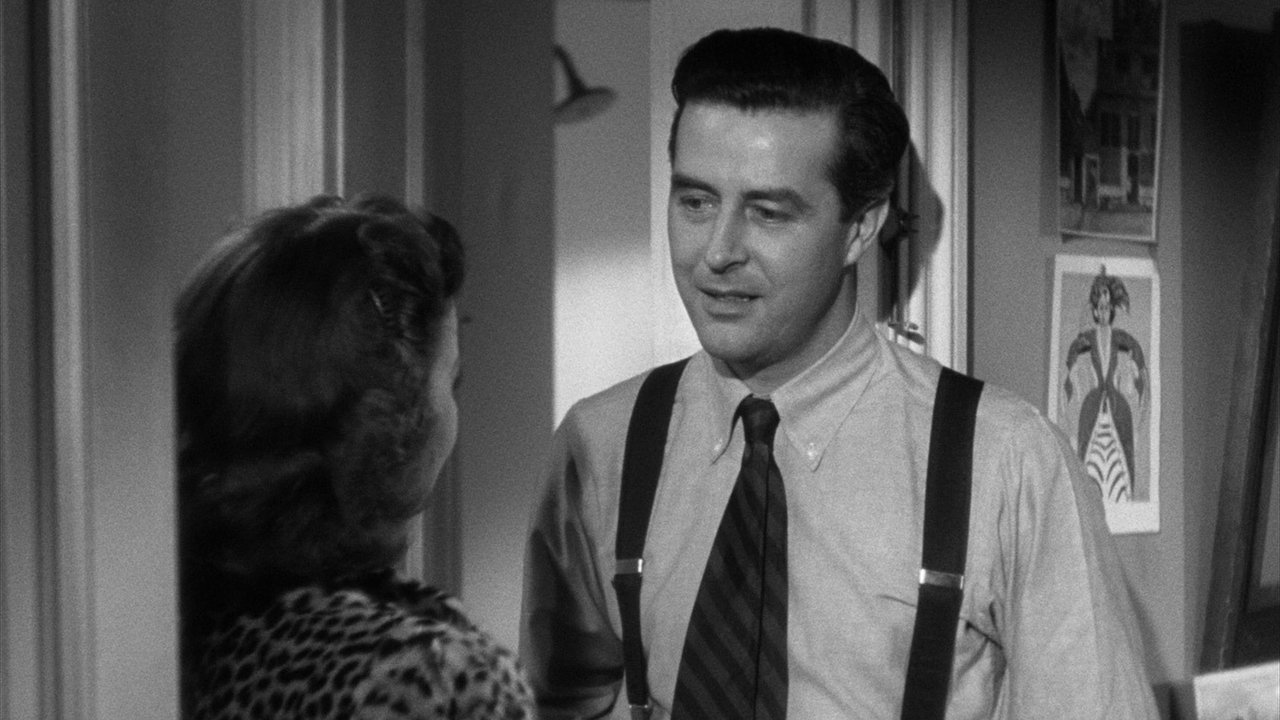
Billy Wilder's adaptation of Charles R. Jackson's 1944 novel arrived at a moment when Hollywood was beginning to permit a more clinical engagement with psychological disorder. The film is unusual in noir terms because it displaces the genre's characteristic external menace – the conspiracy, the corrupt system, the dangerous woman – onto the interior life of a single man. Don Birnam is not framed by circumstance; he is undone by desire and self-deception, and the film is honest about the distance between the two. Wilder and co-writer Charles Brackett refuse to provide a credible clinical explanation for Don's alcoholism, which was a deliberate structural choice: explanation would become excuse. What the film achieves is a portrait of a specific kind of educated, self-aware failure – a man who can describe his condition with precision and continue to choose it. That the film's ending remains contested among critics speaks to the tension Wilder built into every prior scene.
– Classic Noir
Cinematographer John F. Seitz shoots Don's trek up Third Avenue – searching for a pawnshop willing to take his typewriter on Yom Kippur – with a directness that refuses expressionist distortion. The camera tracks alongside Milland at street level, and Seitz shoots on location rather than studio reconstruction, embedding the character in the actual texture of the city. The light is flat and autumnal, offering none of the chiaroscuro shelter of the studio, and the framing keeps Don small within the street's visual clutter. The pawnshop gates, drawn one after another across the frame, function as a visual accumulation of closed doors.
The sequence makes an argument that is central to the film's moral logic: the city does not conspire against Don Birnam – it is simply indifferent. The shops are closed for a religious holiday; that is all. The mundane coincidence of timing is more pitiless than any engineered trap, and Milland's performance registers the specific exhaustion of a man who cannot decide whether his situation is tragic or merely absurd. The scene positions Don not as a victim of circumstance but as a man for whom ordinary life has become an obstacle course he lacks the resources to navigate.
John F. Seitz, who also shot Double Indemnity for Wilder the previous year, makes choices on The Lost Weekend that diverge deliberately from that film's polished noir geometry. Where Double Indemnity uses shadow as moral architecture, Seitz here favors a grayer, more documentary palette, particularly in the location work on Third Avenue and in the Bellevue sequences. The Bellevue ward is lit with an institutional flatness that removes the visual drama noir ordinarily provides as a form of glamour; the absence of strong shadow is itself a statement. In Don's apartment, Seitz uses deep focus to keep both foreground objects – the hidden whiskey bottles, the typewriter – and background figures in simultaneous legibility, so that the spatial geography of concealment is always visible to the audience even when characters cannot see it. The camera's relationship to Milland's face is close and unsparing, particularly during the delirium sequences, where Seitz employs distortion and superimposition not as stylistic ornament but as a precise index of cognitive disintegration.
Criterion's presentation includes supplementary material on Wilder and Seitz, making it the most contextually complete viewing option for serious study.
TCMSubscriptionTCM airs the film periodically in its original aspect ratio as part of themed programming; check the schedule for broadcast dates.
TubiFreeA free ad-supported option that has carried the film; availability may vary, so confirm before viewing.