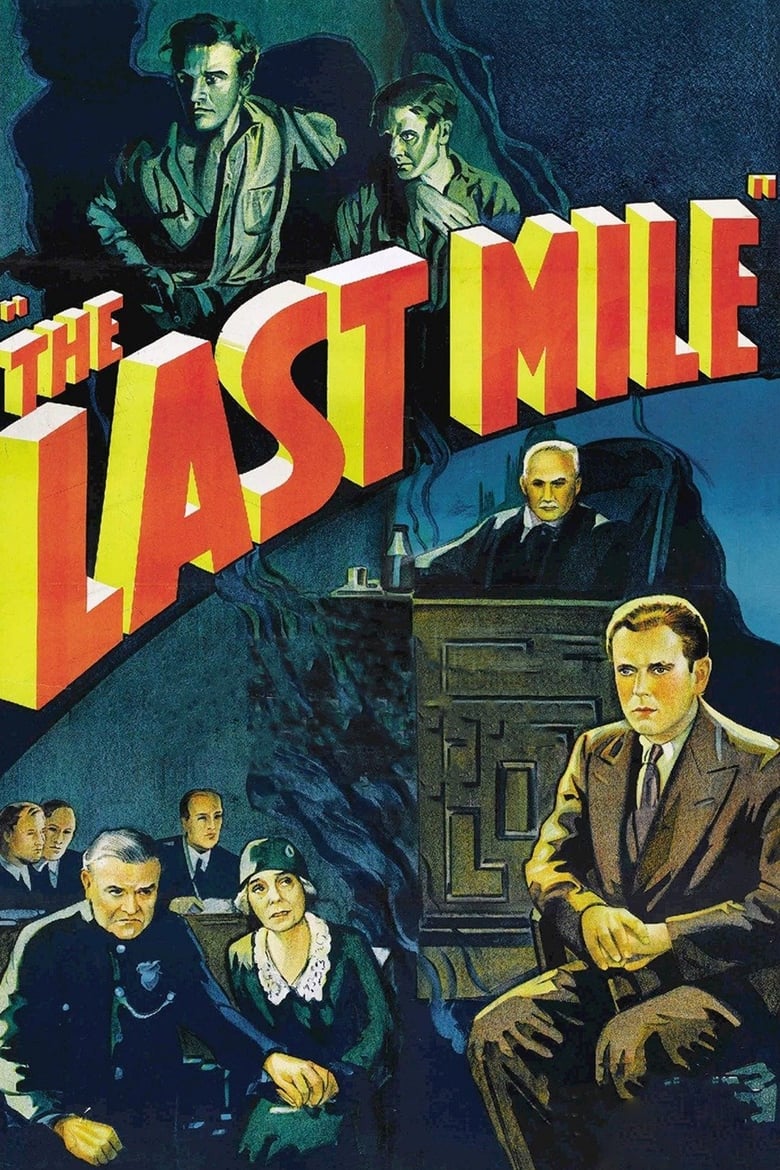
In the death house of an unnamed state penitentiary, eight condemned men occupy adjacent cells, each counting the days to execution. Among them is John 'Killer' Mears, a hardened career criminal in Cell 4 whose contempt for authority and appetite for violence have not diminished with his sentence. Richard Walters, a younger man in Cell 5, carries the particular anguish of someone who believes the system has made an error it will not correct. The prison chaplain, Father O'Connor, moves through the block offering what comfort doctrine can provide to men largely beyond its reach.
Mears, unwilling to accept the passivity of the condemned, begins organizing the other inmates toward a breakout. The plan draws in and divides the cellblock along lines of desperation and self-preservation: Berg, D'Amoro, Kirby, and Werner each weigh survival against the near-certainty of failure. Guard Drake represents the institution's indifferent authority, a man doing a job rather than administering justice. Walters, whose appeals are still pending, occupies a different moral position from the others, and his presence complicates the solidarity Mears requires.
Adapted from John Wexley's 1930 stage play, the film confines its action almost entirely to the cellblock corridor, turning the physical constraint of death row into a formal argument about institutional power and the limits of human will. It belongs to the pre-Code cycle that examined American criminal justice with a directness the Production Code would shortly suppress, and it anticipates the procedural grimness that would characterize later prison noir.
Last Mile arrives at the hinge point between the Warner Bros. social realism cycle and the harder-edged crime pictures that would define the decade. Samuel Bischoff, working for the minor outfit Sono Art-World Wide, lacks the resources of a studio production but turns confinement into an asset: the single-set limitation enforces a claustrophobia the story requires. Preston Foster's Mears is not a sympathetic figure in the tradition of the wrongly accused; he is guilty, conscious of it, and driven by a will to power that imprisonment cannot extinguish. This makes the film unusual for its moment. Where much pre-Code crime drama offered the audience some moral foothold, Last Mile removes it, asking viewers to sit with men the state has already judged. The film's engagement with capital punishment is not polemical in the manner of later social-problem pictures, but the accumulation of detail – the waiting, the counting, the chaplain's rounds – constitutes its own argument. It is a document of what American cinema could say in 1932, before the machinery of self-censorship arrived.
– Classic Noir
Arthur Edeson frames the moment of rebellion in the compressed geometry of the corridor itself, the camera holding at a medium distance that denies the action any cinematic grandeur. The overhead institutional lighting, flat and unsparing, casts no dramatic shadows across the participants; there is no chiaroscuro mercy here. The cell bars divide the frame into vertical registers that contain and isolate each figure even as the action transgresses those boundaries. Edeson's choice to hold the wide shot rather than cut to close-ups during the initial confrontation forces the audience to read the scene spatially, understanding the power shift through body positions rather than facial reaction.
The scene argues that violence in this context is not liberation but a change of confinement. Mears seizes control of the block and in doing so only demonstrates how thoroughly the institution has defined the limits of his imagination. The breakout is planned in the same space as the execution; the geography never changes. What the sequence reveals about character is that Mears's will – the quality that kept him alive in the criminal world – is now turned against an architecture specifically designed to absorb it.
Arthur Edeson, whose work would span from All Quiet on the Western Front to Casablanca, brings to Last Mile a controlled pragmatism suited to the material. Working within the severe constraints of a single interior set, Edeson relies on the existing geometry of the cellblock rather than constructing elaborate lighting rigs; the institutional overhead sources are incorporated as motivated light, giving the space an authenticity that location shooting might have softened. His camera placement is deliberate rather than expressive in the conventional sense – angles are chosen to emphasize confinement, with vertical framing elements persistent throughout. There is little rack focus or depth staging of the kind Edeson would later employ at Warner Bros.; instead he works in a flatter visual register that suits the film's moral argument: these men exist in a space that offers no perspective, no depth, no exit. The cinematography does not editorialize. It records.
Last Mile is in the public domain and available in full on the Internet Archive, making it the most direct and cost-free access point, though print quality varies.
TubiFreeTubi has carried pre-Code titles of this vintage in the past; availability fluctuates, so confirm current listing before seeking elsewhere.
KanopyFree with library cardKanopy periodically carries pre-Code and early sound-era titles through its library partnerships; check your institution's holdings.