Films People Pull a Fast One Night Beat Reading Room On TV Shop
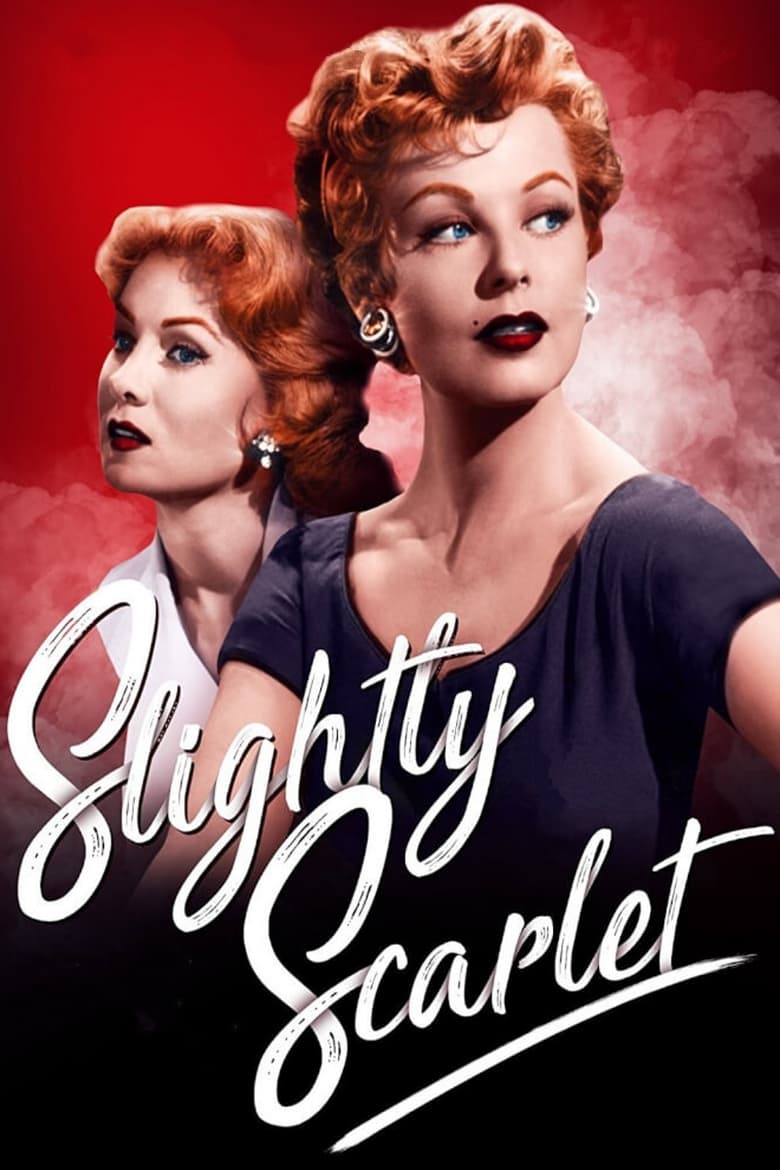
Slightly Scarlet 1956
1956 RKO Radio Pictures
★★★☆☆ Notable
Film Noir · 99 minutes · Black & White

Slightly Scarlet

Directed by Allan Dwan
Year 1956
Runtime 99 min
Studio RKO Radio Pictures
TMDB 6.2 / 10
"Two sisters, one crime boss, and a man caught between loyalty and desire in a city where the light never quite tells the truth."

In a coastal California city, political reformer John Grace works to unseat corrupt crime boss Solly Caspar, whose organization controls the local rackets. Grace engineers Caspar's downfall through careful, calculated maneuvering, and when Caspar is driven out, Grace steps into the resulting vacuum – not as a crusader, but as the new power. His ambitions are complicated from the outset by June Lyons, Caspar's secretary, a composed and self-possessed woman who understands the machinery of corruption better than most men in the film.

Grace's position grows more precarious when June's younger sister Dorothy arrives – volatile, reckless, and drawn to dangerous men with a compulsiveness she cannot govern. Dorothy's instability becomes a liability Grace cannot afford and a weakness he cannot resist exploiting. As Caspar maneuvers to reclaim his territory, Grace finds himself enmeshed in a web of shifting allegiances, where the distinction between the reformer and the criminal he replaced has ceased to mean anything. The sisters pull in opposite directions, and Grace's survival depends on reading each of them correctly.

Slightly Scarlet belongs to the late cycle of American noir, where the genre's moral architecture has grown openly cynical. The reformer-turned-operator is a familiar figure, but the film complicates him through the doubled femininity of the Lyons sisters – one calculating, one self-destructive – suggesting that power and desire are not opposing forces in this world but the same force wearing different faces. The film's resolution, when it comes, carries the weight of inevitability that defines the best work of the period.

Classic Noir

Slightly Scarlet arrives near the end of the classical noir cycle and displays both the genre's accumulated sophistication and its willingness to push against Production Code constraints. Adapted from James M. Cain's novel Love's Lovely Counterfeit, the film relocates Cain's bleak determinism into a world of Technicolor excess that is itself a form of irony – beauty as corruption made visible. Allan Dwan directs with an economy that belies his reputation as a journeyman; the narrative mechanics are precise and the pacing controlled. What distinguishes the film, beyond John Alton's cinematography, is the casting of Arlene Dahl as Dorothy, a performance that refuses to sentimentalize psychological instability. Dorothy is not a victim to be rescued but a force of nature operating outside the film's transactional logic. John Payne, often underestimated in this period, plays Grace as a man whose moral vacancy is more dangerous than villainy because it reads, from the outside, as competence. The film's place in the canon is secure if modest – a late-cycle work that earns its reputation through craft and intelligence rather than ambition.

– Classic Noir
3 ★★★☆☆ Notable
Credits

The Crew

DirectorAllan Dwan
ScreenplayRobert Blees
CinematographyJohn Alton
MusicLouis Forbes
EditingJames Leicester
Art DirectionVan Nest Polglase
CostumesNorma Koch
ProducerBenedict Bogeaus
Performances

The Cast

Close Reading

The Signature Scene

Slightly Scarlet – scene
The Beach House, Night Red Hair Under Fractured Light

John Alton frames Dorothy's arrival at the beach house in a low angle that places the night sky behind her, the Technicolor palette pushed toward an almost hallucinatory red-gold. The key light falls from screen left at a sharp diagonal, catching Arlene Dahl's hair and the planes of her face while leaving the room behind her in a receding darkness. The camera holds at a distance that refuses intimacy, observing rather than participating – a compositional choice that places the viewer in Grace's position: attracted, wary, calculating. Shadow pools in the corners of the frame with a deliberateness that reads as architectural.

The scene establishes the film's central argument about visibility and danger: Dorothy is not hidden or disguised, she presents herself completely, and that total transparency is precisely what makes her lethal to the men around her. Grace cannot manage what he cannot deceive, and the frame refuses him – and us – any interpretive cover. What Alton renders here is not seduction but exposure, the moment when a man realizes the thing he wants will not accommodate his need for control.

Visual Language

The Cinematography

🎞️
John Alton – Director of Photography

John Alton's work on Slightly Scarlet represents one of the few occasions in his career where he operated in Technicolor, and the result is a sustained demonstration that his instincts were not dependent on black-and-white contrast. Alton – whose collaboration with Anthony Mann across a series of noirs had established him as the period's most technically rigorous cinematographer – approaches the color process not as an invitation to pictorialism but as an extension of his existing moral grammar. Reds are saturated past comfort; shadows retain their density even within the color field, a technically demanding achievement that required precise control of fill ratios. The coastal California locations are integrated with studio interiors through consistent directional lighting that maintains spatial logic across cuts. Wide-angle lenses in tighter spaces exaggerate depth, creating interiors that feel simultaneously luxurious and inescapable. The cinematography never decorates the narrative; it argues alongside it, treating the beauty of the image as complicit in the moral corruption it depicts.

In the Catalogue

Themes & Motifs

Availability

Where to Watch

Also in the Directory

See Also