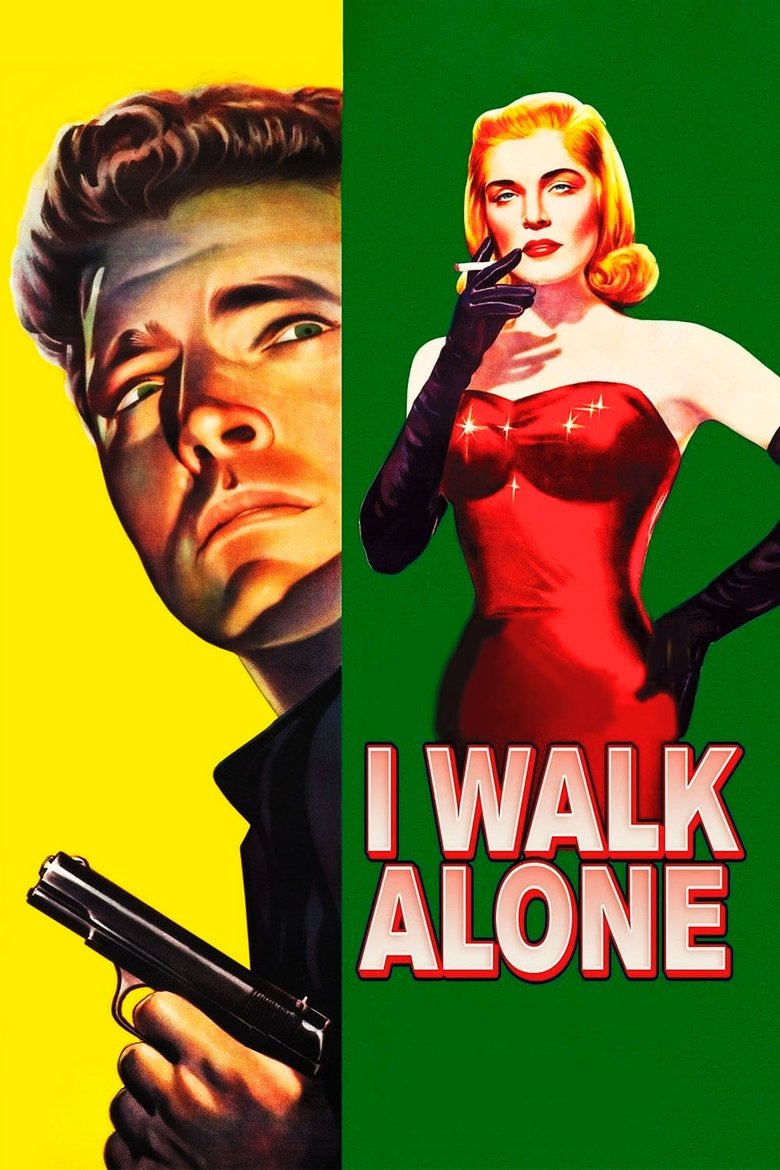
Frankie Madison (Burt Lancaster) walks out of prison after serving fourteen years for a Prohibition-era bootlegging charge, a sentence his partner Noll Turner (Kirk Douglas) avoided by disappearing before the law closed in. Frankie arrives in New York expecting to collect on the handshake deal they once made – half the business, half the profits. What he finds instead is Turner's sleek nightclub operation, a labyrinth of shell companies designed to make ownership legally untraceable, and a man who has spent a decade and a half learning how to insulate himself from the obligations of the past.
Turner's hostess and sometime singer Kay Lawrence (Lizabeth Scott) is caught between the two men – drawn to Frankie's blunt, uncomplicated grievance but indebted in ways she cannot easily name to Turner's world. Turner's lawyer Dave (Wendell Corey) works methodically to neutralize Frankie through legal maneuver rather than violence, while Turner courts a wealthy socialite (Kristine Miller) whose money would render Frankie's claim permanently irrelevant. Frankie, a man shaped entirely by loyalties that no longer exist, cannot read the new language of legitimacy that Turner speaks, and that incomprehension becomes as dangerous as any weapon.
I Walk Alone belongs to the postwar cycle of noirs preoccupied with reentry – the returning figure who discovers that the world restructured itself in his absence and left no place for him. The film is less interested in crime mechanics than in the texture of obsolescence: what happens to a man whose entire moral framework, however crude, was rendered worthless by time. Lancaster's physical presence and Douglas's cool calculation give the central opposition genuine weight, and the film uses their contrast to examine how legitimate enterprise and criminal enterprise began, in this era, to look uncomfortably alike.
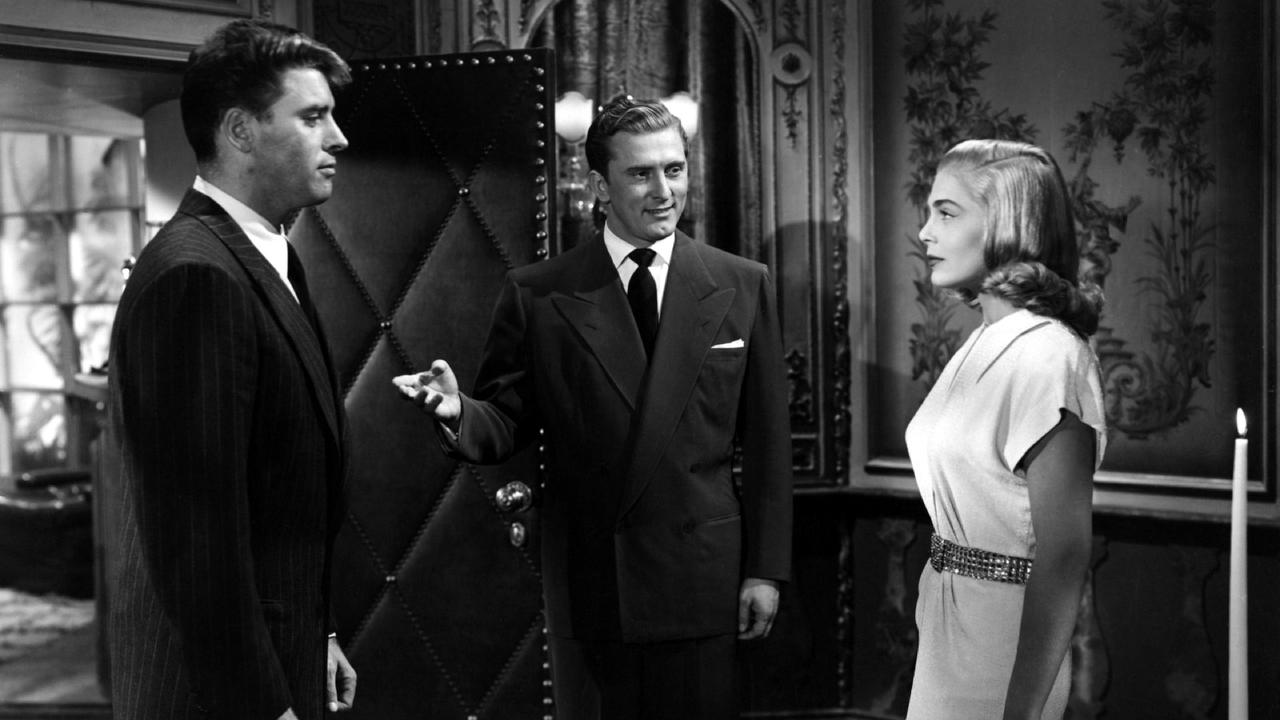
I Walk Alone arrived in 1947, the same year that paired Lancaster and Douglas for the first time, and it remains a document of two careers finding their register before either actor had fully solidified his screen persona. Byron Haskin directs with functional economy rather than stylistic ambition, which means the film's strengths are concentrated in performance and premise rather than formal invention. What the film understands with some precision is the postwar anxiety about legitimacy – the sense that organized crime had laundered itself into respectable commerce while men like Frankie were locked away, still thinking in the old categories. The screenplay, adapted from Theodore Reeves's stage play Beggars Are Coming to Town, carries some of its theatrical origins: the confrontations are staged and the dialogue occasionally explains what the images should show. But the Douglas-Lancaster opposition is not merely star chemistry. It is an argument about adaptability as moral failure – Turner wins not because he is stronger but because he has no fixed loyalties to betray him.
– Classic Noir
Turner summons Frankie to his office above the club floor and presents him with a wall of accountants, ledgers, and corporate documentation – a bureaucratic theater staged to demonstrate that there is nothing to claim. Leo Tover frames the scene with Turner seated at a remove, his desk functioning as a barrier rather than a workspace, while Frankie stands in the foreground, physically dominant but spatially adrift. The light falls clean and institutional on Turner's side of the room; Frankie occupies a zone where the shadows from the slatted blinds cut across him at irregular intervals, the geometry of the frame placing him outside the order Turner has constructed.
The scene crystallizes the film's central argument in visual terms. Frankie's size and physical authority, the qualities that once made him valuable, are useless against paper. Turner does not need to threaten him because the architecture of modern criminal enterprise has already neutralized him. What the scene reveals is not simply a betrayal but a category error: Frankie arrived expecting a confrontation between men and found instead a confrontation between a man and a system, and no amount of physical force resolves that kind of contest.
Leo Tover's cinematography on I Walk Alone operates within the established grammar of studio noir without departing dramatically from it, but his choices are consistently purposeful. Working on Paramount's controlled studio stages, Tover uses hard-source lighting to define the nightclub environments as spaces of artifice – surfaces that gleam but do not illuminate. The club interiors are lit from above and to the side in ways that produce deep shadow pools at floor level, grounding the action in darkness even when the scene is ostensibly festive. For the office confrontations, Tover favors slightly longer lenses that compress the space between characters, reducing the room's depth and making escape or retreat feel geometrically impossible. His treatment of Lizabeth Scott is notable: he lights her with a diffusion that isolates her slightly from the harder world the men inhabit, which is less a glamour convention than a visual notation of her ambiguous position – neither fully inside Turner's operation nor free of it.
When available in rotation, the Criterion Channel presents the film from a clean studio print and is the most reliable source for correct aspect ratio and contrast.
TCMBroadcast / StreamingTCM holds consistent broadcast rights to the Hal Wallis Paramount catalogue and screens I Walk Alone periodically; the TCM app allows on-demand viewing for subscribers following broadcast.
TubiFreeTubi has carried the film in an ad-supported format, though print quality varies – confirm current availability before viewing.