Films People Pull a Fast One Night Beat Reading Room On TV Shop
Human Jungle 1954
1954 Allied Artists
★★★☆☆ Notable
Film Noir · 82 minutes · Black & White

Human Jungle

Directed by Joseph M. Newman
Year 1954
Runtime 82 min
Studio Allied Artists
TMDB 5.5 / 10
"A new captain inherits a precinct built on silence and old debts."

John Danforth arrives as the newly appointed captain of a big-city police precinct, inheriting a division mired in low morale, institutional inertia, and quiet corruption. His predecessor left the district in a state of managed disorder, and the men under him – including veteran detective Bob Geddes and younger officers Lannigan and Strauss – are accustomed to looking the other way. Into this environment comes Mary Abbott, a nightclub singer whose proximity to local muscle George Mandy and the volatile Earl Swados draws her toward the center of a simmering violent dispute.

A murder fractures the precinct's uneasy equilibrium, forcing Danforth to press an investigation that implicates people on both sides of the law. His wife Pat watches from the margins as the job consumes him, while Geddes – loyal but shaped by years of compromise – struggles to follow a captain who refuses the old accommodations. Swados, physically imposing and psychologically unstable, becomes the investigation's fulcrum, a man capable of violence whose guilt or innocence is never simple. Mary Abbott, caught between self-preservation and something closer to conscience, complicates every calculation Danforth attempts.

Human Jungle belongs to the cycle of procedural noirs that emerged in the early 1950s under the influence of The Naked City, films that traded the private investigator's solitude for the institutional friction of a police precinct. Allied Artists produced it at the economy end of the market, which gave the film a documentary roughness that suits its material. The drama turns not on elaborate plot mechanics but on the pressure a functioning institution places on the individuals inside it – the question of whether a man with principles can operate within a structure designed to blunt them.
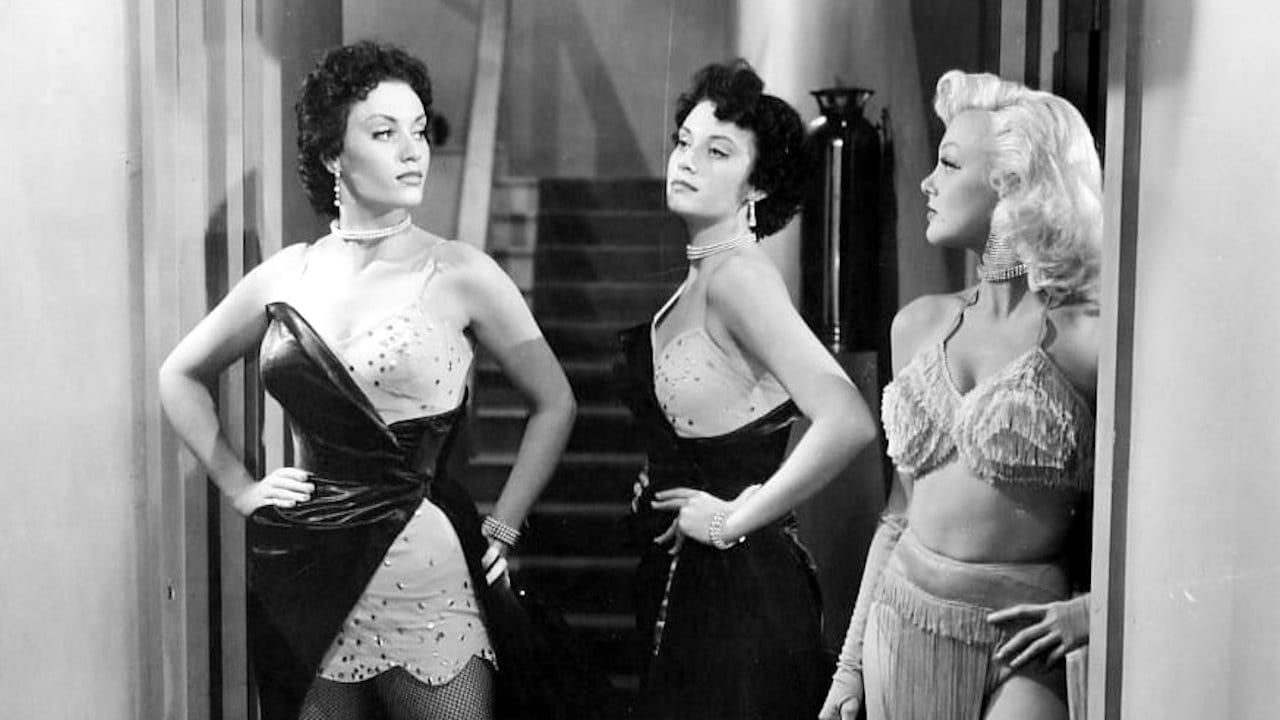
Classic Noir

Human Jungle is a minor entry in the procedural branch of American noir, but it earns its place in the cycle through consistency of tone and a genuine interest in institutional behavior. Joseph M. Newman directs without flourish, keeping the camera close to the human geography of a precinct house and the streets adjacent to it. Gary Merrill, never a star given to sentiment, brings exactly the right quality of contained exhaustion to Danforth – a man who believes in the job without illusions about what the job costs. Jan Sterling, working the edge between vulnerability and calculation that she had refined across several stronger noirs, gives Mary Abbott a moral weight the script does not always earn on its own. Chuck Connors and Claude Akins occupy the film's more volatile register with conviction. What the film reveals about 1954 is the genre's deepening interest in systemic corruption rather than individual villainy – the idea that the rot is structural, not merely personal, and that any honest officer must contend with the institution as much as with the criminal.

– Classic Noir
3 ★★★☆☆ Notable
Credits

The Crew

DirectorJoseph M. Newman
ScreenplayDaniel Fuchs
CinematographyEllis W. Carter
MusicHans J. Salter
EditingSam Fields
ProducerHayes Goetz
Performances

The Cast

Close Reading

The Signature Scene

Human Jungle – scene
The Precinct Interrogation Light Across a Hard Face

Ellis W. Carter places the key lamp at a low angle to one side, throwing the upper half of Swados's face into shadow while leaving his jaw and throat harshly lit – a division that registers as the character's internal split between threat and fear. Danforth stands at the frame's edge, partially occluded, so the composition gives us the suspect's physical dominance while the captain's partial presence implies procedural authority without staging it as confrontation. The room is small and the walls press in; Carter uses a moderate wide-angle to exaggerate that compression without distorting the actors.

The scene argues that institutional interrogation is less about force than about patience – Danforth does not break Swados so much as outlast him, and the light that falls away from the subject's eyes throughout the exchange makes that erosion visible. It is the film's clearest statement that knowledge and power in this precinct are not the same thing, and that the camera's placement, always slightly off-center, is a formal equivalent of the moral position Danforth occupies throughout.

Visual Language

The Cinematography

🎞️
Ellis W. Carter – Director of Photography

Ellis W. Carter, a reliable craftsman at the economy studios through the 1950s, shoots Human Jungle with the controlled restraint the film's procedural logic demands. He favors medium shots that position characters within their environment rather than isolating them heroically, a choice that reinforces the film's argument about institutional pressure. Interior lighting runs to hard single sources – overhead practicals in the precinct, bare bulbs in the back rooms where money and threats change hands – with fill kept deliberately low so that shadow accumulates in corners and against walls rather than dramatic pools on faces. Location material, apparently drawn from second-unit work on actual Chicago streets, is cut against studio interiors without anxious matching; the seams are visible and they do the film no harm. Carter's lens choices stay conservative throughout, but in the interrogation sequences he tightens the focal length slightly to increase apparent spatial confinement, aligning the visual texture with the moral narrowing the story enacts.

In the Catalogue

Themes & Motifs

Availability

Where to Watch

Also in the Directory

See Also