Films People Pull a Fast One Night Beat Reading Room On TV Shop
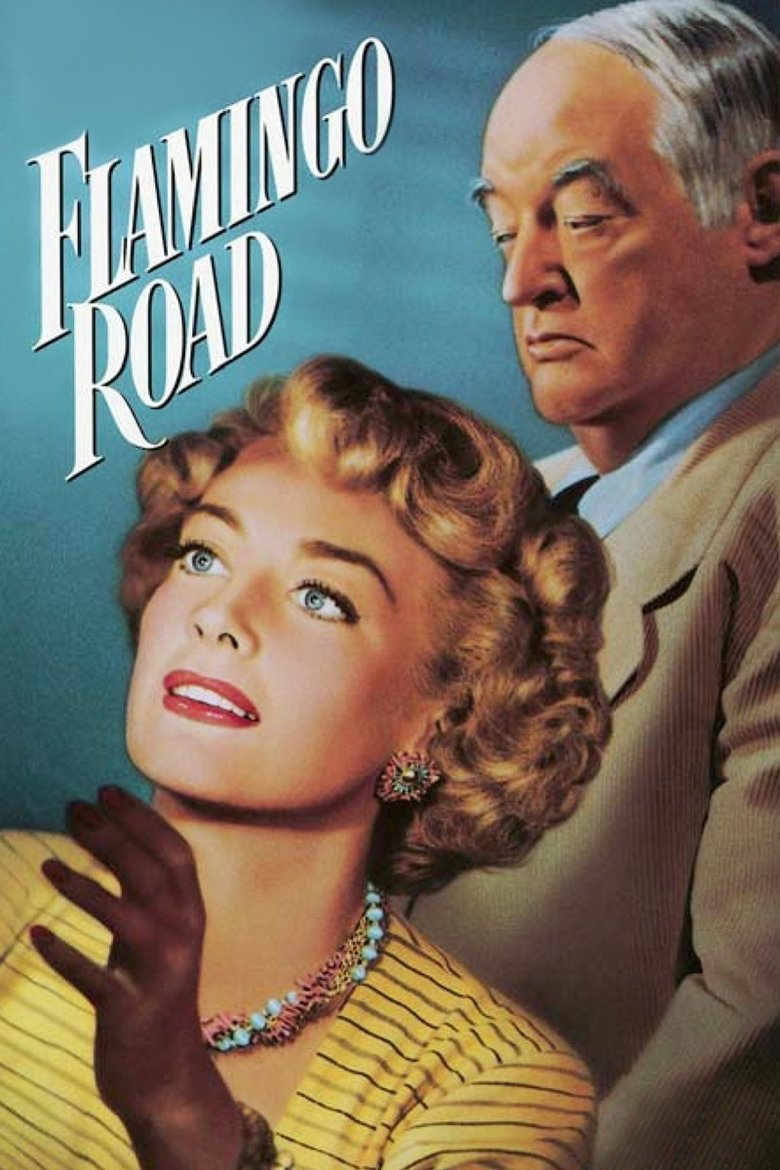
Flamingo Road 1949
1949 Warner Bros. Pictures
★★★☆☆ Notable
Film Noir · 94 minutes · Black & White

Flamingo Road

Directed by Michael Curtiz
Year 1949
Runtime 94 min
Studio Warner Bros. Pictures
TMDB 7.1 / 10
"A carnival girl climbs toward respectability, and a corrupt sheriff decides she has climbed far enough."

Lane Bellamy arrives in the small Southern town of Boldon with a traveling carnival, a woman of no fixed address and no illusions about how the world works. When the carnival moves on without her, Lane finds work at Lute Mae Sanders's roadhouse and falls into the orbit of Fielding Carlisle, a young man of good family and blurred ambitions. Fielding is charmed; Lane is careful. Watching all of it, with the patient malice of a man who has run this county for decades, is Sheriff Titus Semple – a vast, deliberate figure who has decided that Lane does not belong here and will not be permitted to stay.

Semple manufactures a vagrancy charge to drive Lane out of Boldon, but she returns, older in her understanding of how power operates. She attaches herself to Dan Reynolds, a rising political force with money and connections, and the two eventually marry. This alliance positions Lane on Flamingo Road itself, the town's address of consequence. But Semple, who owns Fielding Carlisle as surely as he owns the county courthouse, will not concede the ground. As Fielding's ruin deepens – drink, diminishment, a marriage to another woman arranged for Semple's convenience – Lane's precarious ascent becomes inseparable from the damage left in her wake.

Flamingo Road belongs to a cycle of late-1940s Warner Bros. noirs preoccupied with provincial corruption and the American myth of social mobility. The film frames Lane's story as a contest between personal will and institutional power, with desire and ambition functioning less as individual failings than as the only weapons available to someone without inherited position. Crawford's performance anchors the film in the tradition of the woman's picture while the plotting and visual grammar pull steadily toward noir's darker register, producing a hybrid that is more honest about its contradictions than most.

Classic Noir

Flamingo Road is not an easy film to categorize, and that resistance is part of what makes it worth examining. Michael Curtiz, working with a cast of considerable weight, keeps the melodramatic machinery in tension with noir's more fatalistic tendencies. Sydney Greenstreet's Semple is the film's genuine achievement – a performance of controlled menace that locates corruption not in hysteria but in procedure, in the quiet administration of ruin. Crawford, rarely given credit for restraint, builds Lane Bellamy from the outside in, using posture and silence as much as dialogue. What the film reveals about its era is something specific: the postwar suspicion that American social structures were not neutral mechanisms but instruments held by particular hands. The good addresses are earned at someone's expense. The sheriff's office is not a protection but a tool. Flamingo Road will not be remembered as a summit of the genre, but it is an honest and technically accomplished work that earns its place in the noir catalogue without apology.

– Classic Noir
3 ★★★☆☆ Notable
Credits

The Crew

DirectorMichael Curtiz
ScreenplayRobert Wilder
CinematographyTed D. McCord
MusicMax Steiner
EditingFolmar Blangsted
Art DirectionLeo K. Kuter
CostumesTravilla
ProducerJerry Wald
Performances

The Cast

Close Reading

The Signature Scene

Flamingo Road – scene
Semple's Office – The Second Warning The Sheriff Fills the Frame

Curtiz and McCord position Greenstreet behind a wide desk in a low-ceilinged office, the camera placed slightly below eyeline so that Semple seems to occupy more square footage than the room should allow. Light falls from a single source above and to the side, carving the left half of his face into shadow while leaving his eyes fully visible – a setup that refuses to let the audience locate his expression as either benign or openly threatening. Crawford, seated across from him, is lit conventionally, her face legible. The framing makes the power differential concrete: she is readable; he is not.

The scene enacts the film's central argument without a word of exposition. Lane Bellamy can be seen clearly because she has no institutional cover; she is exposed to scrutiny in a way that Semple never is. His corruption operates in the shadow half of the frame – present, organized, invisible to official view. The geography of the shot is the geography of the film's moral world.

Visual Language

The Cinematography

🎞️
Ted D. McCord – Director of Photography

Ted D. McCord's work on Flamingo Road demonstrates what studio-era cinematography could accomplish within the disciplined economy of a Warner Bros. production schedule. McCord favors deep-focus compositions in the interior scenes, keeping both foreground and background in resolution so that spatial relationships carry dramatic weight – Semple looming at the back of a shot while Lane negotiates something in the fore is never accidental. His lighting design for the roadhouse sequences relies on practical sources pushed slightly harder than realism requires, producing pools of warm light surrounded by areas of genuine dark. On Flamingo Road itself, the lighting shifts: broader, more even, the shadow work subtler, as if the address confers a kind of surface respectability that the film never quite believes in. McCord does not use expressionist distortion for its own sake; he earns every tilted angle and every shadow with dramatic logic, which makes those choices land with proportionate force when they arrive.

In the Catalogue

Themes & Motifs

Availability

Where to Watch

Also in the Directory

See Also