Anthony John is a celebrated stage actor whose gift for total immersion in his characters has made him one of Broadway's most respected performers. His professional life is orderly and productive; his personal life less so. He and Brita, his leading lady and former wife, maintain a working relationship edged with unresolved feeling, while his producer Bill Friend quietly manages the human costs of Anthony's artistic intensity. When the company mounts a production of Othello, Anthony accepts the role with characteristic seriousness, and rehearsals begin under a watchful public eye.
As the run extends and Anthony's performance deepens, the boundary between actor and character begins to dissolve in ways that alarm those around him. Offstage, his jealousy becomes ungoverned; his moods darken without theatrical cause. He begins a liaison with Pat Kroll, a waitress with no connection to his world, and the relationship takes on a dangerous coloring wholly removed from any performance. Brita watches his deterioration with growing unease, uncertain whether what she sees is artistic commitment carried to its limit or something more irreversible.
A Double Life belongs to a small category of noir that locates its threat not in criminal networks or institutional corruption but in psychology – in the collapse of the self under the pressure of sustained performance. The film uses the Othello framework not as literary decoration but as structural logic: the more completely Anthony inhabits the Moor's jealousy, the more the fiction becomes operational fact. The result is a character study with a body count, shaped by Cukor's precision and anchored by a performance of genuine technical ambition.
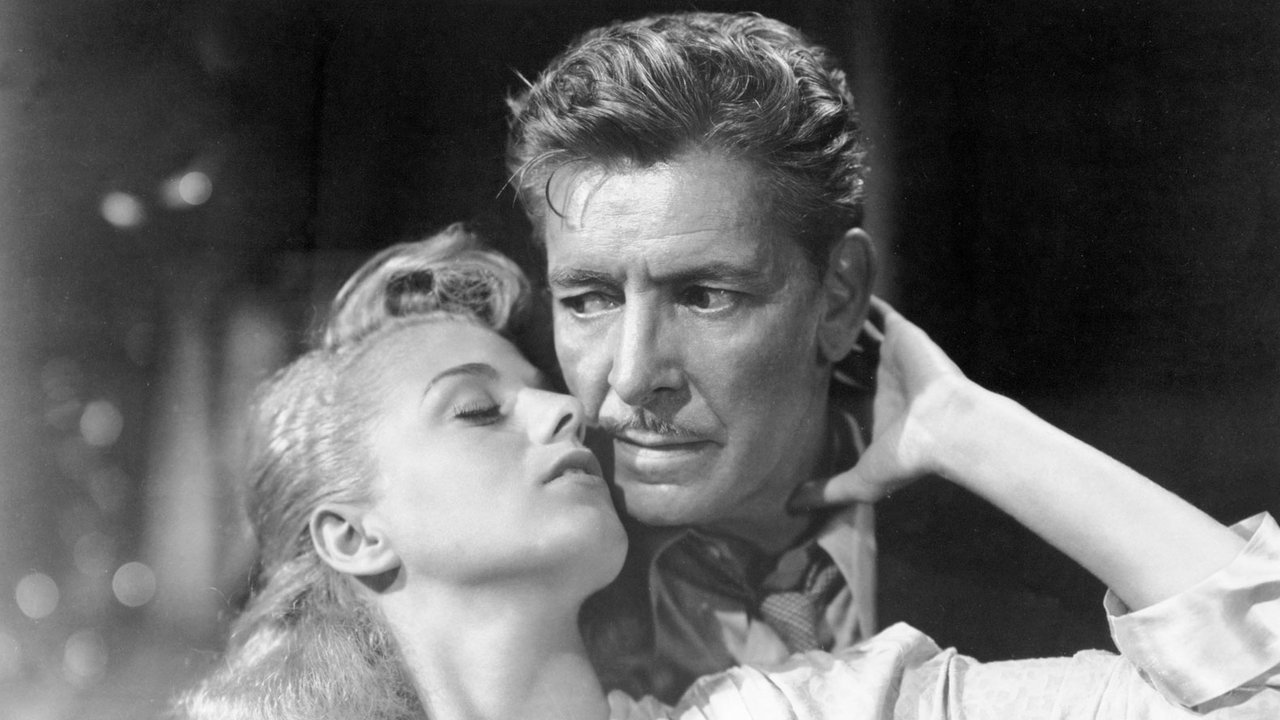
A Double Life occupies an unusual position in the postwar American noir cycle. George Cukor, whose reputation rested on literary adaptations and films attentive to the interior lives of performers, brings to the material an observational precision that a more programmatic noir director might have sacrificed for pace. The result is a film that earns its darkness through character rather than atmosphere. Ronald Colman's performance – which won him the Academy Award – functions as a sustained argument about the cost of artistic self-obliteration: the actor who can feel nothing outside a role is as dangerous as any sociopath, perhaps more so because he is admired for the very capacity that destroys him. Miklós Rózsa's score, lush in its theatrical passages and spare in its domestic scenes, mirrors this double register. The film's limitation is a procedural third act that undercuts the psychological rigour of what precedes it, leaning on noir convention when the internal logic might have sustained something starker. Even so, A Double Life remains a serious examination of identity, performance, and the violence latent in absolute commitment to a fiction.
– Classic Noir
Milton Krasner frames the scene in a low-ceilinged room where the practical light source – a single lamp beside the bed – casts a cone of warm illumination that does not reach the walls. Anthony moves through the space in and out of shadow, his face intermittently visible, intermittently gone. Krasner holds the camera at mid-height, neither low enough to be expressionistic nor high enough to observe with detachment; the angle implicates the viewer without releasing them into spectacle. Pat Kroll occupies the lit zone; Anthony occupies the dark one. The composition does not shift as the scene progresses.
What the frame argues is simple and exact: Pat exists in the world of visible consequence; Anthony does not. He has moved so far into the character of Othello that his actions no longer carry the weight of personal agency – they carry only dramatic inevitability. The scene makes no claim that this is tragic in any redemptive sense. Cukor and Krasner render it as a fact, which is considerably colder.
Milton Krasner's work on A Double Life is defined by a disciplined refusal of visual excess. Where many noir productions of the period employed deep-focus compositions and oblique angles as expressive shorthand, Krasner keeps his framing close to the conventional grammar of prestige studio filmmaking, departing from it only when the narrative has earned the deviation. The result is that expressionist moments – the elongated shadows in Pat's room, the theatrical lighting that bleeds from stage into street – register as psychological events rather than stylistic gestures. Krasner uses the Broadway stage itself as a controlled laboratory: the theatrical lighting rigs visible in some setups remind the viewer that illumination is always a constructed act, never neutral. As Anthony's grip on his own identity loosens, Krasner's compositions become incrementally less stable, the light sources less clearly motivated. The cinematography serves the film's central moral argument: that seeing clearly is not the same as understanding what you see.
The most reliable streaming home for Universal-era noir and prestige crossovers; check current availability as titles rotate seasonally.
TubiFreeHas carried the film in an acceptable transfer; picture quality is adequate for a first viewing though not a reference source.
Archive.orgFreePublic domain prints are available but vary considerably in condition; useful if no other option is accessible.