Films People Pull a Fast One Night Beat Reading Room On TV Shop
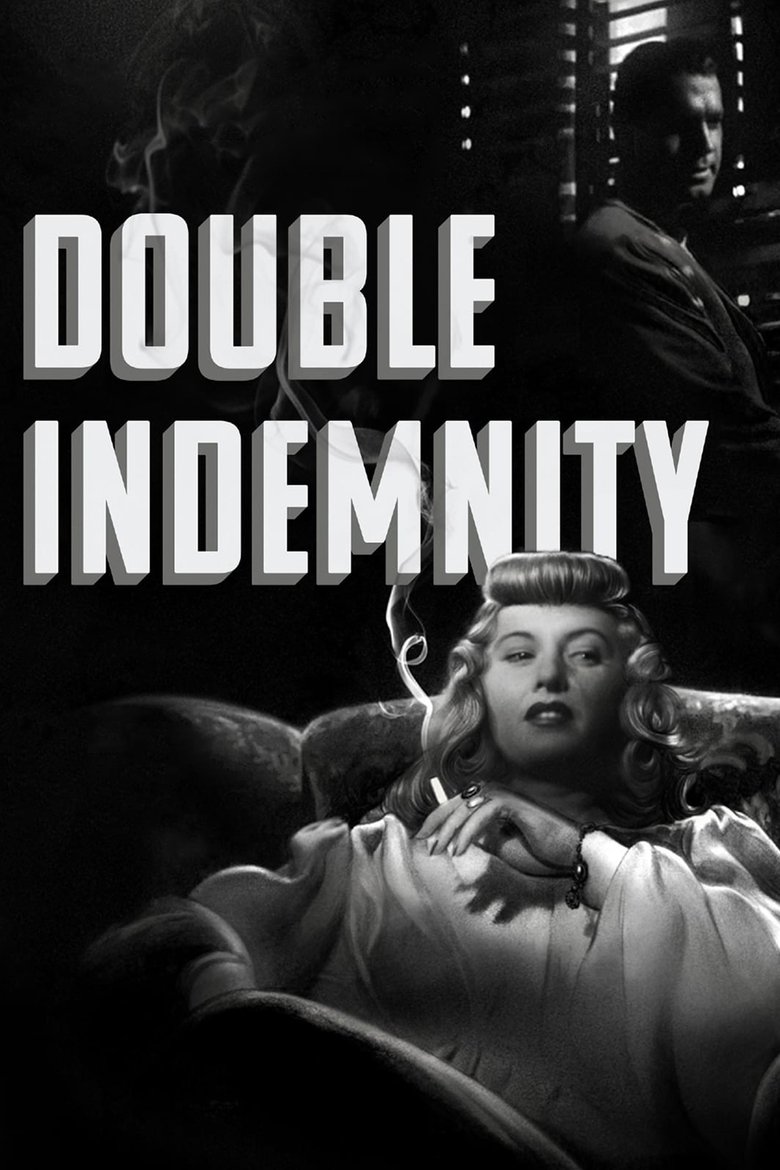
Double Indemnity 1944
1944 Paramount Pictures
★★★★★ Essential
Film Noir · 107 minutes · Black & White

Double Indemnity

Directed by Billy Wilder
Year 1944
Runtime 107 min
Studio Paramount Pictures
TMDB 8.1 / 10
"A man walks into a trap he built himself."

Insurance salesman Walter Neff calls on a client in the Los Feliz hills and finds instead the client's wife, Phyllis Dietrichson – cool, calculating, and already working an angle. What begins as a routine policy renewal becomes, within days, a conspiracy to murder her husband and collect on a double indemnity clause that would pay twice the face value of an accident policy. Neff, experienced enough to know every fraud in the book, chooses to write one of his own.

The murder is committed on a train line north of Los Angeles, staged to look like a fall from the observation platform – a scheme Neff has designed with almost professional detachment. But the claims investigator assigned to the case, Barton Keyes, is Neff's closest colleague and the sharpest mind at Pacific All Risk Insurance. As Keyes works the evidence with quiet, methodical precision, Neff begins to understand that the plan he considered airtight is unraveling at points he never anticipated – including the character of the woman he trusted.

Double Indemnity places itself squarely at the intersection of desire and greed, using the structures of the insurance industry as a moral architecture against which every decision the characters make registers as a kind of actuarial error. The film arrives at a moment when American cinema is beginning to look at ordinary men and women with genuine suspicion, treating domesticity and professional ambition not as virtues but as conditions that can be exploited.
Classic Noir

Double Indemnity did not invent American film noir, but it codified it with a precision that subsequent films spent decades imitating. Billy Wilder and Raymond Chandler's screenplay – adapted from James M. Cain's serialized novella – brought to the screen a vernacular fatalism that had existed in pulp fiction but had rarely survived the translation to studio filmmaking intact. The film's structural gambit, opening with a wounded Neff dictating his own confession, removes suspense in the conventional sense and replaces it with something more corrosive: the spectacle of a man analyzing his own destruction. Edward G. Robinson's Keyes is the film's moral center, yet the relationship between Keyes and Neff – paternal, competitive, genuinely affectionate – gives the film an emotional register that the Phyllis-Neff dynamic, for all its heat, cannot match. Paramount released it into a culture still processing wartime displacement and returning anxiety about the home front, and audiences recognized something in Neff's trajectory that the studio system had until then largely kept offscreen.

– Classic Noir
5 ★★★★★ Essential
Credits

The Crew

DirectorBilly Wilder
ScreenplayBilly Wilder and Raymond Chandler
CinematographyJohn F. Seitz
MusicMiklós Rózsa
EditingDoane Harrison
Art DirectionHans Dreier
CostumesEdith Head
ProducerJoseph Sistrom
Performances

The Cast

Close Reading

The Signature Scene

Double Indemnity – scene
The Dietrichson Living Room Anklet in the Afternoon

Phyllis Dietrichson descends the staircase wrapped in a towel, and John F. Seitz's camera holds on the anklet at her ankle – a detail that Neff's voiceover will return to obsessively. The living room is bleached by California afternoon light cutting through venetian blinds, casting the horizontal bar pattern that becomes the film's dominant visual motif. Seitz keeps the framing tight and functional: Stanwyck is lit from slightly above and in front, her face half in shadow, while MacMurray occupies a position just below her eyeline, already subordinate in the geometry of the scene.

The venetian blind shadows falling across both figures encode the argument the film will spend 107 minutes making explicit: these two are already behind bars before they have committed any crime. The anklet, lit to catch the eye, functions as a symbol of exactly the kind of superficial glamour that Neff's voiceover tells us, from the film's opening moments, he was too experienced to fall for and fell for anyway. The gap between what Neff knows and what Neff does is the engine of the entire film, and it is established here in a single composition.

Visual Language

The Cinematography

🎞️
John F. Seitz – Director of Photography

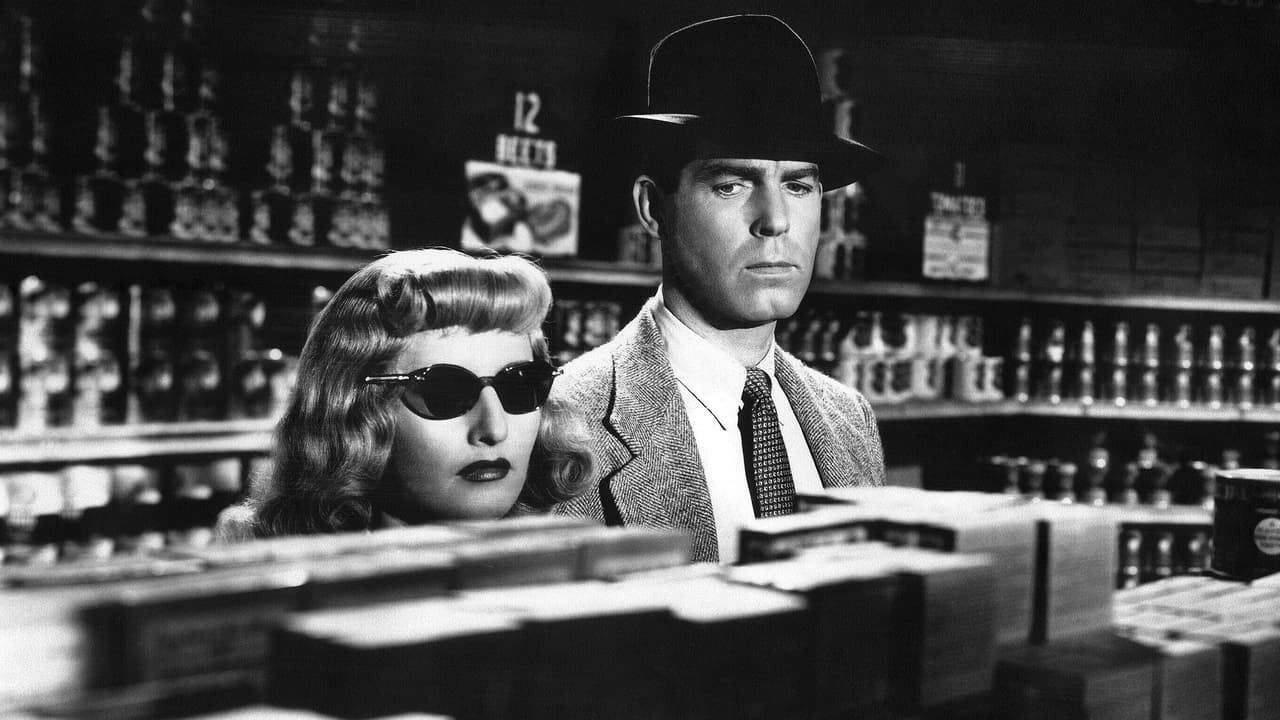
John F. Seitz's work on Double Indemnity is one of the most deliberately constrained visual programs in studio-era Hollywood. Shooting largely on constructed Paramount interiors, Seitz used hard, directional sources to simulate the flat California sunlight that bleaches color from everything it touches – a quality that, rendered in black and white, becomes something closer to glare than warmth. The venetian blind motif is so rigorously applied that it functions less as decoration than as a recurring visual argument about entrapment. Seitz also worked in pronounced contrast ratios, pulling shadow detail down in domestic interiors to make ordinary spaces – a supermarket, a living room, an office corridor – feel morally unreliable. The night exteriors, including the train platform sequence, are shot with minimal fill, keeping the edges of the frame unresolved. Wilder and Seitz made a consistent choice to deny the audience comfort in the frame, reflecting a screenplay that denies its protagonist the comfort of innocence.

In the Catalogue

Themes & Motifs

Availability

Where to Watch

Also in the Directory

See Also