At a rundown provincial boarding school outside Paris, Christina Delassalle – frail, devout, and legally the institution's owner – endures the open cruelty of her husband Michel, the school's tyrannical headmaster. Michel conducts an unabashed affair with Nicole Horner, a fellow teacher, yet Nicole's loyalties have quietly shifted: she despises Michel as much as Christina does, and the two women have formed an unlikely, cautious alliance under the same roof.
Nicole proposes a plan. The women will lure Michel to Nicole's flat in Niort, drug him, drown him in a bathtub, and return the body to the school's neglected swimming pool to make his death appear accidental. Christina's conscience strains against every step, but she follows. The plan appears to succeed – until the pool is drained and the body is not there. A retired police inspector named Fichet, dry-witted and watchful, begins circling the school with questions that neither woman can answer without exposing herself.
Diabolique operates in the tradition of the domestic crime film – the locked household, the poisoned marriage, the murder arranged between intimates – while pushing that tradition toward something closer to psychological dismantlement. Clouzot strips the thriller of glamour and replaces it with institutional drabness, damp corridors, and the particular anxiety of waiting for consequences that keep failing to arrive on schedule.
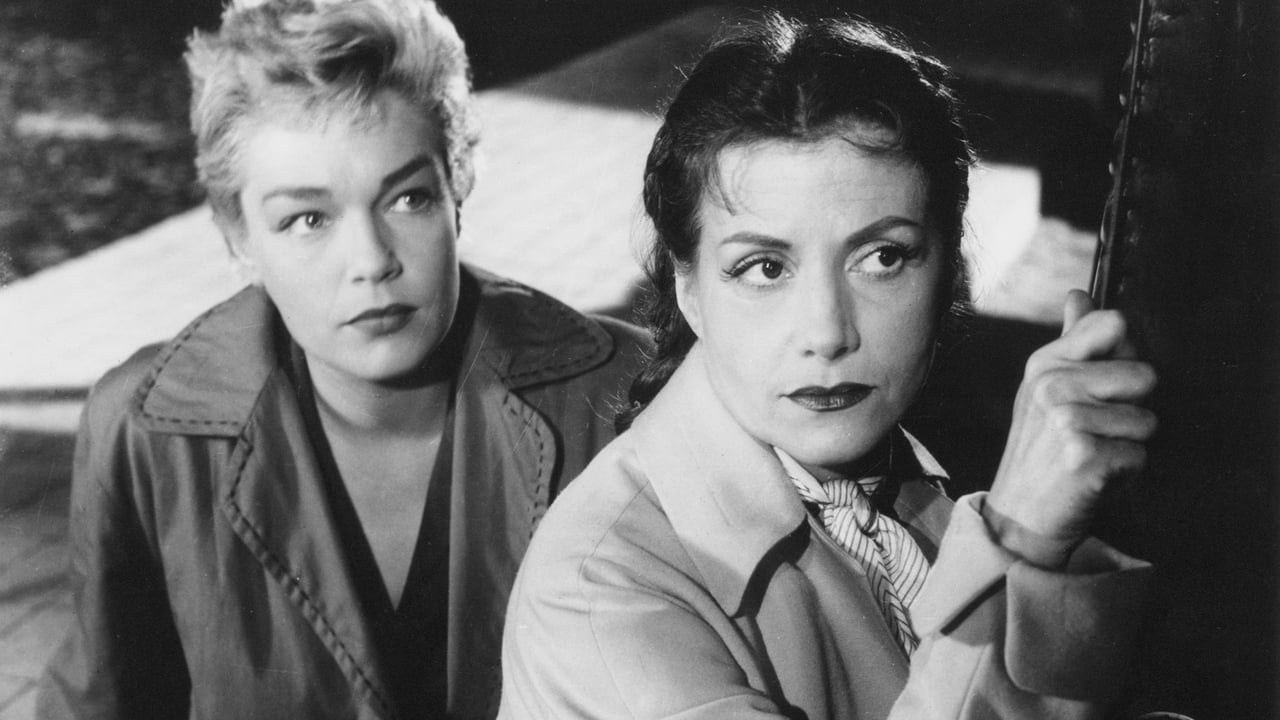
Clouzot's reputation as the French Hitchcock flattens what Diabolique actually does. Where Hitchcock organizes suspense around the audience's privileged knowledge, Clouzot withholds nearly everything, forcing the viewer into Christina's narrowing perspective until the film's architecture collapses around her. The screenplay, adapted from the Boileau-Narcejac novel by Clouzot and Jérôme Géronimi, treats the boarding school as a moral environment – its decay is not atmospheric dressing but argument: institutions rot when cruelty is permitted to administer them. Simone Signoret brings to Nicole a controlled opacity that makes every gesture ambiguous in retrospect, while Véra Clouzot's Christina registers physical fragility as a form of ethical exposure. Paul Meurisse's Michel is the rare noir villain whose menace derives entirely from pettiness rather than grandeur. The film belongs to the postwar French tradition of crime as anatomy of complicity, and it remains one of the most precisely constructed studies of how guilt – anticipated, not yet incurred – can undo a person before any crime is confirmed.
– Classic Noir
Thirard's camera holds at a low angle as the murky water drains from the school pool, the frame organized around the slow recession of the surface. Light is flat, institutional – overcast exterior light that refuses shadow and therefore refuses concealment. The composition places Christina and Nicole at the pool's edge, small against the concrete surround, while the emptying water draws the eye toward a center that produces only silt and absence. Clouzot does not cut to reaction shots until the bottom is fully visible; the duration of the wait is the scene's primary instrument.
The empty pool does not resolve the women's guilt – it compounds it by removing the evidence on which that guilt depends. Christina's cardiac vulnerability, established early as a medical fact, now reads as a moral condition: the body that cannot sustain shock. The scene argues that the real subject of the film is not murder but anticipation of consequence, and that the absence of a body is more destructive to the conscience than its presence would have been.
Armand Thirard shoots Diabolique in a sustained low-contrast register that refuses the deep-shadow expressionism common to American noir of the period. The choice is deliberate and precise: the boarding school's institutional spaces – tiled corridors, a scum-edged pool, low-ceilinged dormitories – are rendered in a grey, diffuse light that offers nowhere for guilt or menace to pool dramatically. Thirard works largely on location at a functioning school near Paris, and the texture of real plaster and standing water gives the images a material weight that studio construction rarely achieves. Close-ups of Véra Clouzot are lit to emphasize pallor without glamorizing it, the key light placed to flatten rather than sculpt. The film's most considered visual decision is its treatment of water: in the bathtub sequence, in the pool drain, and in the film's climactic bathroom, Thirard frames water as a surface that records and reveals rather than conceals – inverting the conventional noir use of shadow as the medium of hidden truth.
The Criterion Channel streams the restored Janus Films print with optional English subtitles, representing the most complete and well-sourced version currently available in North America.
MUBISubscriptionMUBI has periodically carried Diabolique as part of French crime retrospectives; availability rotates, so confirm before subscribing.
KanopyFree via libraryKanopy offers the film through many public library and university systems at no cost – check local library card eligibility for access.