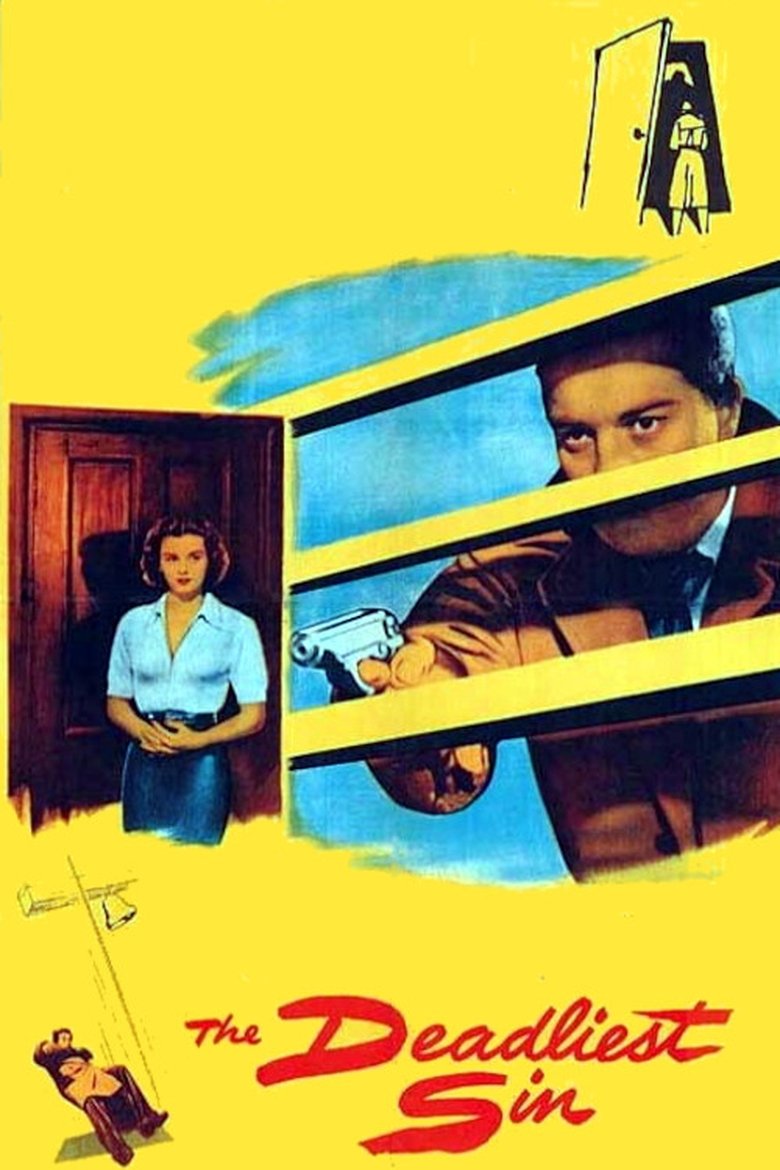
In postwar London, Mike Nelson (Sydney Chaplin) is a drifter caught between loyalty to his ailing father, Pop Nelson (Jefferson Clifford), and the cold practicalities of survival. When a man turns up dead and the evidence points uncomfortably toward Mike, Inspector Kessler (John Bentley) begins a methodical pursuit that unsettles the entire Nelson household. Mike's wife Louise (Audrey Dalton) watches her husband with a wariness she cannot quite name, while the local priest Father Neil (John Welsh) offers counsel that carries its own burden of ambiguity.
The investigation draws in Alan (Peter Hammond), a younger man whose proximity to the crime complicates the question of motive, and Corey (Patrick Allen), a harder figure whose interests are never entirely transparent. Kessler is not the bullying detective of convention – he proceeds with patience, reading the silences between answers as carefully as the answers themselves. As alibis fray and small deceits accumulate, Louise finds herself caught between what she fears her husband has done and what she might be willing to conceal to protect the life they have built.
Deadliest Sin works in the tradition of the British domestic thriller, using confined settings and credible working-class detail to ground its moral inquiry. The film's title points toward guilt as a spiritual condition as much as a legal one – sin here is less about the act than the long accommodation of dishonesty. Without resolving neatly into either innocence or damnation, it occupies the ambiguous middle ground that the best postwar noir understands as its natural territory.
Deadliest Sin (1955) belongs to a strand of British noir that has been consistently undervalued – the modest, studio-produced thriller that substitutes psychological texture for spectacle and finds its tension in the erosion of domestic trust rather than in action. Ken Hughes, working at Anglo-Guild Productions before his more prominent later career, demonstrates the same economy of means he brought to The Long Haul and Wide Boy: he keeps the frame close, lets performances carry moral weight, and resists the temptation to telegraph guilt through expressionist excess. Sydney Chaplin, more at ease here than in his Hollywood outings, brings an opacity to Mike Nelson that keeps the viewer's allegiances genuinely unsettled. The film also reflects a specific postwar British anxiety – the sense that respectability is a performance maintained through collective silence rather than actual virtue. Father Neil's presence is not decorative; the film takes seriously the question of what confession costs and what it permits. That seriousness, however quietly carried, is what earns the film its place in the genre.
– Classic Noir
Hughes and cinematographer Phil Grindrod frame the exchange between Mike and Father Neil in a room that offers no neutral ground – a desk between them, a single practical lamp throwing light upward against a wall of dark wood, the priest's face half-lit and half-lost in shadow. The camera holds in a medium two-shot for longer than is comfortable, refusing the relief of cutting away, so that every small adjustment of posture registers as a kind of testimony. When it does move, it is to isolate Mike in close-up, the background falling into near-total darkness, the light catching only his jaw and the line of his eyes.
The scene establishes what the film ultimately argues: that guilt is not a single moment of action but an interior architecture built over time. Mike does not confess in the legal sense, and Father Neil does not absolve in any simple sense, and the scene's refusal to provide either release or condemnation mirrors the film's wider insistence that moral life operates in a register the law cannot fully reach.
Phil Grindrod's cinematography on Deadliest Sin works within the constraints of a modest British studio production to create a visual grammar of enclosure and partial disclosure. Where American noir of the period often uses deep shadow as spectacle, Grindrod employs it more quietly – as a condition of the domestic world rather than a dramatic intrusion into it. Interior settings are lit with practical sources wherever possible, giving rooms a lived-in dimness rather than a designed chiaroscuro; the effect is that darkness feels earned rather than applied. Grindrod keeps his lens choices conservative throughout, favouring moderate focal lengths that flatten depth just enough to make walls and furniture feel like pressures rather than backgrounds. Location shooting in London, limited as it is, provides textural contrast that the studio interiors cannot replicate, and Grindrod uses the shift between the two registers to mark the boundary between public exposure and private concealment – a spatial logic that reinforces the film's moral argument at every level of the image.
Public domain prints of British B-pictures from this era circulate on Archive.org and are often the most readily available option, though print quality varies.
TubiFreeTubi has carried a number of Anglo-Guild and similar British productions from the 1950s; availability shifts, so confirm before seeking.
MUBISubscriptionMUBI periodically programmes overlooked British noir of this period; check the catalogue, as titles rotate on a limited run basis.