Films People Pull a Fast One Night Beat Reading Room On TV Shop
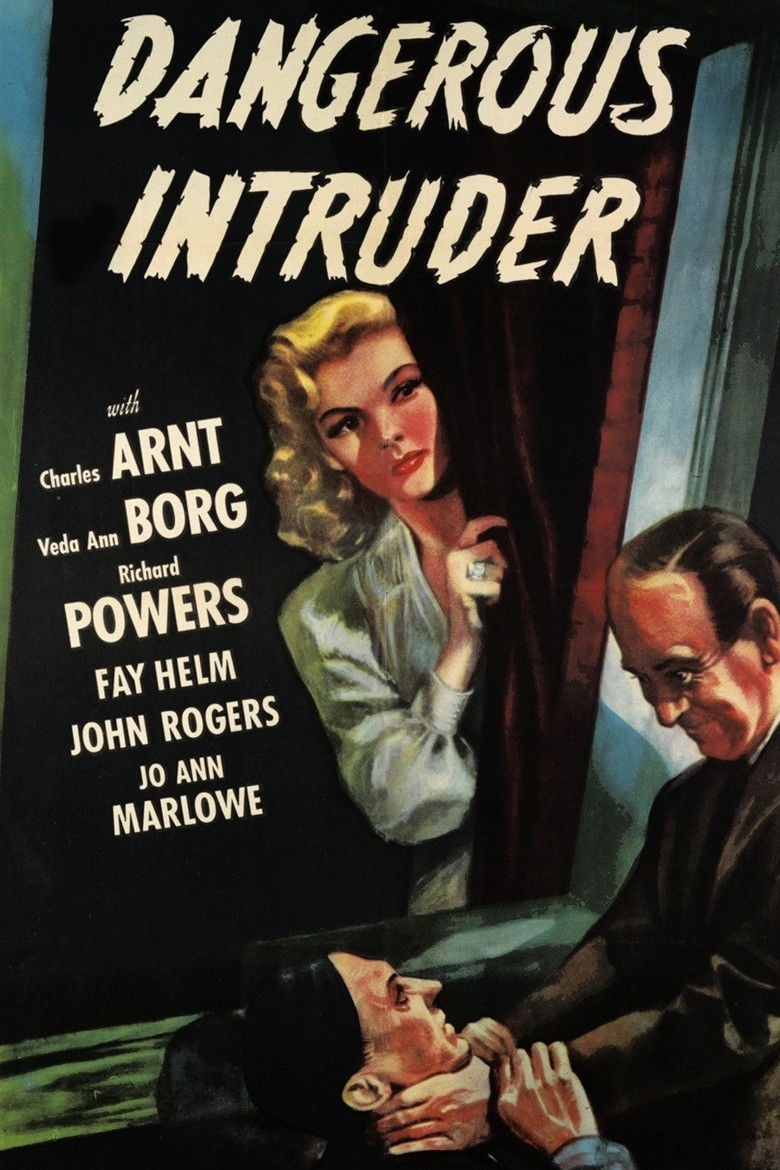
Dangerous Intruder 1945
1945 PRC
★★★☆☆ Notable
Film Noir · 65 minutes · Black & White

Dangerous Intruder

Directed by Vernon Keays
Year 1945
Runtime 65 min
Studio PRC
TMDB 5.1 / 10
"A dead man's house holds more secrets than the men who want it."

In a quiet residential neighborhood, Max Ducone – a small-time schemer with an eye for easy money – arrives at a house he believes to be empty, only to find it occupied by a tangle of competing interests. Curtis, a straight-edged figure caught between duty and suspicion, is already on the premises, and the nervous, sharp-tongued Jenny makes her own claims on what the house may contain. The household's other occupants – the fragile Millicent, the watchful Mrs. Stevens, and the young Jackie – each carry a version of events that does not quite align with anyone else's.

What begins as a dispute over property and inheritance curdles into something darker when violence enters the frame. Ducone's motives prove less straightforward than his manner suggests, and Jenny's loyalty shifts with the available light. Foster, a figure from the margins, complicates the question of who stands to gain from the dead man's affairs, while Millicent's emotional fragility begins to look less like weakness and more like concealment. Allegiances form and dissolve across a confined set of rooms where everyone is listening through walls.

Dangerous Intruder is a tight, low-budget entry in the tradition of the contained noir thriller, where a single location becomes a pressure chamber and domestic space turns hostile. PRC's limited resources push the film toward atmosphere over action, and the result is a character study in miniature – a portrait of how quickly ordinary cupidity escalates into something irreversible.
Classic Noir

Dangerous Intruder sits comfortably within PRC's output of brisk, economy-minded noir programmers – films that traded production value for speed and compensated with a certain unadorned directness. Vernon Keays directs without flourish, which is itself a kind of discipline: there is no room in 65 minutes for anything that does not carry weight, and the film mostly respects that constraint. Charles Arnt's Ducone is a persuasive study in mid-level menace – not the brooding fatalist of A-picture noir but a man whose corruption is petty in origin and serious in consequence, a figure the era produced in abundance. Veda Ann Borg brings her customary precision to Jenny, shading what could be a stock role toward something more calculating. The film is less interested in the mechanics of crime than in the social grammar of a household under pressure, and in that narrower ambition it occasionally finds a register that more polished productions of the period bypassed entirely. A minor work, but an honest one.

– Classic Noir
3 ★★★☆☆ Notable
Credits

The Crew

DirectorVernon Keays
ScreenplayMartin Goldsmith
CinematographyJames S. Brown Jr.
MusicKarl Hajos
EditingCarl Pierson
Art DirectionEdward C. Jewell
CostumesMona Barry
Performances

The Cast

Close Reading

The Signature Scene

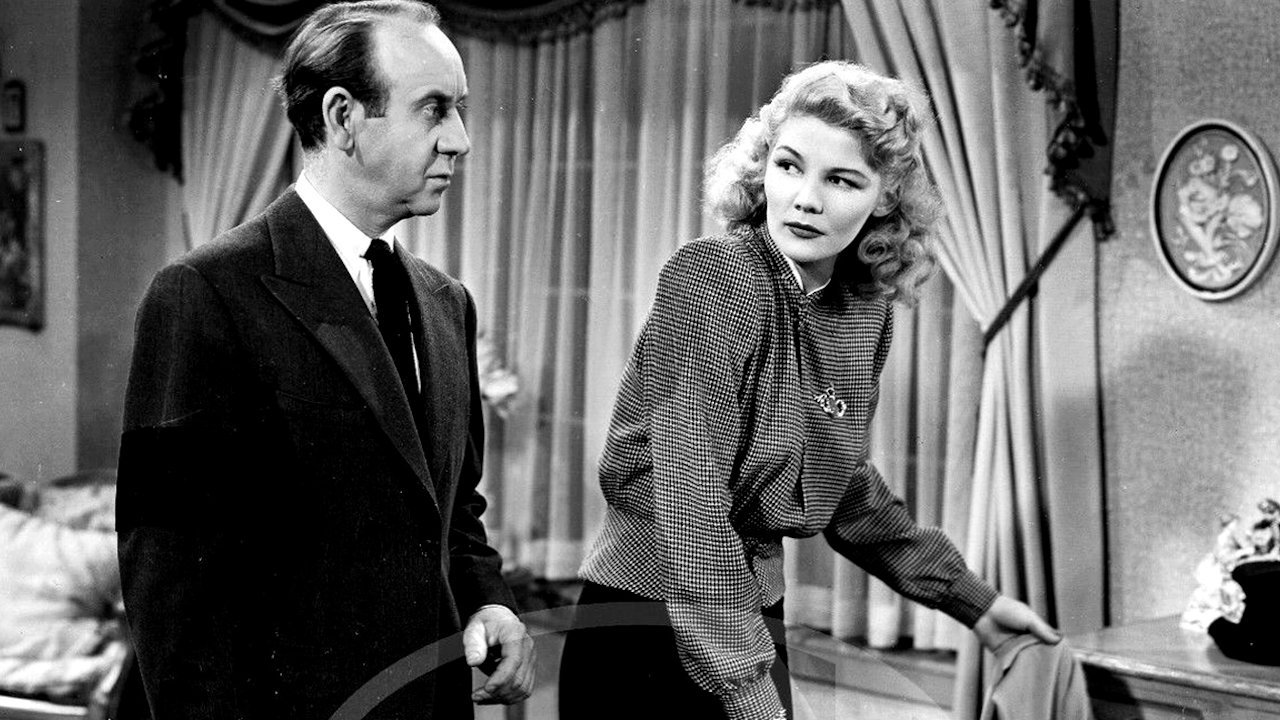
Dangerous Intruder – scene
The Darkened Parlor Light Through a Closed Door

The camera holds at a slight remove as a sliver of light from an adjoining room cuts across the parlor floor, bisecting the frame diagonally and leaving the near foreground in near-total shadow. A figure – still, listening – is visible only as a silhouette anchored to the right edge of the composition. James S. Brown Jr. makes no attempt to fill the darkness; the available light is the point, a single source doing the work that more resourced productions would assign to a full lighting package.

The scene distills the film's central anxiety: that proximity to the truth is not the same as possession of it. The listening figure knows something is happening beyond that door but cannot act without revealing their own position. It is a small moment that the film earns precisely because it has resisted explaining everything too early – the darkness is not decorative but moral, a visual correlative for the suspended judgment in which every character in the house is living.

Visual Language

The Cinematography

🎞️
James S. Brown Jr. – Director of Photography

Working within PRC's stringent budgets, cinematographer James S. Brown Jr. constructs Dangerous Intruder almost entirely on studio interiors, and the constraint shapes every choice. Brown relies on hard, directional sources – practical lamps augmented by off-camera instruments positioned low and lateral – to fragment the domestic space into zones of knowledge and ignorance. Shadow is not softened or graduated; it falls in flat, decisive planes that turn familiar rooms into something less habitable. Lens selection stays close to standard focal lengths, which keeps the geometry of the rooms legible while allowing faces to be read in half-light without losing compositional integrity. There is little camera movement; Brown favors the held frame, which concentrates pressure on the actors and keeps the audience reading the background for information. The result is a visual language that mirrors the film's moral logic: in a house where everyone is withholding something, the camera withholds too.

In the Catalogue

Themes & Motifs

Availability

Where to Watch

Also in the Directory

See Also