In a shabby room, a dying police sergeant named Joe Portugal recounts how he came to be shot by Margot Shelby, a cold and calculating woman whose ambitions have left a trail of ruined men. Margot's story unfolds in flashback: she is the mistress of Frank Olins, a convicted killer awaiting execution, and she is convinced he has buried a quarter-million dollars somewhere beyond the reach of the law. When Olins goes to the gas chamber, Margot's plan does not end – it begins.
Margot recruits Dr. Craig, a weak and debt-ridden physician, to use a rare antidote to revive Olins after his execution and force him to reveal the money's location. She also manipulates Jim Vincent, a small-time accomplice, playing on his infatuation with her while treating him as expendable. As alliances shift and each man begins to understand the depth of her indifference, the film traces the systematic way in which Margot disposes of anyone whose usefulness has expired.
Decoy occupies an extreme position within the femme fatale tradition. Where many noirs soften the woman's villainy with ambiguity or victimhood, this film strips away every mitigating layer. Margot Shelby is neither corrupted nor coerced; she is the film's sole engine of destruction, and the narrative is structured entirely around the logic of her ruthlessness. The result is one of the starkest portraits of predatory will in the cycle.
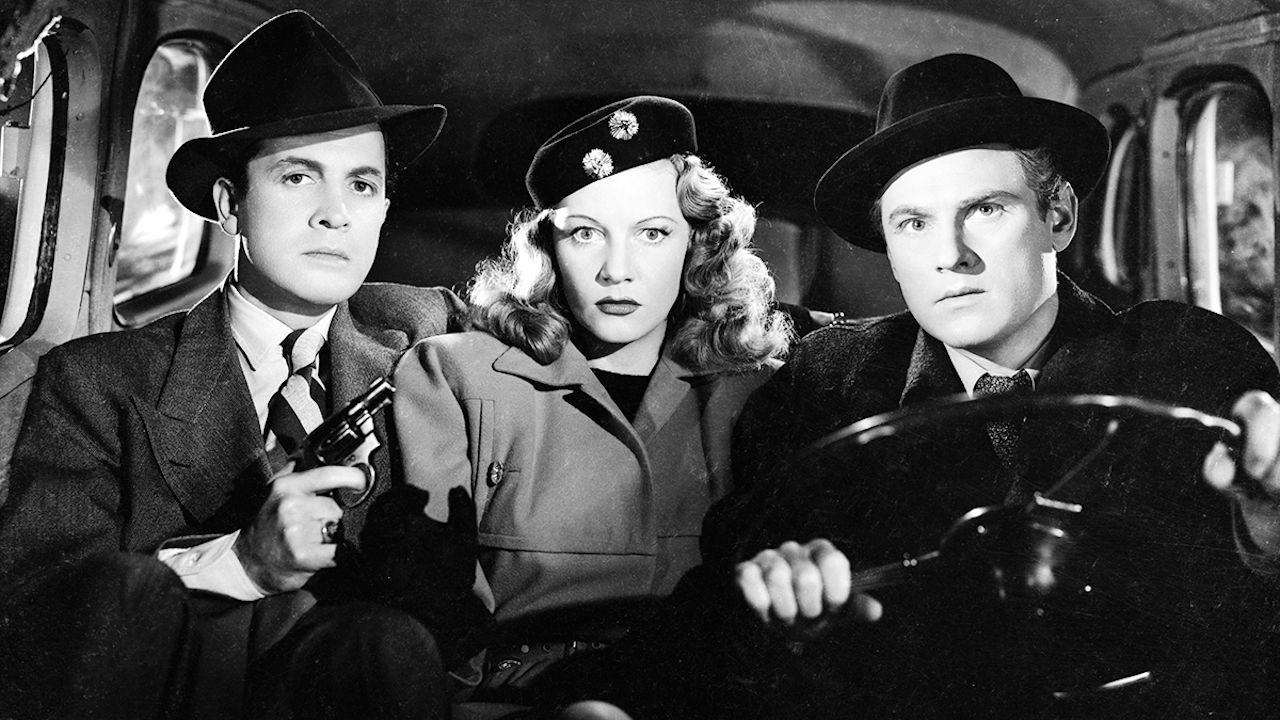
Decoy is a minor-studio production that achieves something the major studios rarely permitted: an unqualified female monster. Jean Gillie, a British actress who would die the following year at thirty-three, delivers a performance of unsettling flatness – not the flatness of limited range, but of a character in whom conscience has simply never operated. The film was produced by Bernhard-Brandt on a poverty-row budget, and director Jack Bernhard turns those constraints into atmosphere, keeping the action close and interior. What Decoy reveals about its era is the degree to which the Production Code could be navigated by framing transgression as cautionary tale: Margot is punished, but the punishment arrives so late and so casually that it functions less as moral restoration than as narrative punctuation. The film's willingness to let her dominate every scene, to let her contempt for the men around her go largely unchallenged until the final minutes, marks it as an outlier whose reputation has grown steadily among scholars of the cycle.
– Classic Noir
After Olins collapses on a rural road, the camera holds on Margot in medium close-up as he reaches toward her from the ground. L. William O'Connell keeps the frame tight, the surrounding darkness undifferentiated, so that the spatial relationship between the two figures is reduced to its essential geometry: one figure prostrate, one upright and still. The light falls from a slightly elevated angle, catching the planes of Gillie's face without softening them, leaving her expression readable but not sympathetic.
The scene functions as the film's thesis statement. Margot does not act, does not speak, does not move toward or away from the dying man. Her stillness is not shock or hesitation – the film has already established that she feels neither. It is the stillness of completion. What the scene argues, and what makes Decoy unusual within its cycle, is that the femme fatale's power is not sexual manipulation alone but the total absence of the reciprocal feeling her victims assume must be present.
L. William O'Connell was a journeyman cinematographer with roots in silent-era production, and in Decoy he works within the tight geography of low-budget studio shooting to produce imagery that compensates for what the production cannot afford. Without elaborate location work, O'Connell relies on high-contrast single-source lighting to compress interior spaces into fields of shadow interrupted by hard light. Faces are often lit from acute angles that flatten the warmth out of a shot, a choice that serves Margot's characterisation directly – there is nothing in the lighting that invites the audience to linger on Gillie's features as conventionally desirable. Deep focus is used selectively in wider compositions to keep multiple characters readable within the same frame, reinforcing the film's interest in power dynamics and spatial control. The visual language is not decorative; it is diagnostic, treating the frame as an enclosure from which none of the men Margot encounters will exit intact.
Decoy entered the public domain and multiple transfers are available on Archive.org; print quality varies, but the platform offers the most immediate free access.
TubiFreeTubi has carried public-domain noir titles of this vintage; availability may shift, but it has been a reliable source for low-budget 1940s productions.
Criterion ChannelSubscriptionThe Criterion Channel periodically programmes poverty-row and B-noir cycles where Decoy would sit naturally; check current listings as availability rotates.