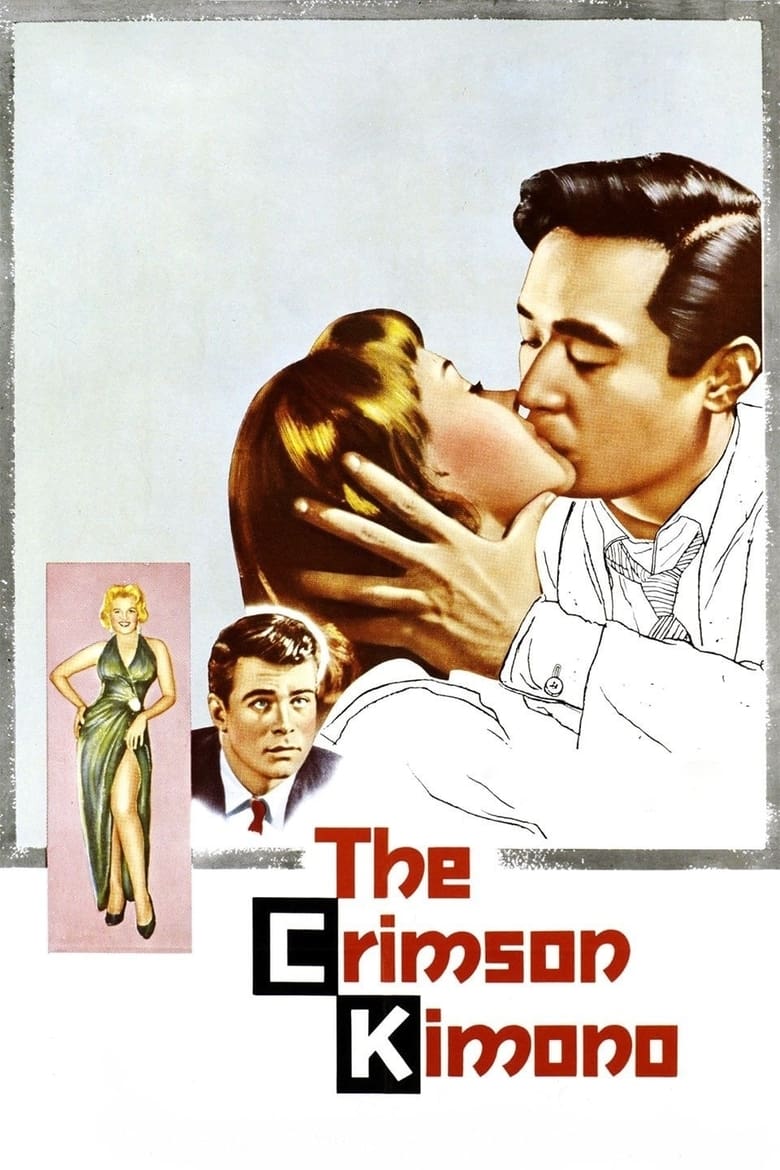
When strip dancer Sugar Torch is shot dead on a Los Angeles street, homicide detectives Charlie Bancroft and Joe Kojaku – Korean War veterans and close friends – pick up the case. The trail leads them into Little Tokyo, where Sugar had been seen in the company of a man connected to the local underworld. As they canvas the neighborhood, the two men encounter Christine Downs, a painter who witnessed something she cannot quite articulate, and whose presence begins to alter the investigation's center of gravity.
Christine's account points toward a small-time operator named Casale, but the case resists easy resolution. More consequential is what happens off the record: both Charlie and Joe fall for Christine, and when she chooses Joe, Charlie's response unsettles him. Fuller refuses to let the love triangle function as simple melodrama. Joe, a Japanese American navigating a city still marked by wartime prejudice, reads Charlie's withdrawal as racial resentment, a suspicion that corrodes the partnership and forces each man to examine what he actually believes about himself and the other.
Fuller uses the murder investigation as scaffolding for a film primarily concerned with race, loyalty, and the gap between a man's self-image and his behavior. The procedural mechanics are sound, the Los Angeles locations – shot on the street rather than on a backlot – give the film a documentary texture, and the resolution manages to honor both the noir tradition and the more discomforting argument Fuller is making about postwar American identity.
The Crimson Kimono occupies an unusual position in Fuller's output and in the genre at large. Released in 1959, it arrives at the tail end of classical noir's run and uses the genre's conventions – the murder, the procedural chase, the destabilizing woman – as cover for something more pointed. The film's central claim, that a Japanese American man in Los Angeles cannot trust his own interpretation of white behavior, and that his white partner cannot fully account for his own motives, is not resolved tidily. Fuller refuses the liberal reassurance most studio pictures of the era would have supplied. What makes the film durable is precisely this refusal: the racial tension is not cleared away by the final reel but absorbed into the characters' ongoing uncertainty about each other. James Shigeta's performance as Joe Kojaku is understated in a way the script's thesis requires – a man trained by experience to second-guess every social signal. Glenn Corbett matches him without overplaying the ambiguity. The film is minor Fuller in scale but not in seriousness.
– Classic Noir
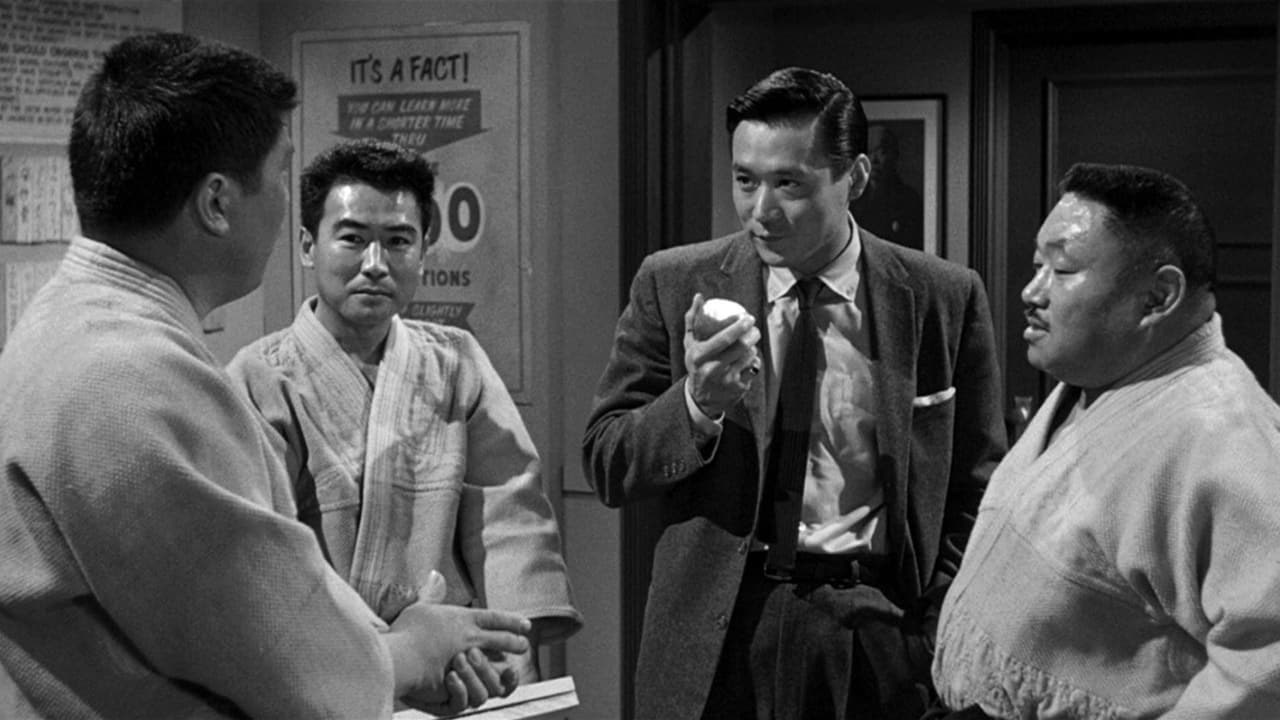
The two detectives square off in a kendo match at a local dojo, protective armor converting them into figures stripped of individual identity. Sam Leavitt's camera stays close, cutting between the masked faces and the bamboo strikes, the overhead gymnasium lights creating flat, hard shadows that fall straight down and eliminate the middle ground. The frame is spare – bare floor, white walls, two figures – and the editing rhythm accelerates in a way that belongs less to sport than to collision.
The scene functions as the film's emotional fault line. Charlie fights with a ferocity that surprises Joe and, the film implies, surprises Charlie. Fuller withholds any confirming glance or explanatory dialogue. What the sequence establishes is that the question the film is asking – whether Charlie's withdrawal from Joe is rooted in racial prejudice or in wounded friendship – cannot be settled by watching two men hit each other. The physical contest externalizes an interior conflict that the film insists remains unresolved even as the combatants bow and remove their masks.
Sam Leavitt, working in crisp black-and-white CinemaScope, shoots Los Angeles as a city of surfaces rather than shadows. Unlike the chiaroscuro interiors that define classical noir, Leavitt's approach here favors available light and location depth – the streets of Little Tokyo, the interior of the parade route, the dojo's functional geometry. The wide frame is used not for compositional elegance but for social information: figures are placed in relation to storefronts, crowds, and architecture that carry meaning about who belongs where. When the film moves indoors, Leavitt tightens the frame and lets the single-source lighting produce the genre's familiar angular shadows, but these moments feel like quotation rather than default. The visual contrast between the open, documented street and the constrained interior mirrors the film's argument: prejudice operates in public space, not only in the expressionistic dark.
The Criterion Channel carries a clean transfer as part of its Fuller programming, making this the most reliably presented option for a film that rewards close attention to Leavitt's location photography.
TubiFreeA free ad-supported stream is available on Tubi, though transfer quality may vary; confirm availability in your region before viewing.
Archive.orgFreeA public domain version circulates on the Internet Archive; image quality is inconsistent but the film is watchable and freely accessible without registration.