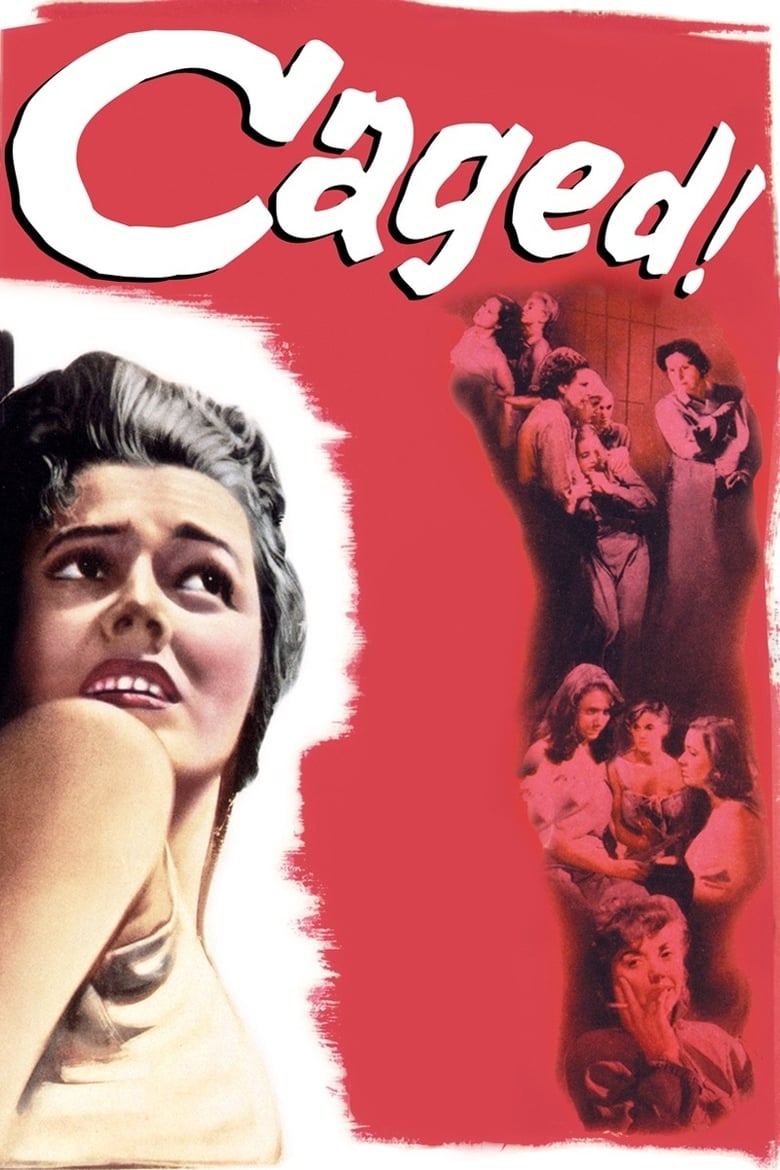
Marie Allen (Eleanor Parker) arrives at a state women's prison young, pregnant, and convicted as an accessory to the armed robbery in which her husband was killed. Superintendent Ruth Benton (Agnes Moorehead) recognizes in Marie the profile she has seen too many times – a peripheral offender ground into the institution's machinery – and attempts to navigate a prison bureaucracy that is indifferent at best and predatory at worst. Marie gives birth, surrenders her child to relatives she can barely afford to call, and begins serving her sentence in the company of women whose circumstances range from the merely desperate to the genuinely dangerous.
The real power inside the prison does not belong to Benton. Matron Evelyn Harper (Hope Emerson) runs the cell block through physical intimidation and petty extortion, while Kitty Stark (Betty Garde), a career criminal with syndicate connections, operates a pipeline that moves women from release into prostitution. Marie resists, then accommodates, then is shaped. The film traces that erosion carefully: each small capitulation is legible, each institutional failure is specific. Jan Sterling's Smoochie and Ellen Corby's Emma Barber provide contrasting models of survival, and Lee Patrick's Elvira Powell offers a study in the damage done to women who are neither fully inside nor fully outside the criminal economy.
Caged belongs to a strand of social-problem filmmaking that Warner Bros. had been developing since the 1930s, but it turns that tradition toward a subject the studio had not previously examined with this degree of sustained attention. The film operates as a procedural critique of carceral institutions, but it also functions within the conventions of noir – the inexorable compression of options, the environment that transforms character, the pessimism about institutional remedies. Where most noir locates its determinism in fate or desire, Caged locates it in policy.
Caged arrived in 1950 as one of the more disciplined social-problem pictures of the postwar cycle, and it has worn better than most of its contemporaries because John Cromwell resists the genre's tendency toward melodramatic resolution. Eleanor Parker's performance is controlled to an unusual degree – she does not announce Marie's degradation but accumulates it across small behavioral details, so that the woman who arrives in the opening scene and the woman who exits in the final one are genuinely different people. Agnes Moorehead's Benton is the film's moral center, but Cromwell refuses to make her effective; she understands the institution's failures and cannot correct them, which places the film considerably to the left of reform-minded Hollywood convention. Hope Emerson's Harper, meanwhile, is one of the period's more fully realized depictions of institutional cruelty – not a cartoon sadist but a woman who has learned which behaviors the system will protect. Taken together, Caged constitutes a serious argument about what prisons do, framed within a genre that gave it sufficient cover to be made at all.
– Classic Noir
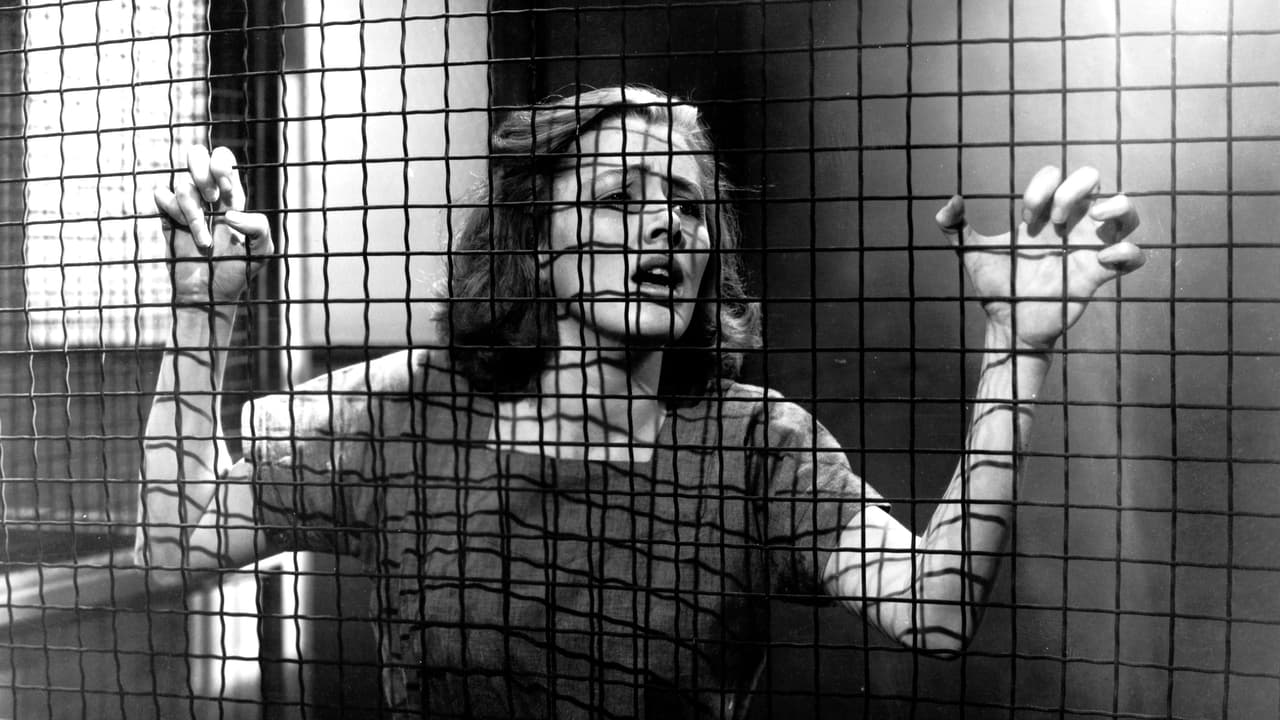
Carl E. Guthrie lights the corridor from a high, raking angle that turns the bar shadows into a grid across the floor and the far wall, geometry that flattens the women inside it into elements of the institution rather than individuals within it. When Harper moves through the frame, her bulk fills it in a way that Guthrie seems to have composed deliberately – she does not merely occupy space, she occludes it. The camera holds at a slight low angle that gives her physical authority over the architecture itself, and the light catches the metal of her keys without flattering anything else in the shot.
The scene makes the film's central argument visible: power here is not procedural or administrative but physical and spatial. Benton can write reports; Harper controls what the women can see, eat, wear, and touch. The composition confirms what the screenplay states indirectly – that the formal hierarchy of the institution and its operational hierarchy are not the same thing, and that the gap between them is where the damage is done.
Carl E. Guthrie shoots Caged almost entirely on studio-constructed sets, and the artificiality works in the film's favor – the prison has the sealed, pressurized quality of a space designed to prevent exit rather than approximate reality. Guthrie favors tight interiors with low ceilings that compress the frame vertically, and his lighting tends toward hard sources placed outside the natural eyeline so that shadows fall at angles that suggest surveillance rather than atmosphere. He avoids the expressionist extremes that contemporaries were using in male-centered noir; the visual language here is closer to institutional fluorescence, an absence of warmth rather than a dramatic deployment of darkness. The effect is a specific kind of oppressiveness – not nightmare but bureaucracy, not fate but policy rendered in light and architecture. Where noir DP work often reads as stylized, Guthrie's choices read as systematic, which is precisely what the material requires.
As a Warner Bros. production, Caged has appeared on Max and is among the more reliably available options for subscribers seeking a clean studio print.
TCMBroadcastTCM rotates Caged into its programming with some regularity and typically presents it from a well-preserved studio source; scheduling is worth checking in advance.
Archive.orgFreeA public-domain transfer circulates on Archive.org; print quality is variable and this is best treated as a fallback rather than a primary viewing option.