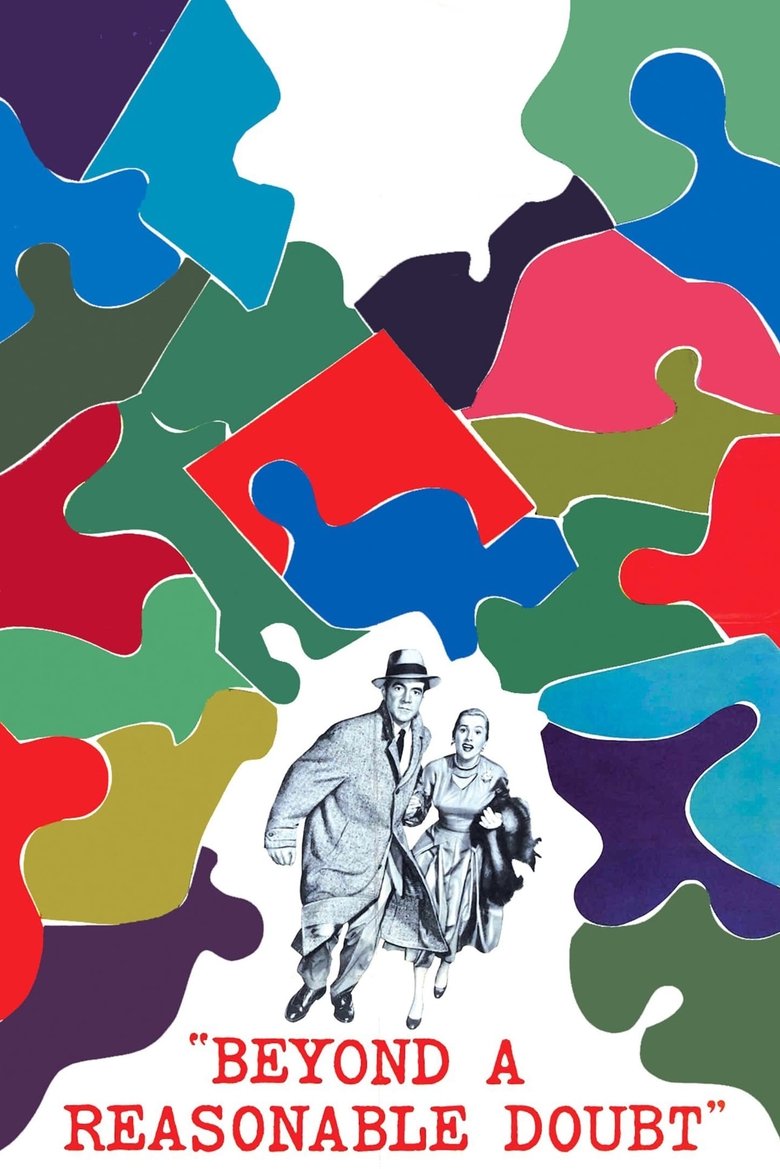
Publisher Austin Spencer opposes capital punishment and conceives a scheme to expose its dangers: he convinces his daughter's fiancé, journalist Tom Garrett, to plant false evidence linking himself to the unsolved murder of a nightclub dancer named Terry Larue. Spencer will photograph each stage of the fabrication, sealing the proof in an envelope to be opened only after Garrett is convicted and sentenced to death – a sensational demonstration that an innocent man can be condemned on circumstantial evidence alone.
The plan proceeds with cold efficiency until Spencer is killed in a car accident before he can produce the exculpatory photographs. Garrett now sits on death row with no witness, no documentation, and a district attorney, Roy Thompson, who has built his career on the conviction. Susan Spencer, torn between love for Garrett and the wreckage of her father's design, works frantically alongside editor Bob Hale to reconstruct the evidence trail before the execution date arrives.
Lang constructs the film as a procedural argument about legal certainty, but the machinery serves a deeper and darker purpose. The courtroom sequences and their aftermath place Beyond a Reasonable Doubt squarely within the wrong-man tradition, yet the film refuses the genre's usual moral consolations – what looks like a thriller about justice in peril is also, and more disturbingly, something else entirely.
Beyond a Reasonable Doubt arrived in 1956 as Fritz Lang's final American film, a stripped, almost schematic work that critics of the period largely dismissed as minor. Reassessment has been slow but steady. Working on a constrained budget for producer Bert E. Friedlob, Lang and screenwriter Douglas Morrow reduce the noir apparatus to its skeleton: no rain-slicked streets, no femme fatale in the conventional sense, no expressionist shadow play. What remains is a film about the machinery of proof – how evidence is constructed, how guilt is assigned, how the justice system can be manipulated by those who understand its logic. Dana Andrews, in his second collaboration with Lang after While the City Sleeps, plays Garrett with a calculated flatness that only retrospectively reveals itself as something other than stoicism. Joan Fontaine functions less as romantic counterpart than as the film's moral register, the one character whose instincts are finally vindicated. The late reversal – abrupt, unsentimental, and deliberately uncomfortable – anticipates the kind of narrative disturbance that would define European art cinema in the following decade. In that sense the film belongs as much to the future as to the tradition it appears to inhabit.
– Classic Noir
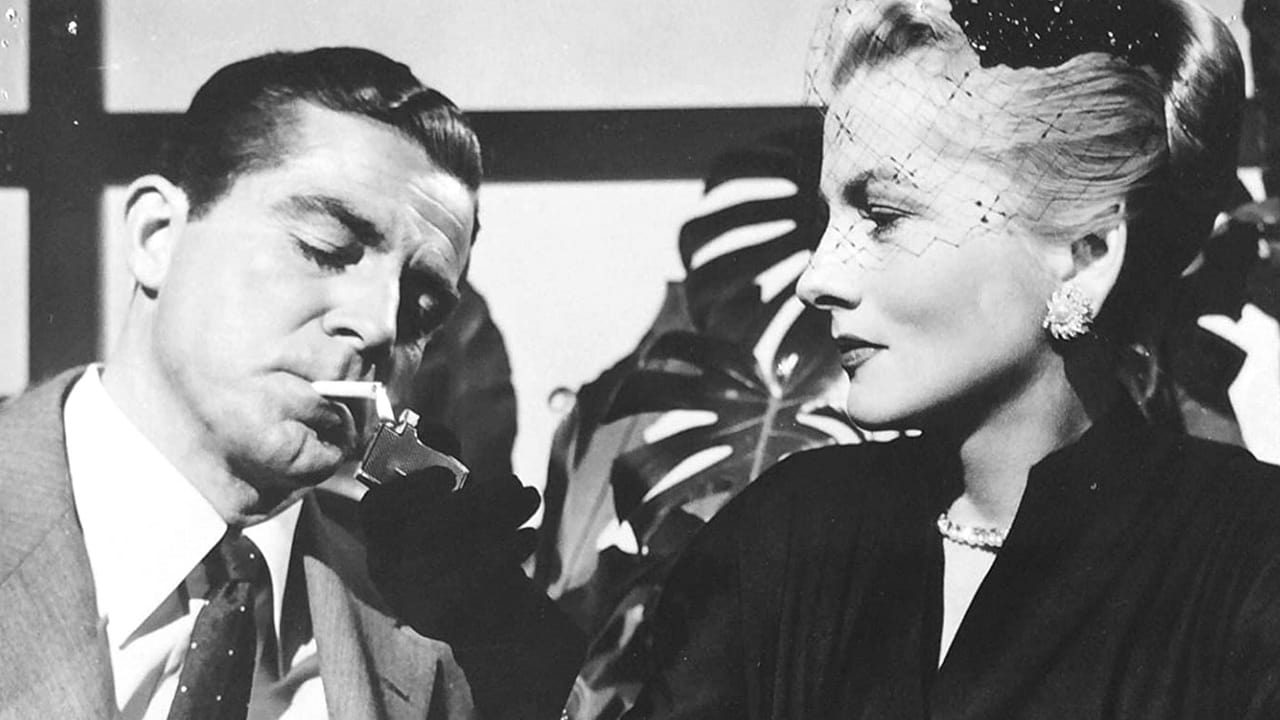
Lang holds the camera at a neutral, institutional distance as Susan confronts Garrett through the intermediary space of a telephone receiver, the mise-en-scène stripped of any atmospheric ornamentation. The light is flat, bureaucratic – William E. Snyder's framing denies the scene the chiaroscuro comfort of classic noir and refuses the viewer any visual cue about where sympathy should rest. The composition places Garrett at a slight remove from the center of the frame, a small displacement that registers as unease before the dialogue confirms it.
The scene enacts the film's central argument in compressed form: the legal standard of reasonable doubt, invoked throughout as a safeguard, is revealed as a threshold that cuts in more than one direction. What Susan discovers is not exculpation but a different kind of guilt, and Lang stages the moment without expressionistic inflation, trusting the geometry of the frame and the silence that follows speech to carry the full weight of the film's moral logic.
William E. Snyder's photography for Beyond a Reasonable Doubt represents a deliberate departure from the high-contrast grammar that defines the classical noir look. Shooting largely on studio interiors with controlled but unromantic light sources, Snyder uses flat, even illumination in the procedural sequences – courtroom, newsroom, state offices – to reinforce the film's argument that bureaucratic rationality, not expressionist darkness, is the true terrain of danger. Shadow enters the frame selectively, most notably in the scenes involving Terry Larue and the planted evidence, where the visual language briefly acknowledges genre convention before retreating again into institutional flatness. The lens choices stay close to the normal range, avoiding wide-angle distortion, which has the effect of placing characters in spaces that feel neither oppressive nor safe. This visual restraint is formally consistent with Lang's purpose: a film about the construction of proof should not tip its own hand through atmosphere. The cinematography thus serves the narrative's deception as much as its resolution.
Criterion Channel's presentation of the film is likely the most carefully sourced streaming option and situates it within broader noir programming context.
TubiFreeTubi has carried the film as a free, ad-supported stream – a convenient option, though transfer quality should be verified before relying on it for close viewing.
Archive.orgFreeThe film's public domain status means Archive.org hosts multiple versions; quality varies significantly between uploads and should be previewed.