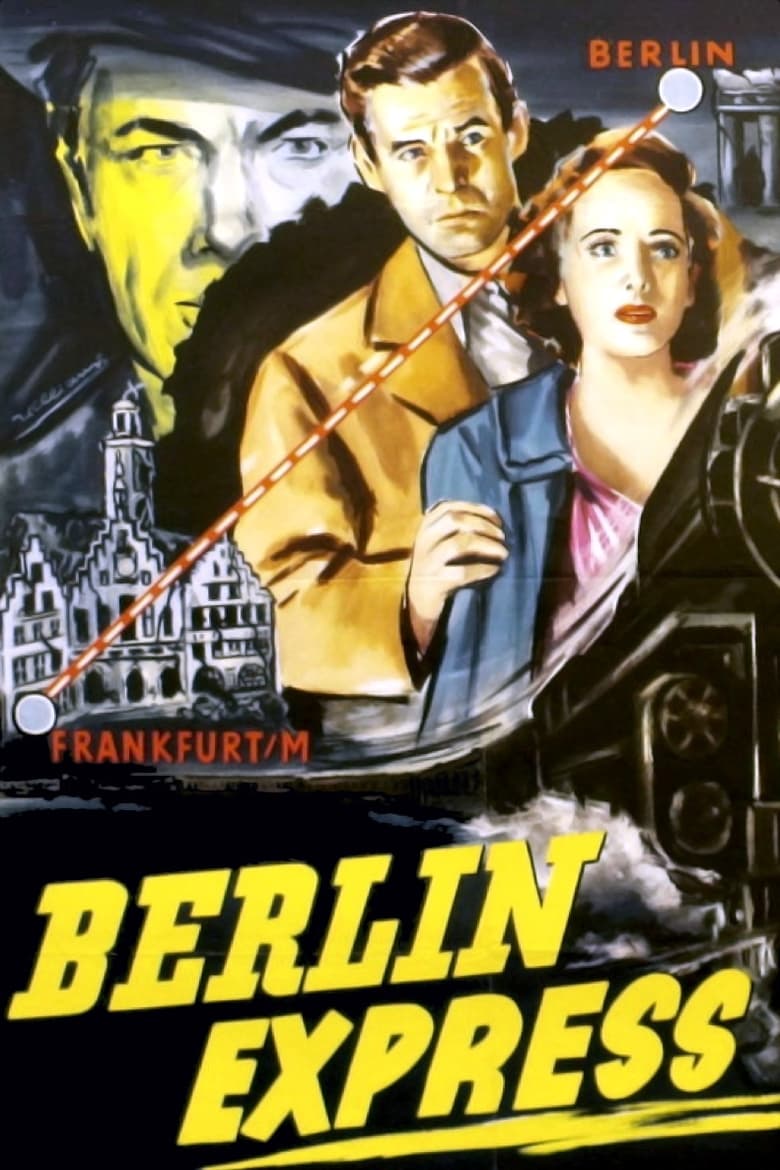
In the chaotic months of Allied occupation, a train departs Frankfurt for Berlin carrying an unlikely assembly of passengers: American agriculture expert Robert Lindley, French liaison Lucienne, British officer Sterling, and Soviet representative Kiroshilov. Among them travels Dr. Bernhardt, a German statesman whose blueprint for reunification has made him a target. Before the train clears the first stretch of ruined countryside, a bomb kills the wrong man and Bernhardt vanishes – seized by a shadowy German nationalist faction determined to bury his work before it can reach the conference table.
The Allied passengers, strangers divided by language and mutual suspicion, are compelled into reluctant cooperation by Soviet and Western occupation authorities who see Bernhardt's recovery as a rare point of common interest. Lindley, an unlikely protagonist with no appetite for intrigue, finds himself drawn into the search through the bombed-out architecture of Frankfurt and Berlin, guided and complicated by Lucienne, whose connection to Bernhardt and to the chief suspect Perrot is never quite transparent. The nationalist cell, meanwhile, operates through the ruins with the practiced invisibility of men who survived one regime and are adapting to the next.
Berlin Express uses the machinery of the political thriller – the ticking clock, the concealed identity, the uneasy alliance – to examine something more unsettled: what postwar Europe actually looks like from street level, and whether cooperation among former enemies is possible when the rubble is still warm. Tourneur keeps the film grounded in documentary texture without surrendering the genre's capacity for moral ambiguity, and the result sits at the intersection of noir's fatalism and the era's cautious, contested optimism.
Berlin Express arrives at a precise historical moment – 1948, the occupation still raw, the Cold War not yet fully named – and Tourneur treats that moment as both setting and subject. The film was shot on location in Frankfurt and Berlin with the cooperation of Allied military authorities, and that access gives it something most studio-bound noirs cannot manufacture: the weight of actual consequence. Lucien Ballard's photography of gutted Wilhelmine facades and displaced-persons camps is not expressionist borrowing; it is record. Against this, Tourneur builds a genre narrative that is genuinely procedural in its middle passages, less interested in suspense mechanics than in the texture of distrust between people who need each other and cannot quite manage it. Robert Ryan, cast against his usual menace as a diffident American civilian, carries the film's thematic argument in his posture alone – a man who would rather be elsewhere, doing something useful. Paul Lukas as Bernhardt gives the endangered idealist a gravity that resists sentimentality. The film does not resolve its anxieties about international cooperation so much as dramatize their difficulty, which is why it holds.
– Classic Noir
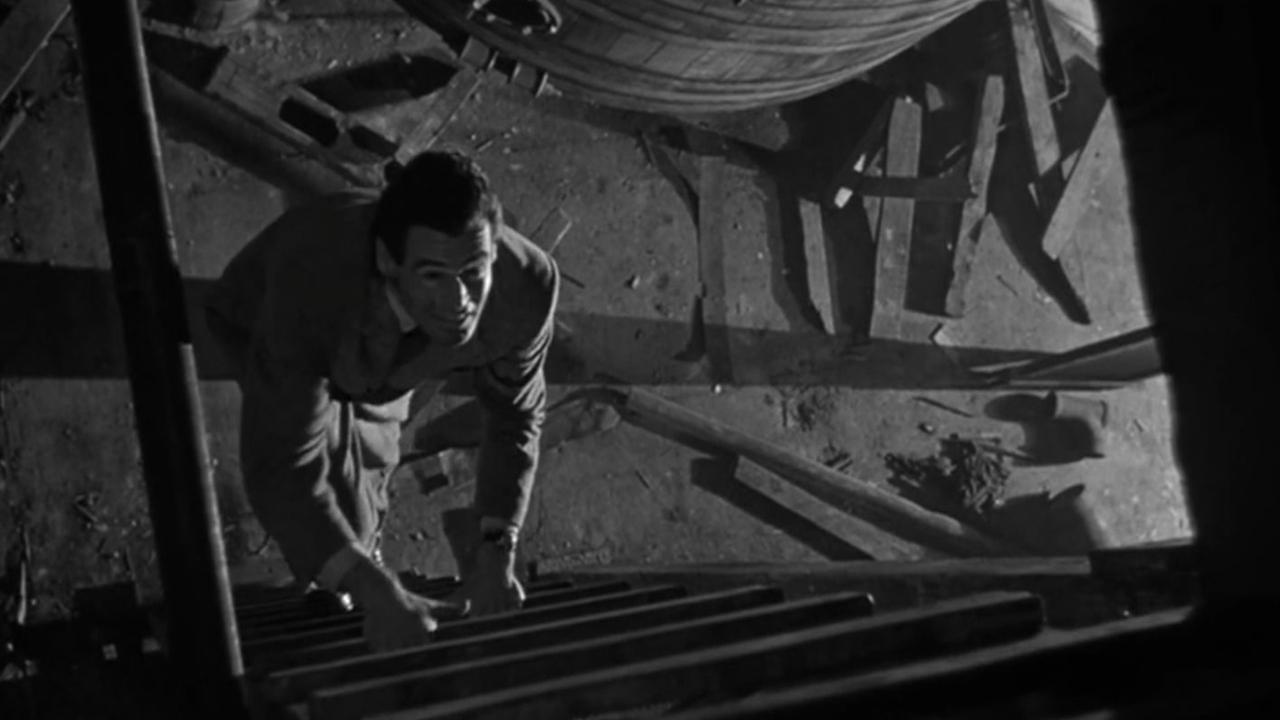
Tourneur and Ballard take the pursuit into the skeletal remains of Frankfurt's old city, and the camera refuses the safety of the studio. Natural light falls through blown-out window casings in hard, uneven shafts, striping the rubble with geometry that has nothing decorative about it. The frame is wide enough to dwarf the figures moving through it – Lindley and Lucienne reduced to small, tentative shapes against facades that retain only their outlines. Ballard holds focus deep into the ruins, so that background and foreground exist in the same plane of sharp, indifferent clarity. There is no chiaroscuro manipulation here; the darkness is simply where the light no longer reaches.
What the sequence establishes, more than plot, is the film's central moral proposition: these characters are moving through the consequence of ideology taken to its end, and the architecture makes that argument without dialogue. Lindley's discomfort in this environment – he keeps looking up, as though floors might still exist – is the American abroad registering, for the first time, what the war cost in material and human terms. The ruins are not backdrop. They are the film's most precise statement about what Bernhardt's peace plan is actually for.
Lucien Ballard's work on Berlin Express is inseparable from the film's argument. Shooting extensively on location in Frankfurt and Berlin under Allied occupation permits, Ballard faced conditions that made conventional studio lighting setups impossible, and he used that constraint. Interior scenes retain a portable, available-light quality that keeps them honest – shadows fall where walls and debris dictate, not where a gaffer might prefer. On the train itself, Ballard uses the narrow corridors and compartment windows to confine and isolate characters within the frame, the moving exterior providing an unstable, indifferent background. His lens choices favor moderate focal lengths that preserve spatial relationships between figures and environment rather than compressing or dramatizing them; the ruins are not made picturesque. Where Ballard does deploy deliberate shadow work – in the Frankfurt cellar scenes and the climactic confrontation – the darkness reads as earned rather than imposed, a product of architecture and situation rather than genre convention. The result is a visual language that aligns with the film's refusal to aestheticize destruction.
The most reliably curated streaming home for RKO-era noir; check current availability as titles rotate.
TCMSubscriptionTCM holds deep RKO library rights and periodically broadcasts Berlin Express in good transfers; scheduling varies.
Archive.orgFreePublic domain prints are available but vary in quality; acceptable for research viewing, not ideal for first encounter.