Films People Pull a Fast One Night Beat Reading Room On TV Shop
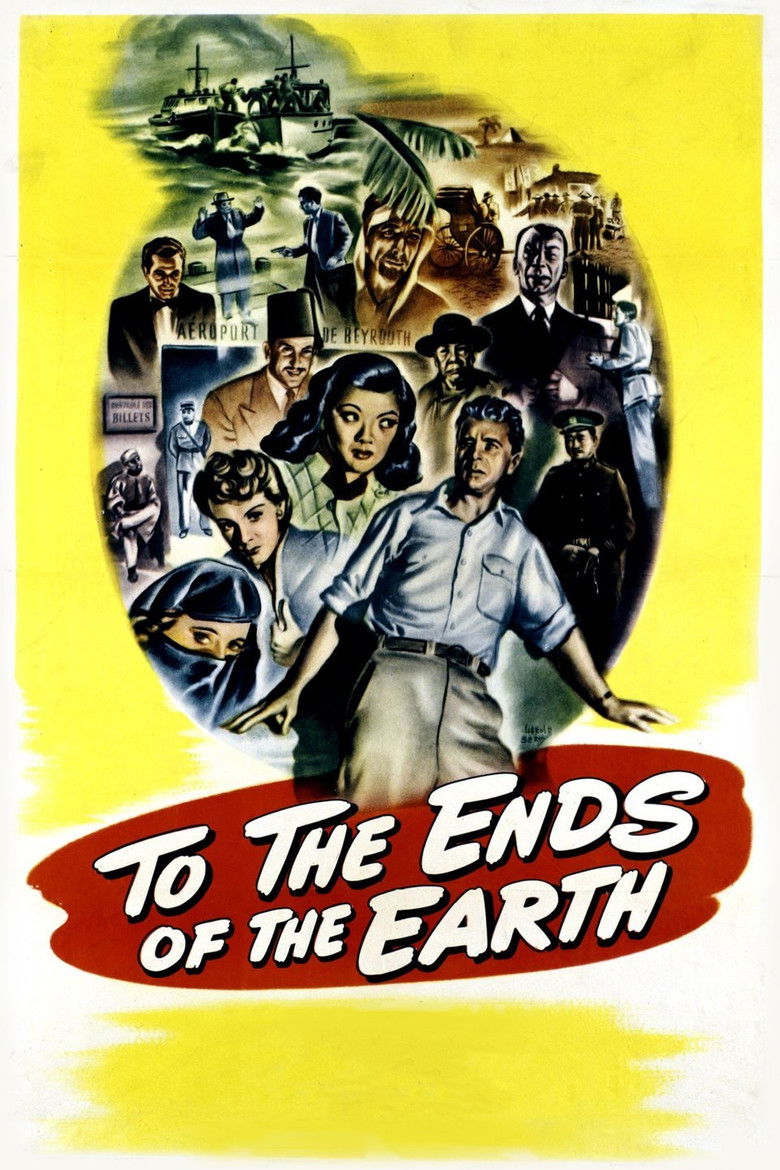
To the Ends of the Earth 1948
1948 Kennedy-Buckman Pictures
★★★☆☆ Notable
Film Noir · 109 minutes · Black & White

To the Ends of the Earth

Directed by Robert Stevenson
Year 1948
Runtime 109 min
Studio Kennedy-Buckman Pictures
TMDB 5.9 / 10
"A federal agent follows an opium trail across four continents, and the world grows darker at every port."

U.S. Treasury Commissioner Michael Barrows is assigned to dismantle a vast international opium smuggling network operating across Shanghai, Cairo, Havana, and New York. Working largely alone and often undercover, Barrows traces the ring through a chain of couriers, middlemen, and corrupt officials whose identities shift with each new city. The investigation brings him into contact with Ann Grant, a woman whose connection to the syndicate remains ambiguous – a potential ally, a potential plant, or simply another casualty of a trade that destroys everyone it touches.

As Barrows moves deeper into the network, the line between investigator and pursued begins to blur. His superiors at the Treasury Department, represented through a chorus of international commissioners including the taciturn Lum Chi Chow and the calculating Lariesier, provide coordination but little protection. The syndicate's operatives – among them the cold functionary Nicholas Sokim and the elusive George Shannon – prove capable of surveillance, disappearance, and murder, forcing Barrows to improvise in environments where his authority carries no weight.

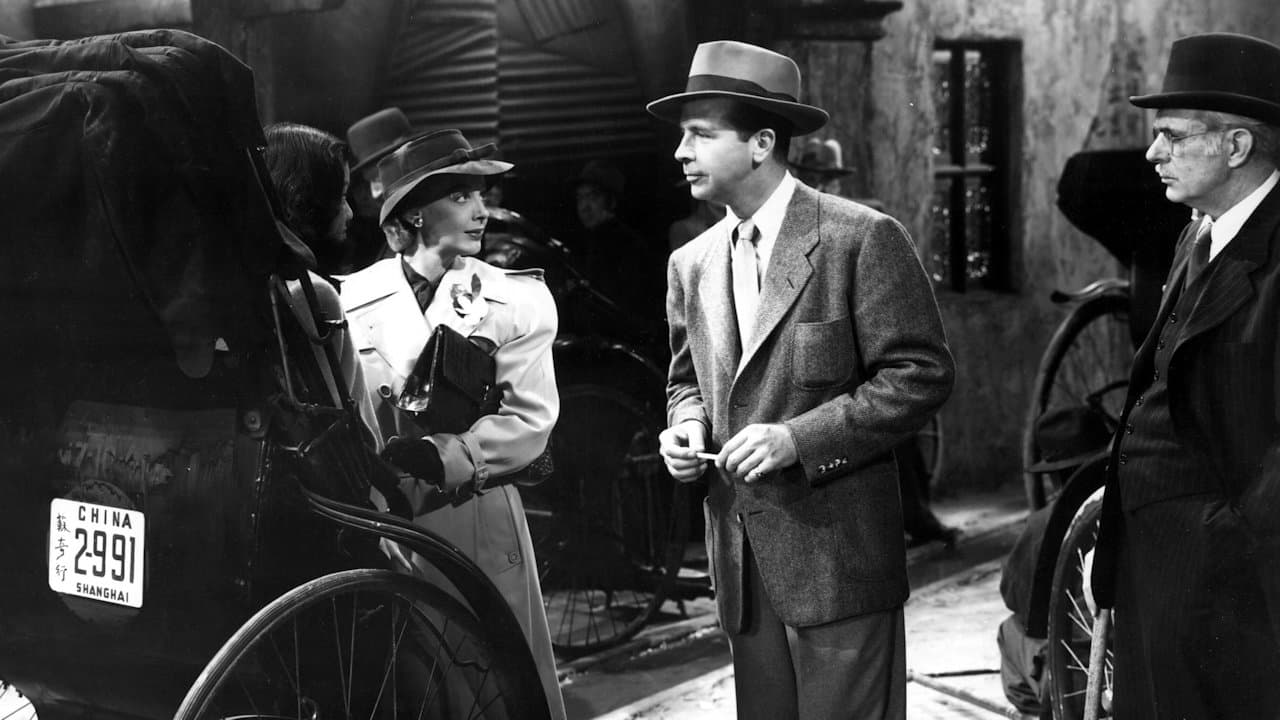
Adapted from a Treasury Department case file and shot partly on location across multiple countries, To the Ends of the Earth occupies a distinctive position between the procedural documentary style emerging in postwar American crime cinema and the more expressionist tradition of the noir thriller. The film's genuine geographic sweep gives its moral argument a specific weight: the opium trade is not an abstraction but a machinery with identifiable parts, and Barrows's relentless forward motion is the only answer the film offers to a world organized around human suffering.
Classic Noir

To the Ends of the Earth belongs to a small group of late-1940s films that attempt to square the documentary impulse – location shooting, voice-of-government narration, procedural detail – with the subjective pressure that defines noir. Robert Stevenson keeps the tension between those modes productive rather than resolved. Dick Powell, by 1948 well past his transition from crooner to hard-edged lead, plays Barrows with a flat professional competence that resists the romanticism the role might invite. The film's internationalism is not merely cosmetic; the postwar anxiety about porous borders and compromised sovereignty is structurally embedded in the narrative. Burnett Guffey's cinematography shifts register between the location-lit flatness of Shanghai exteriors and the sharper chiaroscuro of studio interiors, and the contrast itself carries meaning – danger is most legible when artificially lit. The film never quite achieves the psychological density of first-rank noir, but its procedural rigor and its implicit argument that organized crime is a form of governance deserve more attention than the film typically receives.

– Classic Noir
3 ★★★☆☆ Notable
Credits

The Crew

DirectorRobert Stevenson
ScreenplaySidney Buchman
CinematographyBurnett Guffey
MusicGeorge Duning
EditingWilliam A. Lyon
ProducerSidney Buchman
Performances

The Cast

Close Reading

The Signature Scene

To the Ends of the Earth – scene
The Cairo Waterfront, Night Light on Still Water

Guffey positions the camera at dock level, so that the harbor's surface fills the lower half of the frame while Barrows moves along a narrow quay above. A single arc lamp to the left casts his shadow at a severe diagonal across the stonework. The water reflects broken light in slow, irregular pulses – a visual instability that contradicts the rigid geometry of the pier itself. Barrows pauses, and the frame holds him between two walls of darkness, the reflected light below him doing the expressive work that dialogue has declined to do.

The scene is one of several in which the film acknowledges, without sentimentalizing, Barrows's essential solitude. He is an agent of a government that cannot protect him, in a city that has no obligation to him, pursuing men who know these streets better than he does. The water's refracted light suggests not revelation but distortion – the recurring condition of an investigation conducted at the edge of institutional reach, where the rules that define Barrows's authority become as unstable as the surface below him.

Visual Language

The Cinematography

🎞️
Burnett Guffey – Director of Photography

Burnett Guffey, who would later shoot From Here to Eternity and Bonnie and Clyde, brings a disciplined pragmatism to To the Ends of the Earth that suits the film's hybrid ambitions. On location in Shanghai, Havana, and Cairo, Guffey works with available architecture and natural light sources, favoring wide lenses that establish geographic legibility over compositional drama – the world must be seen to be believed. Once back on the Columbia lot, the visual register changes: tighter focal lengths, harder shadows thrown by practical sources supplemented by side-placed Fresnel units, backgrounds that recede into black rather than resolving into detail. This transition is not inconsistency but argument. The film's moral logic holds that the smuggling network is most dangerous precisely where it is most hidden, and Guffey's studio sequences make hiddenness a physical property of the image. Shadow, in these interiors, is not atmosphere but jurisdiction – territory where Barrows's authority does not extend and where the camera itself seems uncertain of what it is permitted to see.

In the Catalogue

Themes & Motifs

Availability

Where to Watch

Also in the Directory

See Also