Films People Pull a Fast One Night Beat Reading Room On TV Shop
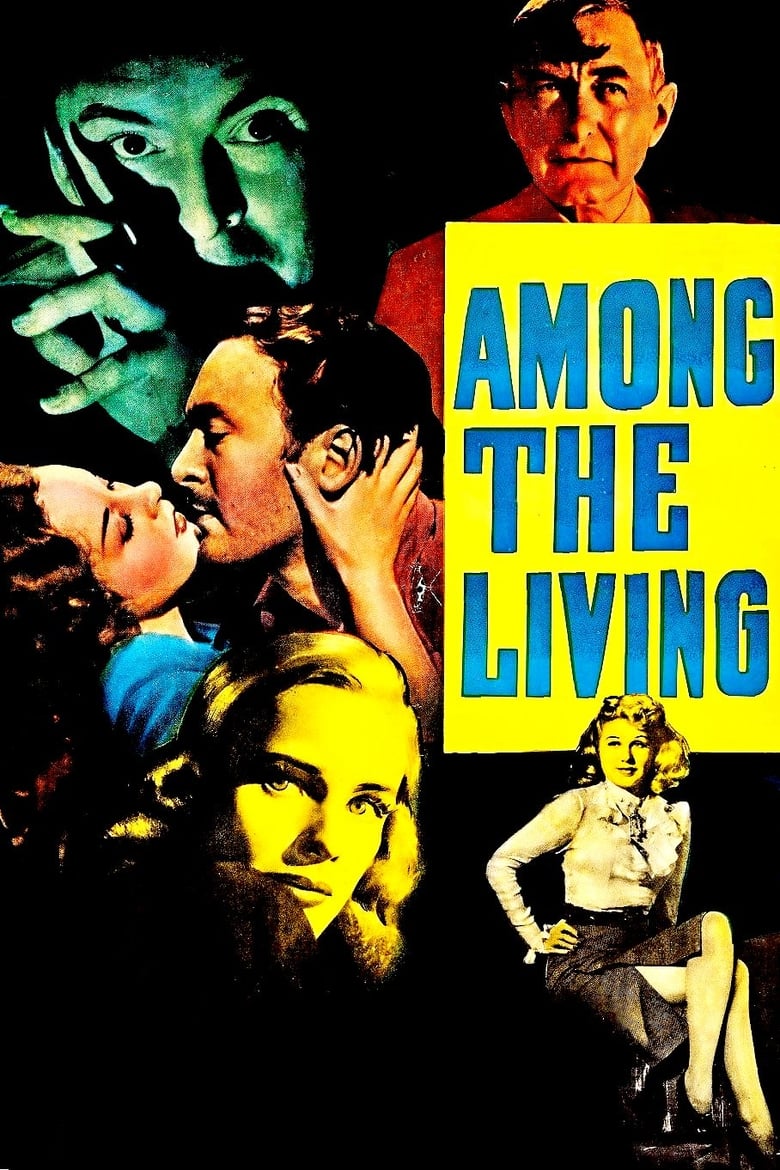
Among the Living 1941
1941 Paramount Pictures
★★★☆☆ Notable
Film Noir · 69 minutes · Black & White

Among the Living

Directed by Stuart Heisler
Year 1941
Runtime 69 min
Studio Paramount Pictures
TMDB 6.1 / 10
"A dead man walks the mill town, and the living cannot tell him from his brother."

When John Raden returns to his Southern mill town after twenty-five years to settle his father's estate, he discovers a secret the family buried long ago: his twin brother Paul has been confined for years in the decaying Raden mansion, kept hidden from the world by a complicit doctor and a household built on silence. Paul, played with unsettling conviction by Albert Dekker in a dual performance, is mentally disturbed – a man arrested somewhere between childhood violence and adult cunning. John, the respectable twin who escaped, must now reckon with what his family chose to conceal rather than confront.

Paul escapes the mansion and moves through the town undetected, mistaken by townspeople for John. He gravitates toward Millie Pickens, a young woman of loose reputation played by Susan Hayward with an edge of ambition and vulnerability, who sees in the well-dressed stranger a ticket out of poverty. As Paul's violence resurfaces and bodies begin to accumulate, the town turns on John, whose identical appearance makes him the natural suspect. The machinery of mob justice accelerates while the two men – one legally innocent, one morally unknowable – remain intertwined by blood and circumstance.

Among the Living operates in the register of psychological unease more than hard-boiled crime, placing it closer to the Gothic strain of early noir than to the urban procedural that would define the cycle's later years. The film's real subject is suppression – of inconvenient truths, of dangerous persons, of class guilt – and it uses the twin conceit not as a thriller gimmick but as a structural argument about identity, inheritance, and the violence that surfaces when a community's self-image is threatened.

Classic Noir

Among the Living arrives at the edge of what is conventionally dated as the noir cycle's beginning, and its uncertainties of tone are precisely what make it worth revisiting. Stuart Heisler works in a register that belongs as much to the Southern Gothic as to crime cinema: the rotting mansion, the hidden lunatic, the complicit professional class. Albert Dekker's dual performance is the film's primary instrument, and he calibrates Paul's menace through restraint rather than excess – a man who is dangerous because he does not know he is. Susan Hayward, in an early role that the studios had not yet decided how to use, brings a material hunger to Millie that prevents her from functioning as a simple victim. Frances Farmer's presence, given her own history of institutionalization that was already unfolding in parallel with this film's production, lends the scenes of confinement an uncomfortable resonance. The film does not fully resolve its moral questions, which is, in the end, its most honest quality.

– Classic Noir
3 ★★★☆☆ Notable
Credits

The Crew

DirectorStuart Heisler
ScreenplayLester Cole
CinematographyTheodor Sparkuhl
MusicGerard Carbonara
EditingEverett Douglas
Art DirectionHans Dreier
ProducerSol C. Siegel
Performances

The Cast

Close Reading

The Signature Scene

Among the Living – scene
The Carnival Crowd Paul Lost Among Faces

Theodor Sparkuhl shoots the carnival sequence with a restless, mobile frame that refuses to settle. Paul moves through the crowd and Sparkuhl keeps him slightly off-center, the surrounding bodies pressing at the edge of the image. Light sources are practical and inconsistent – strands of bulbs, the flash of a ride – throwing irregular shadows across Dekker's face so that his expression shifts meaning depending on which half is illuminated. The composition denies the viewer a stable reading of the man.

The scene makes the central argument of the film visually legible: Paul is not a monster set apart from society but a figure absorbed into it, indistinguishable in the crowd until the moment violence crystallizes. The carnival context – where performance and concealment are the governing conditions – frames him not as an aberration but as a version of something the community already contains. The town's subsequent scapegoating of John becomes, in this light, an act of collective self-protection rather than justice.

Visual Language

The Cinematography

🎞️
Theodor Sparkuhl – Director of Photography

Theodor Sparkuhl, a German-born cinematographer who had worked in the expressionist tradition before emigrating, brings a controlled severity to Among the Living that sits against the film's Southern setting with productive unease. Shooting on Paramount studio sets dressed to suggest provincial decay, Sparkuhl uses deep shadow not atmospherically but architecturally – the Raden mansion is lit so that its interior geography becomes illegible, rooms opening into darkness without clear boundary. His work on the exterior scenes is deliberately flatter, the daylight world of the town rendered in a higher key that makes Paul's intrusion into it feel wrong in a way that is visual before it is narrative. There is no evidence of anamorphic work at this date; Sparkuhl uses standard spherical lenses, but his placement of figures within the frame – often partially obscured, rarely centered with any comfort – sustains a low-grade spatial anxiety throughout the film's sixty-nine minutes.

In the Catalogue

Themes & Motifs

Availability

Where to Watch

Also in the Directory

See Also