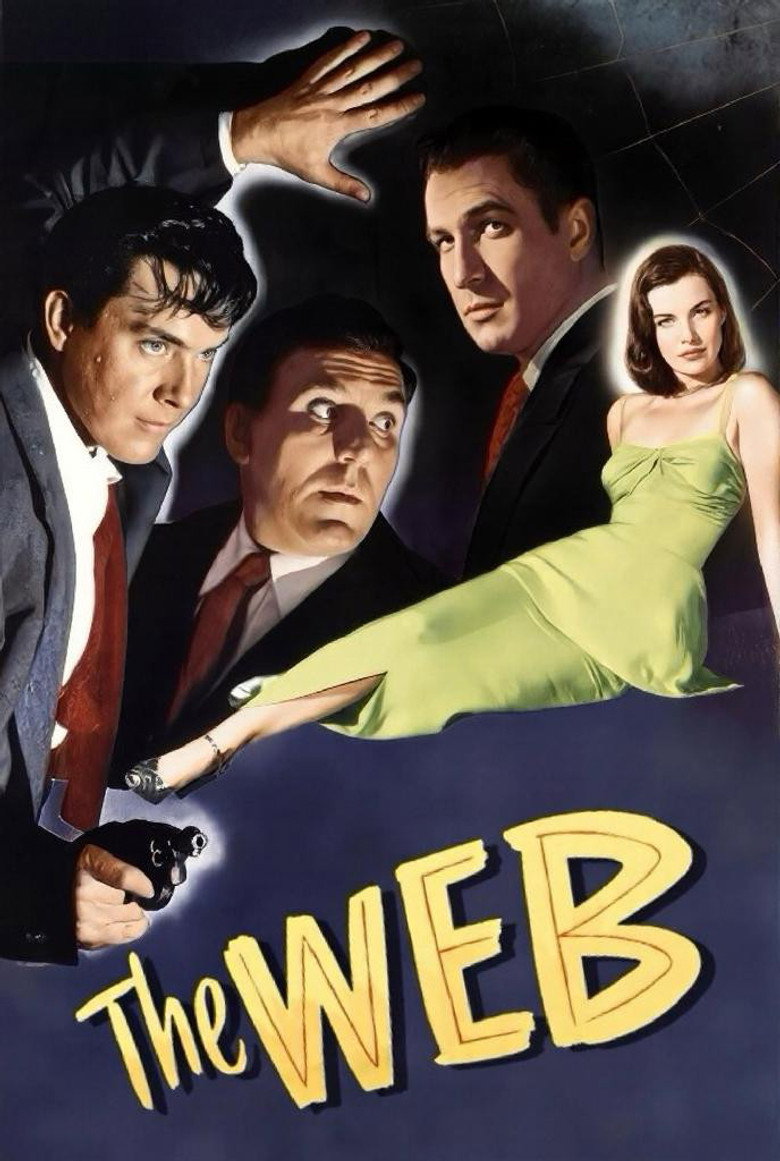
Bob Regan, a lawyer down on his luck, is hired by wealthy industrialist Andrew Colby to serve as his personal bodyguard following an apparent threat on Colby's life. Regan is skeptical but needs the work, and Colby's world – all polished surfaces and private elevators – seems to promise a straightforward assignment. Into this arrangement steps Noel Faraday, Colby's secretary, whose composure masks an unease that Regan cannot yet name.
When Regan kills an intruder in what appears to be clear self-defense, the official machinery moves against him with suspicious efficiency. Lieutenant Damico, a cop whose bluntness reads as either diligence or hostility, pursues Regan as a suspect in what is now reclassified as murder. Colby's support, initially reassuring, begins to feel conditional. Noel, caught between loyalty to her employer and a growing trust in Regan, is pulled toward disclosures that could destroy her own position.
Web belongs to the strand of postwar noir that locates its menace not in the underworld but in the executive suite – where respectability is itself the weapon. The film uses a deceptively modest thriller frame to examine how institutional power criminalizes the vulnerable and protects the guilty, a concern that places it squarely within Universal International's mid-decade run of socially alert genre pictures.
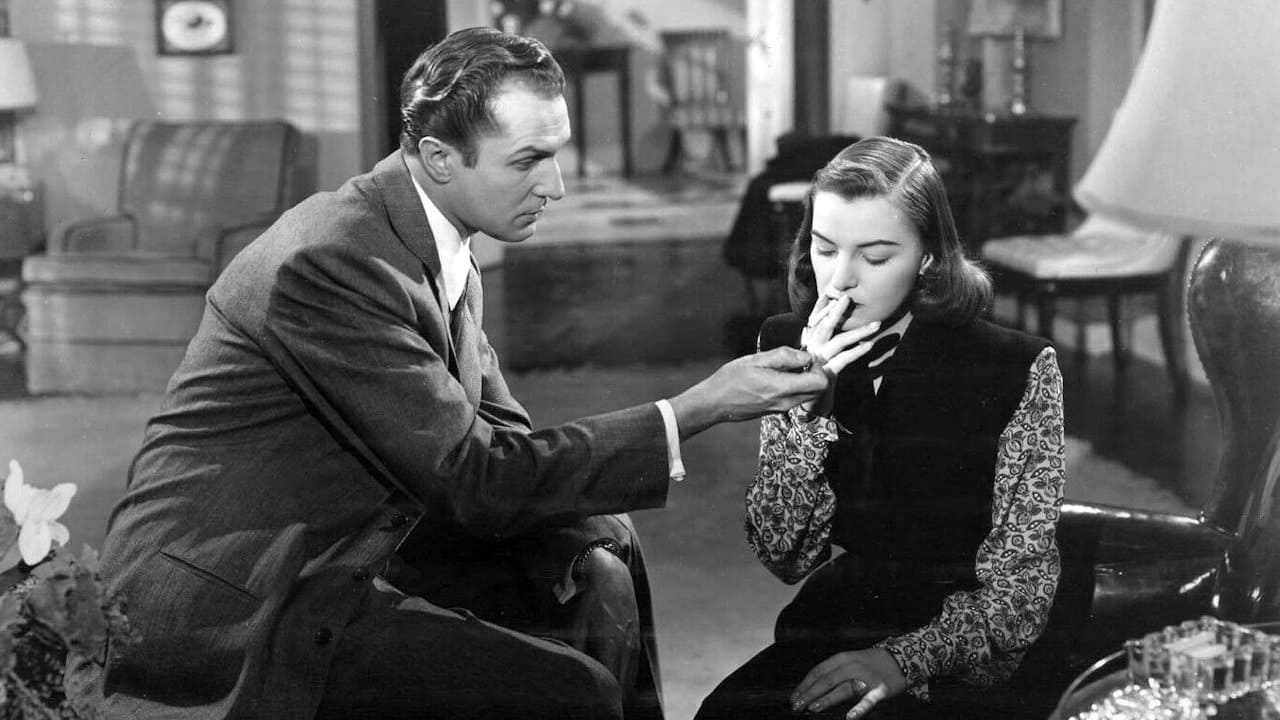
Web is a film that rewards patience with a late structural reversal that recontextualizes nearly everything that precedes it. Michael Gordon, working here in a register more disciplined than much of his studio output, keeps the pace economical and trusts his cast to carry the film's moral weight without underlining it. Edmond O'Brien brings his characteristic quality of reactive intelligence – a man who thinks on his feet because the alternative is defeat – while Vincent Price calibrates Colby's charm to a frequency just slightly too smooth, planting doubt without tipping into caricature. William Bendix, cast against the grain of his usual amiable bruiser, gives Damico an institutional opacity that is more unsettling than outright menace. The film's real argument is about the architecture of plausible deniability: how wealth insulates its owners from consequence while redirecting suspicion downward. That argument was not unusual in 1947, but Web makes it with structural rather than rhetorical conviction, which is the harder thing to do.
– Classic Noir
Gordon and cinematographer Irving Glassberg frame the scene with Colby positioned against the floor-to-ceiling windows of his penthouse office, the city grid visible behind him as a geometry of control. The light source is entirely exterior – cold, diffuse, emanating from a sky that offers no warmth – so that Colby's face is half-illuminated in a way that denies the audience any stable reading of his expression. Regan occupies the foreground, slightly lower in frame, the compositional subordination reinforcing the power imbalance that the dialogue simultaneously contests.
What the scene discloses is the film's central thesis in visual form: that the man with the view owns not just the property but the version of events that will be believed. Regan's physical presence in the frame does not neutralize Colby's authority; it only makes the asymmetry visible. The scene argues, without a word of exposition, that innocence is insufficient protection against a system that has already decided where guilt is convenient.
Irving Glassberg's cinematography on Web operates within the constraints of studio production without being diminished by them. Glassberg – a Universal contract cinematographer who shot prolifically across the decade – uses controlled interior setups to suggest confinement rather than simply depict it. His lighting on the Colby sequences favors high-key sources that produce long lateral shadows, a choice that exposes the institutional spaces as theatres of performance rather than environments of authenticity. In contrast, the scenes involving Regan and Noel in less elevated settings are lit with softer, more diffuse fills, a subtle moral coding that aligns visual comfort with democratic space. Glassberg rarely reaches for expressionist extremes – the Dutch angles and crushed blacks associated with harder noir – but his restrained approach is consistent with the film's argument that corruption in this world wears a presentable face. The camera holds steady where a more demonstrative style would intrude, letting the frame's geometry carry the weight.
Tubi has carried Web as part of its rotating classic noir library; verify current availability before viewing.
Archive.orgFreeAs a Universal International title whose rights status has been contested, Web has circulated on Archive.org – check for the cleanest available print.
Amazon Prime VideoRentalAvailable for digital rental through Prime Video for viewers who prefer a more stable streaming source.