Films People Pull a Fast One Night Beat Reading Room On TV Shop
Way Out 1950
1950 20th Century Fox
★★★★☆ Recommended
Film Noir · 106 minutes · Black & White

Way Out

Directed by Joseph L. Mankiewicz
Year 1950
Runtime 106 min
Studio 20th Century Fox
TMDB 6.9 / 10
"A black doctor and a white bigot share a hospital ward – and a city's capacity for violence."

In a small Midwestern city, two white brothers – Ray and George Biddle – attempt a robbery that goes badly wrong, leaving George gravely wounded and a police officer dead. The only doctor available in the emergency room is Luther Brooks, a young Black physician whose first night on the job becomes an ordeal when Ray Biddle, a virulent racist, refuses treatment from his hands and blames Brooks for the death of his brother. Ray's accusations, fueled by hatred and grief, quickly find a receptive audience among those in the community already predisposed to believe the worst.

As Ray launches a campaign to have Brooks charged with criminal negligence, the doctor's career, marriage, and safety come under increasing threat. Dan Wharton, a seasoned white investigator, attempts to cut through the mob logic forming around the case, while Edie Johnson – a white woman caught between neighborhoods and loyalties – holds testimony that could resolve the matter, at the cost of her own precarious standing. The film traces how institutional racism and personal cowardice allow a false accusation to acquire the momentum of fact.

No Way Out situates itself at the junction of the social problem film and the noir thriller, using the genre's characteristic claustrophobia and moral pressure to examine how racial violence operates not through isolated acts of evil but through the ordinary mechanisms of fear, silence, and complicity. The film's tension depends less on whether Brooks is guilty – he is plainly not – than on whether the world around him is capable of acknowledging that plainly.
Classic Noir

No Way Out arrived in 1950 as one of the most confrontational studio films of its era, and its reputation has only grown more precise with time. Joseph L. Mankiewicz, working from a script he co-wrote with Lesser Samuels, refuses the consolations typical of the cycle of late-1940s race-problem pictures: there is no conversion narrative, no redemptive white savior, and the Black protagonist is not defined by suffering but by professional competence placed under systematic assault. Richard Widmark's Ray Biddle is among the most sustained portraits of racist pathology in classical Hollywood cinema – his performance never aestheticizes the hatred but renders it ordinary, which is far more troubling. Sidney Poitier's debut establishes the composure under duress that would become his screen signature, though the film is careful to frame that composure as a condition of survival rather than a character virtue. As a noir, the film compresses social forces into the register of personal jeopardy, and Milton Krasner's photography makes the geography of segregation – the hospital corridors, the racially divided neighborhoods – feel as deterministic as any femme fatale.

– Classic Noir
4 ★★★★☆ Recommended
Credits

The Crew

DirectorJoseph L. Mankiewicz
ScreenplayJoseph L. Mankiewicz
CinematographyMilton Krasner
MusicAlfred Newman
EditingBarbara McLean
Art DirectionGeorge W. Davis
CostumesTravilla
ProducerDarryl F. Zanuck
Performances

The Cast

Close Reading

The Signature Scene

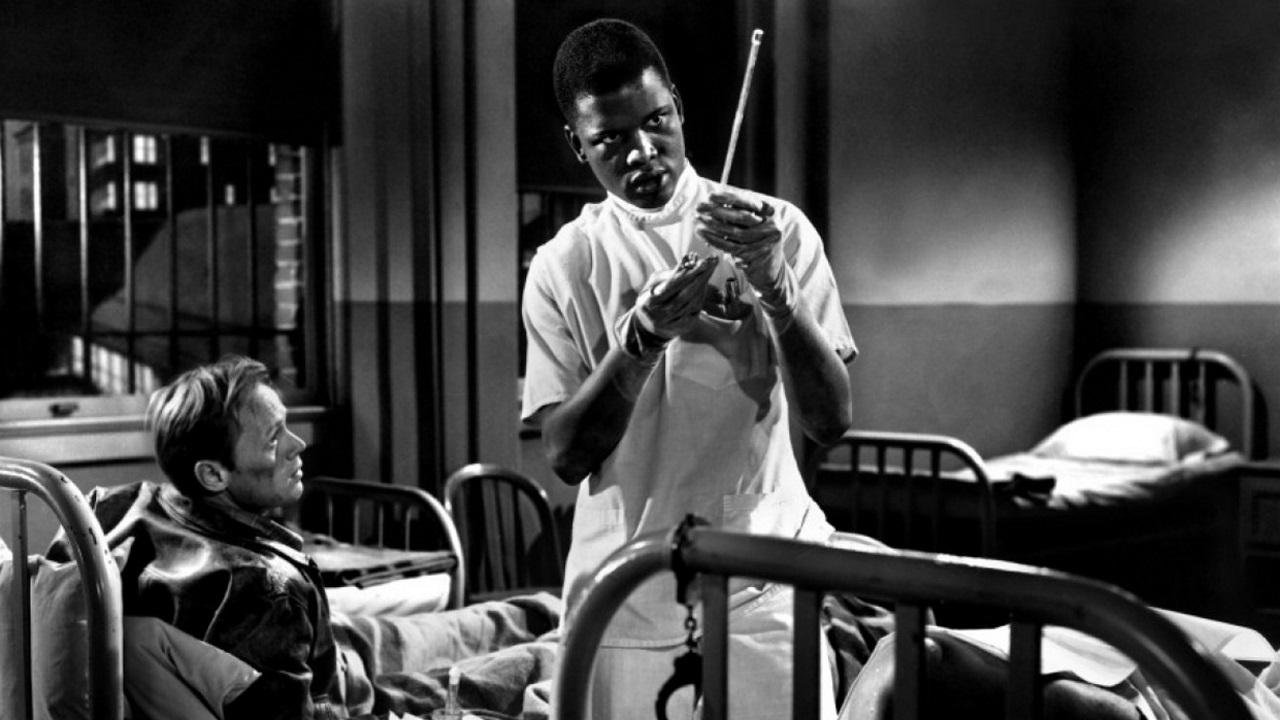
Way Out – scene
The Prison Ward, Night Diagnosis Under Hostile Watch

Krasner shoots the prison ward sequence in hard, institutional light that strips the frame of shadow and offers no atmospheric shelter. The overhead fluorescents bleach everything equally – the white walls, the white sheets, Biddle's white face contorted in contempt, and Brooks's hands moving through the examination with unhurried precision. The camera holds on Brooks in medium close-up, isolating his concentration, then cuts wide to register the ring of hostile witnesses without granting them the intimacy of close framing. The composition insists on the clinical space as a kind of arena.

What the scene argues, through its refusal to cut away from Brooks's steady performance of the work, is that competence itself can become a provocation under the logic of racism. Biddle's rage intensifies in proportion to Brooks's calm – the better the doctor functions, the more the ideology requires his destruction. The scene establishes the film's central paradox: the one character who operates with the most rigorous professionalism is the one the surrounding social order is least equipped to protect.

Visual Language

The Cinematography

🎞️
Milton Krasner – Director of Photography

Milton Krasner's photography for No Way Out deploys a visual grammar closer to the procedural crime film than to the expressionist noir, and that choice carries moral weight. Where shadow and distortion might aestheticize the story's ugliness, Krasner works instead with flat, revealing light – particularly in the hospital interiors, where the camera refuses to let the architecture of institutional space become romantically menacing. His lens choices favor a moderate focal length that keeps characters in relation to their environments, mapping the segregated geography of the unnamed city with a clarity that functions as accusation. When the film moves into the contested neighborhood sequences, the location work introduces a rougher grain and tighter framing, compressing the space in ways that anticipate the mob violence building within it. The cinematography's most consistent argument is that what the film depicts does not require shadow to be sinister – it requires only adequate light and a willingness to look directly at what the light reveals.

In the Catalogue

Themes & Motifs

Availability

Where to Watch

Also in the Directory

See Also