Films People Pull a Fast One Night Beat Reading Room On TV Shop
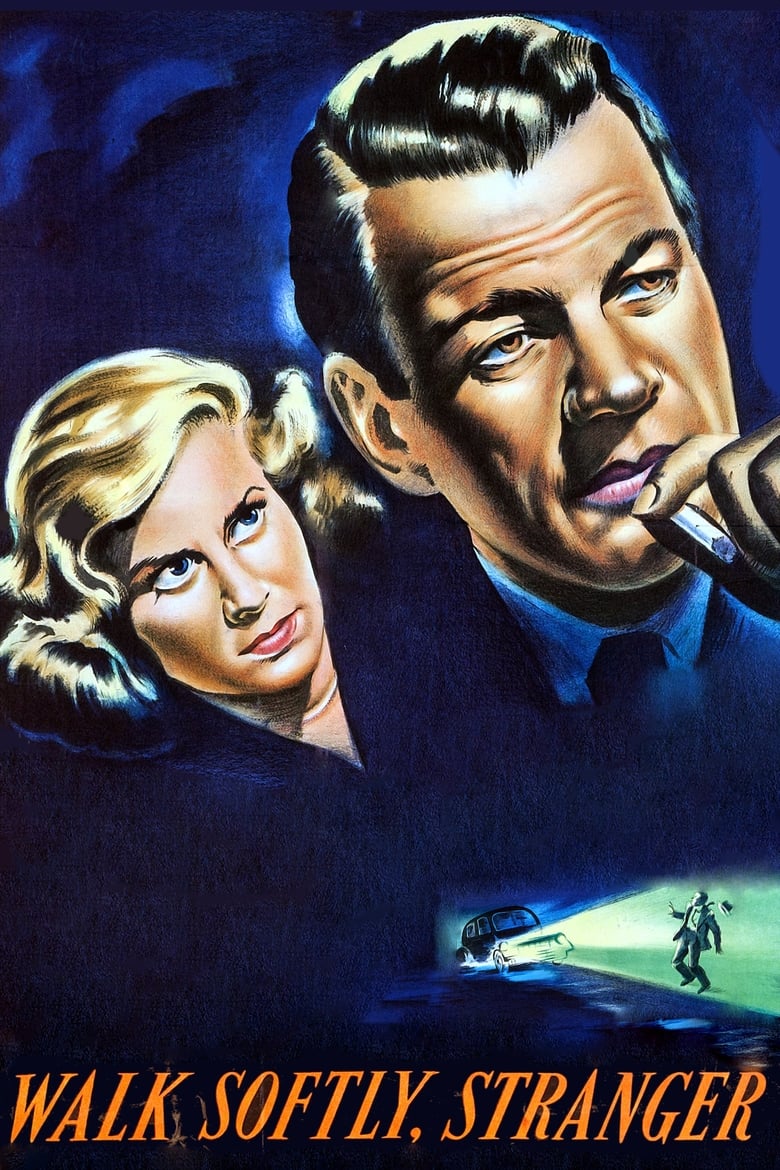
Walk Softly Stranger 1950
1950 Dore Schary Productions
★★★☆☆ Notable
Film Noir · 82 minutes · Black & White

Walk Softly Stranger

Directed by Robert Stevenson
Year 1950
Runtime 82 min
Studio Dore Schary Productions
TMDB 5.1 / 10
"A man running from himself finds the one thing that might make him stop."

Chris Hale arrives in the small Ohio town of Ogdenville under a false name, presenting himself as a respectable drifter looking for work. In reality he is Steve, a small-time grifter who once operated in the town and has returned to collect on a gambling debt owed by a local businessman. He takes a room in a boarding house run by the warm, credulous Mrs. Brentman, and there he meets her niece Elaine Corelli, a young woman confined to a wheelchair following an accident, who lives with a quiet resignation that unsettles him.

Steve's plans begin to fray almost immediately. The debt he has come to collect draws him into the orbit of Whitey Lake, a syndicate enforcer who has his own claim on Steve's loyalties and a more dangerous agenda for Ogdenville. Meanwhile, Steve's growing attachment to Elaine is neither simple sentiment nor calculated manipulation – it occupies the uneasy space between the two, and the film refuses to resolve that ambiguity cheaply. The town, the woman, and the racket form a triangle that places Steve under pressure from every direction.

Walk Softly Stranger works within the familiar noir structure of the returning man who cannot outrun his past, but it locates its tension less in violence than in the question of whether genuine feeling can survive a life built on deception. The film belongs to that strand of late-1940s noir – produced at RKO under Dore Schary – in which moral rehabilitation is possible but never guaranteed, and the cost of it is always higher than the protagonist expects.
Classic Noir

Walk Softly Stranger is a minor but instructive entry in the RKO noir cycle, completed in 1948 and held from release until 1950, a delay that may partly account for its obscurity. Robert Stevenson directs with economy rather than style; the film's interest lies not in expressionist set-pieces but in the performances, particularly Joseph Cotten's. Cotten had already demonstrated in The Third Man and Shadow of a Doubt that he could make moral ambivalence legible without explaining it, and he does so again here, playing a man whose charm functions simultaneously as a professional tool and a form of genuine human response. Alida Valli, also fresh from The Third Man, brings a stillness to Elaine that keeps the romance from becoming sentimental. Paul Stewart's Whitey Lake represents the syndicate as a gravitational force rather than a dramatic device – his scenes exert pressure on the film's moral arithmetic in ways that feel earned. The film does not reach the density of the best RKO noirs, but it uses its 82 minutes honestly and earns its downbeat tenderness.

– Classic Noir
3 ★★★☆☆ Notable
Credits

The Crew

DirectorRobert Stevenson
ScreenplayManuel Seff
CinematographyHarry J. Wild
MusicFriedrich Hollaender
EditingFrederic Knudtson
ProducerRobert Sparks
Performances

The Cast

Close Reading

The Signature Scene

Walk Softly Stranger – scene
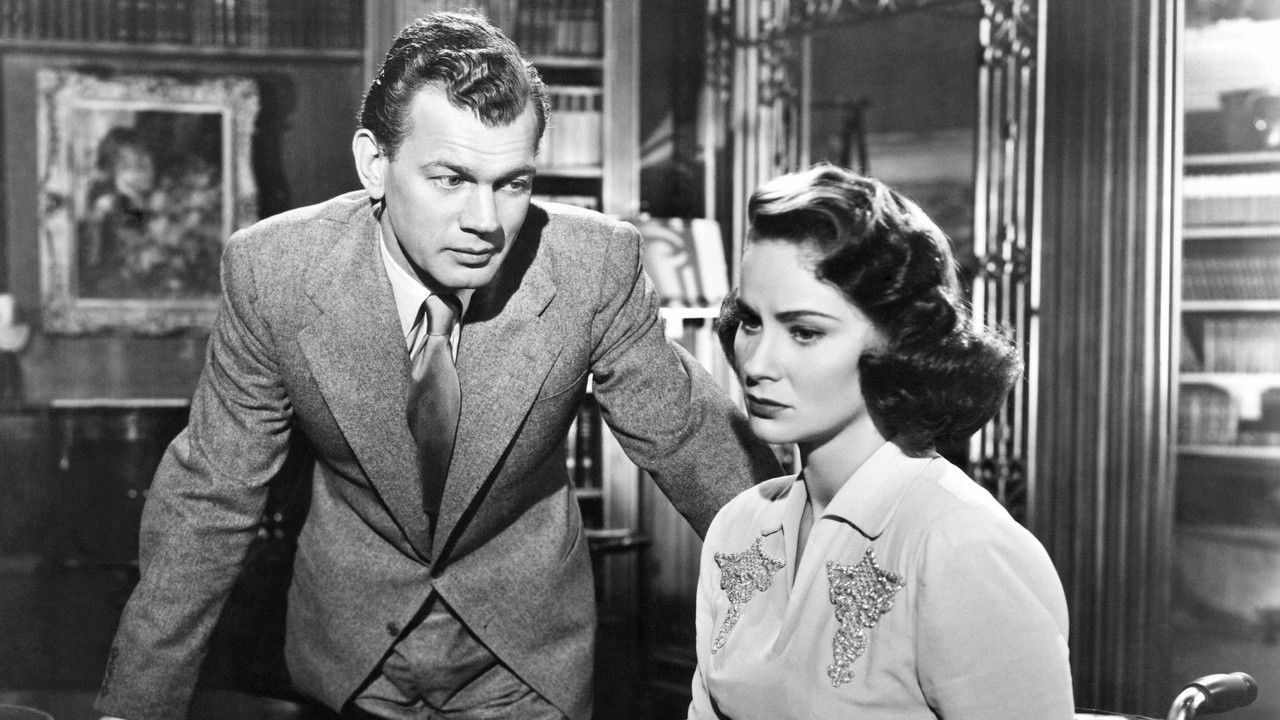
The Boarding House Parlor Two Chairs, One Lamp

The scene is composed around a single practical lamp that sits between Elaine's wheelchair and the armchair Chris has drawn close to it. Harry J. Wild keeps the frame tight, letting the pool of warm light define the boundary of an intimacy that has no business existing. The camera holds on a two-shot for longer than the scene's dialogue requires, allowing the silence between exchanges to register as information. The background dissolves into shadow; the boarding house around them ceases to exist.

What the scene argues is that the film's central problem is not whether Steve will betray Elaine – the genre has already told us he might – but whether he has the capacity to understand what betrayal would cost him. The lamp between them becomes the film's moral object: a limited warmth, shared, that neither character is certain they deserve. It is the moment Walk Softly Stranger stops being a crime picture and becomes something more plainly human.

Visual Language

The Cinematography

🎞️
Harry J. Wild – Director of Photography

Harry J. Wild shot the film on RKO studio sets with the kind of controlled economy that the studio's mid-range productions demanded and that Wild had refined across a decade of genre work, including his later noir assignments on His Kind of Woman and Gentlemen Prefer Blondes. In Walk Softly Stranger he favors tight, high-contrast interiors lit from single practical sources, a strategy that restricts the visible world to what the characters immediately inhabit and bars any sense of escape. Wide shots of Ogdenville are functional rather than expressive; the town is a trap, not a landscape. When Whitey Lake appears, Wild shifts to slightly lower angles and harder shadows, using the frame to register threat before the dialogue does. The boarding house scenes are lit warmer but no less precisely – the softness is conditional, always adjacent to darkness. Wild's work here does not call attention to itself, which is its own form of discipline: the cinematography serves the film's argument that ordinary spaces are where lives actually collapse.

In the Catalogue

Themes & Motifs

Availability

Where to Watch

Also in the Directory

See Also