Films People Pull a Fast One Night Beat Reading Room On TV Shop
Unfaithful 1947
1947 Warner Bros. Pictures
★★★☆☆ Notable
Film Noir · 109 minutes · Black & White

Unfaithful

Directed by Vincent Sherman
Year 1947
Runtime 109 min
Studio Warner Bros. Pictures
TMDB 5.9 / 10
"A woman returns from nowhere, and what she carries back may cost her everything."

Christine Hunter (Ann Sheridan) is found near the body of a dead man, a sculptor named Martin Barrow (Steven Geray), with no clear account of where she has been for the past several hours. Her husband, Bob Hunter (Zachary Scott), is a prosperous man who has been away on business, and her closest confidant is the sardonic Paula (Eve Arden). Into this brittle domestic arrangement steps Larry Hannaford (Lew Ayres), a lawyer and old friend who still carries feeling for Christine, now tasked with mounting her defense as the circumstantial evidence against her hardens into a murder charge.

As the prosecution builds its case, the film excavates Christine's recent past – the loneliness of a wartime marriage stretched thin by absence, an affair conducted under the rationalizations that postwar America preferred not to examine too closely. The dead man is not simply a stranger. Christine's silence on the stand and her resistance to full disclosure force Larry into the position of defending a woman whose guilt or innocence he cannot verify, while Bob Hunter's composed exterior conceals questions of his own about the woman he married and the marriage he returned to.

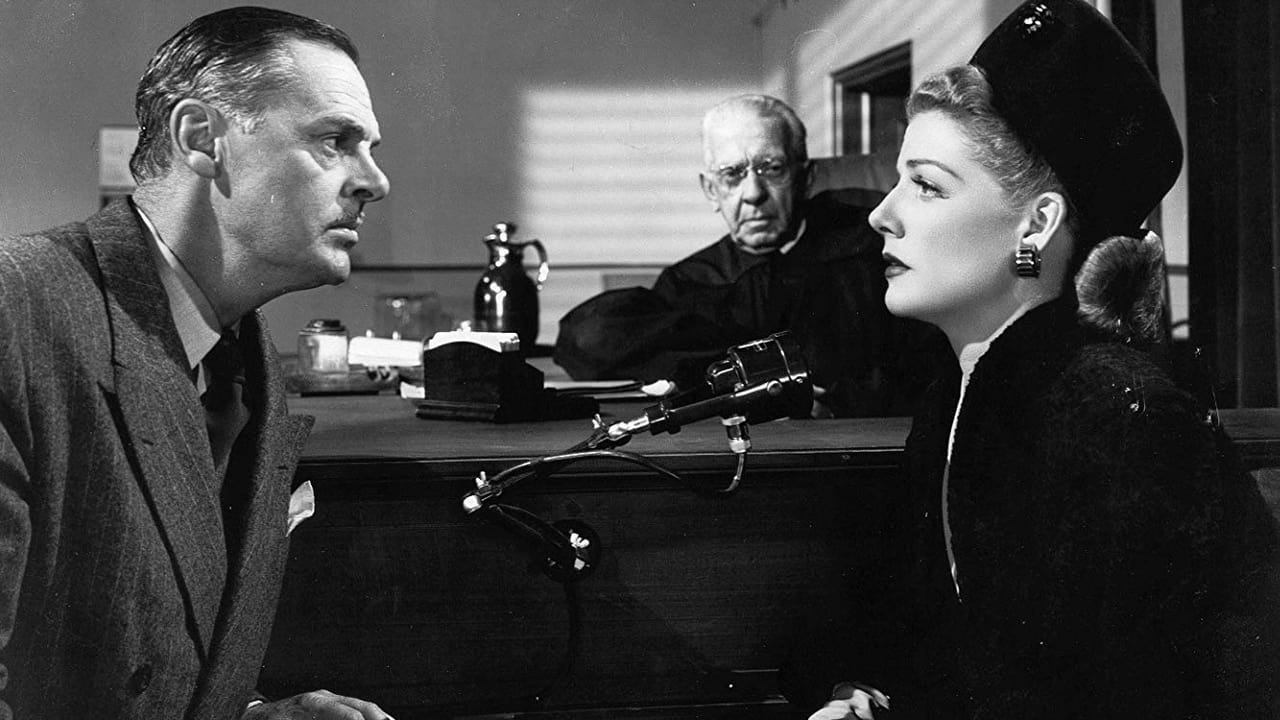
Unfaithful operates within the noir tradition of the imperiled woman – neither femme fatale nor passive victim – whose transgressions are rooted in social circumstance as much as individual failing. The courtroom becomes the mechanism by which private conduct is forced into public light, and the film's interest lies less in the verdict than in what the process strips away. Warner Bros.' house style keeps the film anchored in a recognizable middle-class world, which makes its moral unease all the more pointed.
Classic Noir

Unfaithful occupies a specific and underexamined position in the postwar Warner Bros. cycle: a noir that takes domestic infidelity not as lurid spectacle but as a symptom of social dislocation following the war. Vincent Sherman directs with a controlled hand, resisting melodrama where a lesser craftsman would court it, and Ann Sheridan carries the film's considerable weight by playing Christine's reticence as a form of dignity rather than guilt. The film's structural intelligence is its courtroom inversion – the legal proceeding does not clarify so much as it narrows, forcing characters to reduce complex experience into admissible language. Lew Ayres brings a measure of moral seriousness to what might otherwise be a functional defender role, and Eve Arden's Paula functions as a dry chorus, puncturing pretension with a line reading rather than a speech. What the film ultimately argues is that wartime absence created emotional debts that peacetime could not easily settle – a proposition the era found deeply uncomfortable and the film refuses to soften.

– Classic Noir
3 ★★★☆☆ Notable
Credits

The Crew

DirectorVincent Sherman
ScreenplayJames Gunn
CinematographyErnest Haller
MusicMax Steiner
EditingAlan Crosland, Jr.
Art DirectionLeo K. Kuter
ProducerJerry Wald
Performances

The Cast

Close Reading

The Signature Scene

Unfaithful – scene
The Sculptor's Studio Christine Among the Figures

Ernest Haller lights the sculptor's studio with a sourceless ambiguity – the space feels neither entirely day nor night, the high windows casting diffuse planes of light across stone and plaster figures that populate the frame like silent witnesses. Haller places Christine at mid-depth, the foreground cluttered with unfinished forms, so that she appears embedded in a world of incomplete things. The camera holds at a slight remove, refusing close-up comfort, and the effect is of a woman observed rather than known.

The scene condenses the film's central argument about incompletion. The sculptures – works in progress, figures without full definition – function as an implicit register of Christine's own situation: a woman shaped by circumstances she did not choose, not yet resolved into a final form that the law or her marriage can accommodate. The studio's disorder stands against the composed domestic surfaces that structure the rest of the film, and what Christine does or does not do here becomes the hinge on which her survival turns.

Visual Language

The Cinematography

🎞️
Ernest Haller – Director of Photography

Ernest Haller, who had shot Mildred Pierce two years earlier, brings to Unfaithful a visual approach grounded in tonal restraint rather than expressionist excess. Working on Warner Bros. studio sets, Haller avoids the deep-shadow conventions that define harder noir and instead constructs a world of surfaces that look respectable but photograph with a slight wrongness – interiors that are well-furnished but airless, lights that illuminate without warming. His treatment of Sheridan is notable: he shoots her in three-quarter and mid-range compositions far more often than in the glamour close-ups her star status might have demanded, which keeps Christine at a slight psychological distance from the viewer and reinforces the film's argument about the limits of what can be known about another person. In the courtroom sequences, Haller uses a higher contrast ratio, the public space rendered more harshly than the private one – a choice that gives the film's moral logic a visual grammar.

In the Catalogue

Themes & Motifs

Availability

Where to Watch

Also in the Directory

See Also