Tris Stewart, a convicted counterfeiter serving time in a federal penitentiary, is offered an unusual arrangement by Treasury agents: early release in exchange for helping them identify and break up the counterfeit ring that once employed him. The Treasury operation is led by the methodical Agent John Downey, who assumes an undercover identity to keep Stewart under surveillance once he is back on the street. Stewart, for his part, has no intention of honoring the deal any longer than he has to.
Once free, Stewart reconnects with Meg Dixon, a nightclub cashier who carries her own complicated loyalties, and makes contact with Jack Sylvester, the well-insulated figure at the center of the counterfeiting network. What begins as a controlled federal operation starts to fracture when Stewart's instinct for self-preservation reasserts itself. Allegiances shift: Downey must maintain his cover while managing a man who is simultaneously an asset and a liability, and Meg finds herself caught between a man she may still love and the consequences of his choices.
Trapped works within the semi-documentary procedural mode that Eagle-Lion and other minor studios favored in the late 1940s, yoking federal-agency authority to the moral ambiguities that define the noir cycle. The film does not romanticize its criminal protagonist or excuse the institutional machinery arrayed against him; instead it places both in the same compromised frame, letting the tension between procedure and character carry the narrative toward its inevitable resolution.
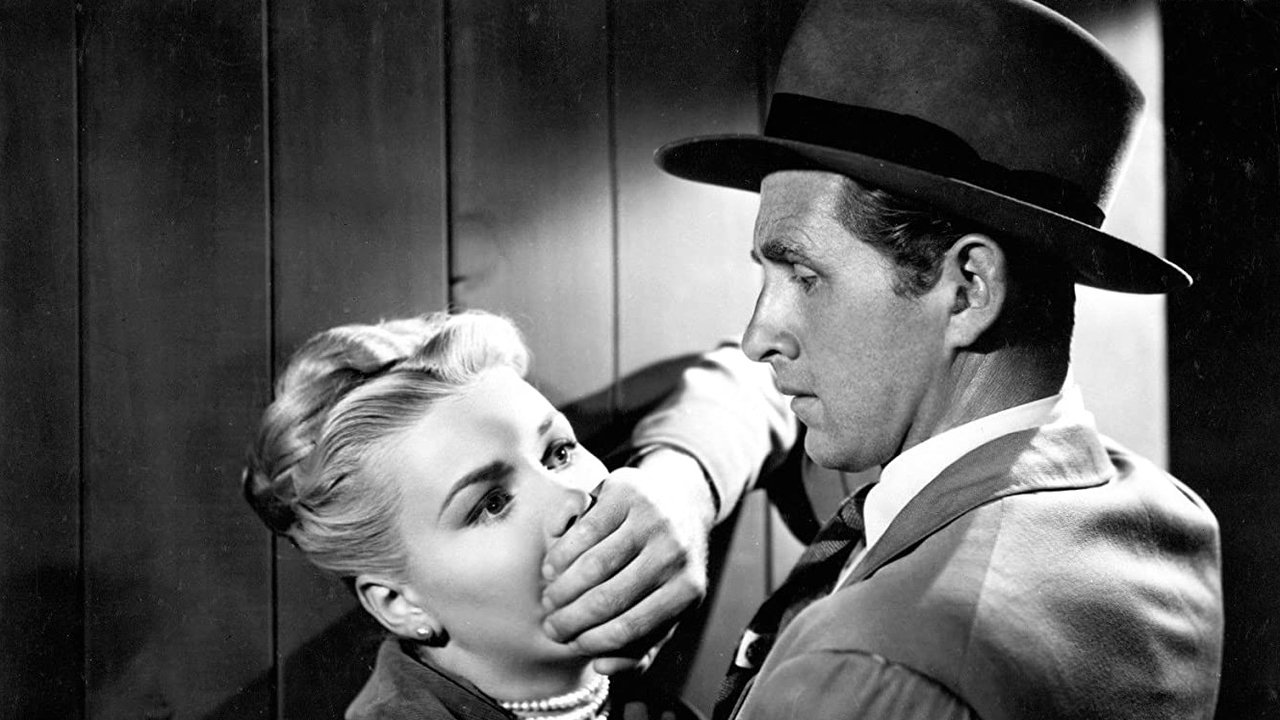
Trapped belongs to the cycle of semi-documentary crime films that flourished between roughly 1945 and 1952, in which the apparatus of federal law enforcement is presented with procedural sobriety while the human material that apparatus processes remains stubbornly noir. Richard Fleischer, working with a tight budget at Eagle-Lion, manages the competing demands with economy: the film never pretends to be more than it is, yet within its seventy-eight minutes it generates genuine moral friction. Lloyd Bridges plays Stewart without sympathy-seeking – the character is opportunistic and self-interested, and Bridges does not soften that. John Hoyt brings an interesting ambiguity to Downey; his professionalism reads at moments as its own kind of coldness. Barbara Payton, whose off-screen life was already beginning to overshadow her screen work, gives Meg a lived-in weariness that the script alone does not supply. The film is also a document of Eagle-Lion's place in the ecosystem of postwar American cinema: operating at the margins, cutting corners, and occasionally, as here, producing work that holds its ground.
– Classic Noir
The sequence unfolds inside a commercial roller rink, a location chosen for its disorienting geometry: the oval track forces continuous movement while the overhead arc lights flatten shadows and leave nowhere to retreat into darkness. Guy Roe's camera holds at mid-distance, allowing the circling skaters to create an involuntary sense of entrapment around the stationary figures. When the confrontation tightens, Roe cuts to close two-shots that use the rink's hard reflective floor as a secondary light source, filling faces from below with an exposure that borders on clinical.
The setting is the scene's argument. The roller rink – loud, public, relentlessly lit – denies Stewart the cover that noir protagonists usually inhabit. He cannot recede into shadow or use the street's anonymity. The mechanical compulsion of the space, bodies going in circles under unforgiving light, externalizes what the film has been saying about his situation all along: the room he had to maneuver has been steadily contracting since the moment he accepted the government's offer.
Guy Roe's cinematography on Trapped operates within the semi-documentary visual grammar of the period while retaining enough expressive latitude to keep the film from feeling like an instructional reel. Shooting largely on location in Los Angeles – streets, a working roller rink, interiors that read as actual rather than dressed – Roe uses available architectural light where possible, supplementing with hard sources that cast directional shadows without the stylized excess of studio noir. His lens choices favor a moderate wide angle that places figures in their environments rather than isolating them, a choice consistent with the film's procedural logic: these characters are shaped by their circumstances, not exempt from them. Interior scenes use low-key lighting with selective fill, keeping background detail legible enough to reinforce the surveillance theme while allowing faces to register moral ambiguity. The overall effect is controlled restraint – Roe does not reach for baroque shadow compositions, but the light is never neutral, and its angle always carries an implicit judgment.
Tubi has carried Trapped as part of its rotating classic crime library; check current availability as titles cycle in and out.
Archive.orgFreeAs a film whose copyright status has been disputed, Trapped has circulated on the Internet Archive – verify the upload quality before viewing, as transfers vary considerably.
Amazon Prime VideoRentalA paid rental option is periodically available through Prime Video's classic catalog for a more reliable transfer than public domain uploads.